When a Melbourne plumber calls us after hiring the wrong agency, the pattern is almost always the same: months of “local SEO” work, a handful of blog posts, and rankings that barely moved. What actually held the site back was never mentioned, because nobody ran a proper technical audit first. Content and citations cannot fix a site Google cannot crawl properly or a homepage that takes six seconds to load on a tradie’s phone standing in a driveway.
This guide covers the five technical checks we run on every plumbing website before recommending anything else, what each one actually costs to fix, and how long it takes to show up in rankings. It is written specifically for the technical layer, because plenty of good advice already exists on choosing an agency; this is about what that agency should actually be looking for once you have hired one.
Not sure where your own site stands? Our free 30-minute audit will tell you, even if you never become a client. Book a free strategy call.
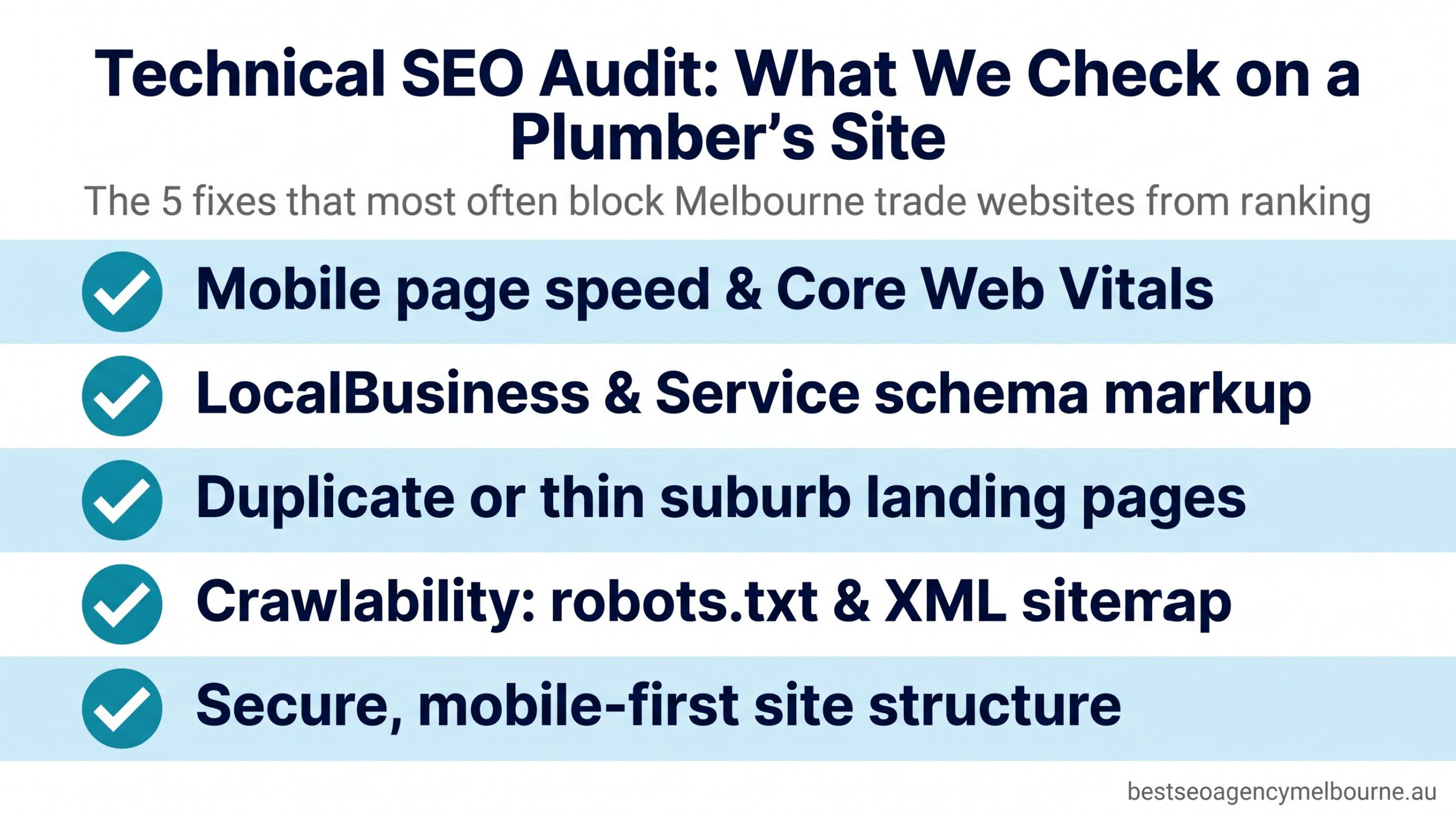
The five checks we run before touching content or citations.
1. Mobile page speed and Core Web Vitals
A customer with a burst pipe is not searching from a desktop. They are standing in a wet laundry, phone in hand, searching “emergency plumber near me” on patchy mobile reception. If your homepage takes five seconds to load on that connection, they have already tapped back to the results and called the next listing before your page finishes rendering.
Core Web Vitals are Google’s specific, measurable speed benchmarks: how fast the main content appears, how quickly the page responds to a tap, and whether the layout jumps around while loading. Google’s own guidance confirms these are used as a ranking signal, not just a nice-to-have. Fixing them on a typical plumber’s WordPress or Wix site usually means compressing hero images, removing unused plugins, and switching to faster hosting — a one to two week job for most small business sites, and one of the highest-return fixes on this list because it affects every page at once. A simple test: open your own site on 4G with wifi turned off and time how long it takes before the phone number is visible and tappable. If it is more than three seconds, a customer mid-emergency has probably already left.
2. LocalBusiness and Service schema markup
Schema markup is a block of code that tells Google exactly what your business is, where it operates, what services it offers and what your reviews say, rather than leaving Google to guess from the page text. For a plumber this means marking up your service area (the suburbs you actually cover), your services (hot water repairs, blocked drains, gas fitting) and your review rating using Google’s own LocalBusiness structured data format.
| Element | Without schema | With schema |
|---|---|---|
| Star rating in search results | No | Yes, if reviews are marked up |
| Service area clarity for Google | Inferred from text | Explicitly stated |
| Opening hours shown | Sometimes, via Business Profile only | Confirmed from two sources |
| Eligible for rich results | No | Yes |
If your Google Business Profile looks strong but your actual website is missing this markup, talk to our Melbourne team — adding it properly across a service-area site is usually a one-week job.
3. Duplicate or thin suburb landing pages
Plumbers often build a separate page for every suburb they service: “Plumber Richmond”, “Plumber Fitzroy”, “Plumber Collingwood”. Done well, this is a legitimate local SEO tactic. Done badly, it means twenty pages with the same 150 words and the suburb name swapped, which Google increasingly treats as thin, near-duplicate content and can quietly stop ranking altogether.
The fix is not deleting the pages; it is making each one genuinely different: real details about response times in that suburb, jobs actually completed there, and specific streets or building types common to the area. This is a content job, not a technical one, but it belongs on a technical audit because duplicate content is a structural problem before it is a writing problem. A useful gut check: read two of your suburb pages back to back. If you could swap the suburb name between them and nobody would notice, Google has probably already noticed.
4. Crawlability: robots.txt and XML sitemap
Before Google can rank a page, it has to find and read it. A misconfigured robots.txt file can accidentally block Google from crawling entire sections of a site (we have seen this happen after a website migration more than once), and a missing or outdated XML sitemap means new pages can take weeks longer to be discovered than they should. Both are quick to check and quick to fix once found; the risk is that nobody checks them unless they are specifically looking. Google Search Console (free, and worth setting up regardless of who manages your SEO) will flag most crawlability problems directly under its Pages report, which is the first place we look on any new client site.
5. Secure, mobile-first site structure
Google now indexes the mobile version of your site first, not the desktop version, under what it calls mobile-first indexing. If your mobile site hides your phone number behind a menu, shows a cut-down version of your service list, or is missing the schema markup that exists on desktop, that is genuinely what Google evaluates your business on. An HTTPS certificate (the padlock in the browser) is also assumed baseline now; sites without it are flagged as “not secure” and lose trust before a visitor reads a word. Most hosting providers now include a free certificate, so a site still missing one is usually a sign nobody has reviewed the technical setup in some time.

The gap between a fast and a slow plumber website, measured in lost customers, not just rankings.
Pages that load in under two seconds bounce at around 9%, while pages taking five seconds or longer bounce at closer to 38%, based on real-world Chrome user data tracked by Google’s own Core Web Vitals reporting. For a plumber paying for every click through Google Ads or ranking hard-won organic positions, that gap is the difference between a booked job and a call to the next name on the list.
What this costs, how long it takes, and what goes wrong
For a typical single-location plumbing business, a full technical audit and fix across all five areas usually falls somewhere between a one-off specialist audit fee and a modest monthly retainer for two to three months, depending on how much needs rebuilding versus adjusting. Speed and schema fixes tend to show measurable improvement within two to four weeks. Suburb page and crawlability fixes take longer to flow through, typically eight to twelve weeks, because Google needs to re-crawl and re-evaluate each page individually.
The most common mistake is agencies (and DIY attempts) skipping straight to content and link building because it is more visible work to report on, while the technical foundation quietly caps how well any of that content can ever perform. A blog post cannot outrank a faster, better-structured competitor no matter how well it is written.
Quick FAQ
Do I need a developer for all of this? Schema markup and crawlability fixes usually need someone comfortable in the website’s backend, but they rarely require a full rebuild. Speed fixes are often achievable through hosting changes and plugin clean-up alone.
Is this different from local SEO? Yes. Local SEO covers your Google Business Profile, reviews and citations. Technical SEO covers whether your actual website can be crawled, ranked and rendered properly in the first place — both matter, but technical issues can silently cap everything else.
How do I know if my current agency is actually doing this? Ask for a screenshot of your Core Web Vitals report from Google Search Console and a copy of your schema markup. If neither exists after a few months of engagement, the technical layer has probably been skipped in favour of easier-to-report content work.
If you are earlier in the process and still comparing which agency to hire, our guides on how to compare and shortlist a local SEO agency for plumbers and what to look for in an SEO agency for plumbers in 2026 cover the buyer-side questions this article does not. This piece is specifically about what a technical audit should find, regardless of who ends up doing the work.
None of these five checks require ripping out your website and starting again. They are the difference between marketing spend that compounds and marketing spend that quietly leaks away on a site Google was never able to properly read. A plumber who fixes the technical foundation first, then adds content and reviews on top, consistently outperforms a competitor who skipped straight to the visible work.
Book a free strategy call. No lock-in contracts, response within 2 hours, Melbourne-based team. Get started.
Leave a Reply