Author: admin

  • On-Page SEO for Melbourne Beauty Salons: The Practical Guide to Title Tags, Copy, Speed and Schema

    If you’ve read our guide to how to choose the right SEO agency for your salon or worked through our Local SEO checklist, you already know Google My Business and reviews matter. But there’s a quieter, equally important battle happening on your actual website — and it’s one most salon owners have never looked at directly. It’s called on-page SEO, and it’s the collection of things on each individual page of your site that tell Google (and your future clients) exactly what you do, where you do it, and why you’re worth booking.

    Unlike local SEO, on-page SEO isn’t about your Google Business Profile or citations — it’s about the words, code and structure on your own pages: your title tags, your headings, your service descriptions, your images, and how fast your site loads on a phone in a client’s handbag. Get these right and every other SEO effort works harder. Get them wrong and even a beautifully designed salon website can sit invisible on page two. If you’d rather have a specialist walk through your site with you, book a free 30-minute strategy call and we’ll show you what’s holding your pages back.

    What On-Page SEO Actually Means for a Salon Website

    On-page SEO covers every element Google reads on a single page: the title tag (the blue clickable headline in search results), the meta description (the short summary under it), your headings, your body copy, your image alt text (a short written description of an image, read aloud by screen readers and used by Google to understand what a picture shows), schema markup (extra code added to a page that explicitly tells Google “this is a hair salon, these are the services, these are the opening hours”), and technical factors like page speed. None of this replaces the local SEO or content work covered in our other guides — it’s the foundation those strategies are built on. Our Content SEO service goes deeper into planning topics and copy at scale; this article focuses purely on getting the on-page fundamentals right, page by page.

    Title Tags and Meta Descriptions That Actually Get Clicked

    Your title tag is the single most important piece of on-page real estate you control. Backlinko’s analysis of more than four million Google search results found that title tags between 40 and 60 characters achieve meaningfully better click-through rates than titles outside that range, and that the top three organic results capture 54.4% of all clicks on a page (Source: Backlinko, 2025). In plain terms: a vague title like “Home” or “Services” wastes the most valuable line on your page. Every salon service page needs a unique, specific title that leads with the service and suburb, not the salon’s name.

    Page type Title tag formula Example
    Homepage [Salon Name] – [Primary Service] in [Suburb] Bloom Beauty – Balayage & Hair Colour in Fitzroy
    Service page [Service] in [Suburb] | [Salon Name] Brazilian Wax in South Yarra | Bloom Beauty
    Location page [Suburb] Hair & Beauty Salon | [Salon Name] Richmond Hair & Beauty Salon | Bloom Beauty
    Blog post [Specific Question or Topic] | [Salon Name] How Long Does Balayage Last? | Bloom Beauty

    Headings and Service-Page Copy That Google (and Clients) Can Follow

    Each page should have one H1 (the main heading), followed by logical H2 and H3 subheadings that break the page into scannable sections — treatments offered, pricing guidance, what to expect, and booking information. The mistake we see most often in Melbourne salon sites is duplicated copy: the same three paragraphs pasted across “balayage,” “highlights” and “colour correction” pages with only the service name swapped. Google can tell, and so can clients comparing your site to a competitor’s. Every service page deserves its own genuinely useful copy — how the treatment works, how long it takes, what it costs, and who it suits. This is exactly the kind of structural and content work our Content SEO team builds strategies around when clients want it done at scale across dozens of pages.

    📊 The five on-page elements every Melbourne salon website should check before publishing a new page.

    A checklist-style infographic titled “On-Page SEO Checklist for Melbourne Beauty Salons” showing five numbered steps: unique title tags, clear heading structure, descriptive alt text, schema markup, and fast load speed.

    Infographic file: best-seo-agency-melbourne-on-page-seo-checklist-beauty-salons.png (attach when uploading to media library)

    Image Alt Text: Small Detail, Real Impact

    Beauty salon websites are usually full of photography — before-and-afters, salon interiors, product shots — and almost none of it has proper alt text. Alt text is a short, written description added to an image in your website’s code; it’s read aloud by screen readers for vision-impaired visitors and it’s how Google Images understands what a photo actually shows, since it can’t “see” a picture the way a person can. Writing “balayage-1.jpg” as the only description is a missed opportunity twice over: it’s an accessibility gap and a lost chance to rank in Google Images, which is a genuine referral source for beauty and hair searches. A better alt text example is: “Soft balayage highlights on brunette hair, styled at a Melbourne hair salon.” Specific, honest, and useful to both humans and search engines.

    Internal Linking Between Your Services, Locations and Blog

    Internal links — the links from one page on your site to another — do two jobs: they help clients find related services, and they help Google understand which pages on your site matter most. A balayage service page should link to your colour correction and toner pages; a blog post about bridal hair trials should link straight through to your booking page and your bridal services page. If your salon serves multiple suburbs, this is also where local relevance is reinforced page by page, which is the focus of our Local SEO service — on-page structure and local signals work best when they’re built together, not treated as separate projects.

    Schema Markup: Helping Google (and AI Tools) Understand Your Salon

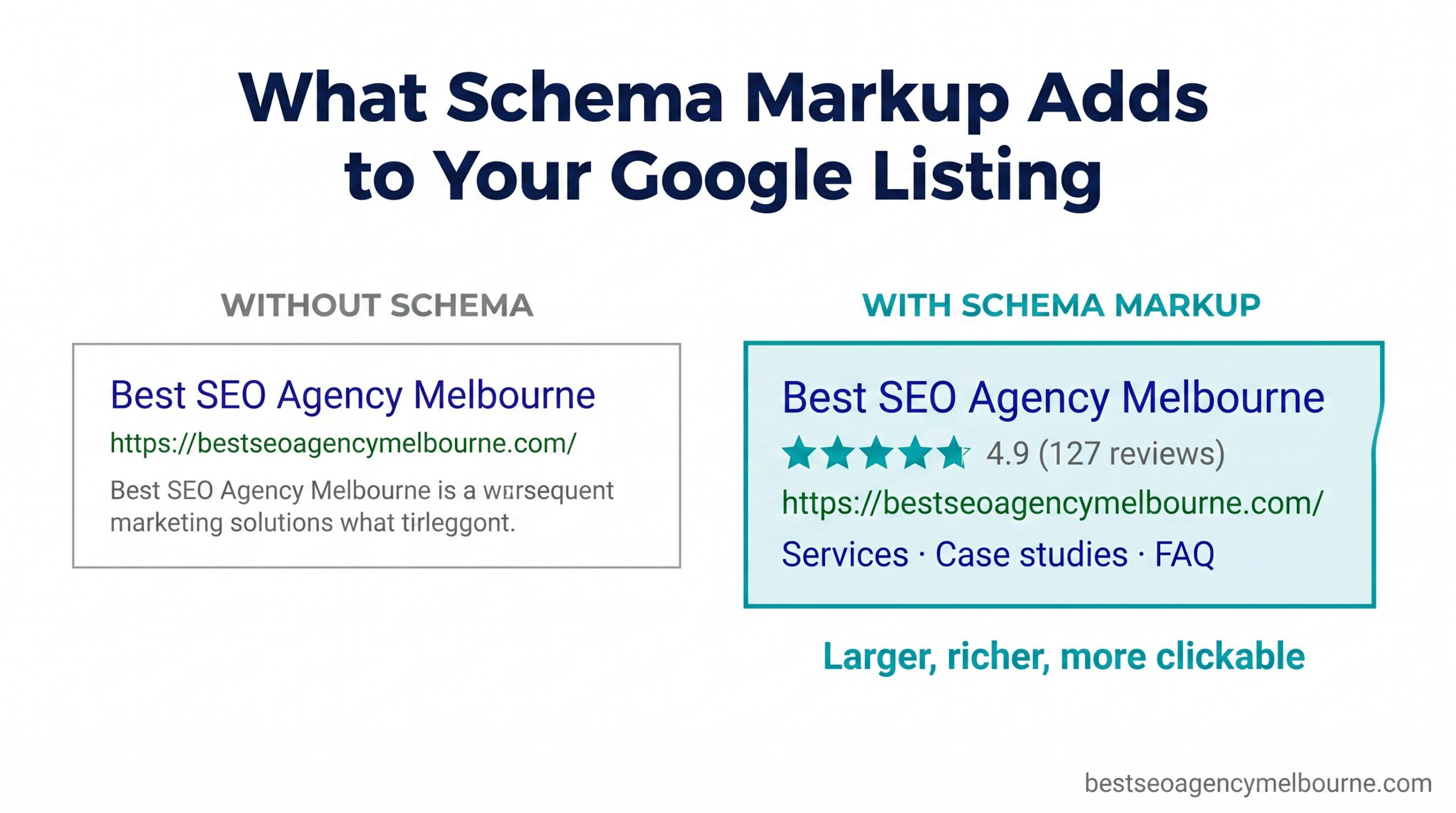
    Schema markup is extra code, invisible to visitors, that explicitly labels the information on your page — “this is a LocalBusiness,” “this is a Service called Balayage,” “these are the opening hours.” Search Engine Land’s 2026 reporting on structured data notes that while schema won’t guarantee a citation in AI-generated answers, it materially helps AI systems and search engines understand entities and extract information cleanly (Source: Search Engine Land, 2026). For a salon, that means adding LocalBusiness and Service schema to your homepage and service pages so Google — and increasingly, AI-powered search tools — can confidently surface your opening hours, services and location in response to relevant searches. Not sure where to start with the technical setup? Book a free 30-minute strategy call and we’ll audit what’s missing.

    Page Speed and Mobile UX: Why Slow Sites Lose Bookings

    Most salon website traffic arrives on a phone, often between appointments or on a lunch break, so speed and mobile usability aren’t cosmetic — they’re commercial. Google’s own Core Web Vitals guidance (a set of measurements for loading speed, responsiveness and visual stability) recommends pages load their main content within 2.5 seconds, respond to taps within 200 milliseconds, and avoid layout jumping around as it loads (Source: Google Search Central). Google’s own mobile research found that 40% of visitors will abandon a mobile page that takes longer than three seconds to load (Source: Think with Google). For a salon site, the usual culprits are oversized, uncompressed photos, heavy booking-widget scripts, and pop-ups that push the “Book Now” button below the fold on a small screen.

    📊 The three speed and stability targets every Melbourne salon website should be tested against on mobile.

    An infographic titled “Mobile Speed Checklist for Salon Websites” showing a smartphone icon with three callouts: loads under 2.5 seconds, responds under 200 milliseconds, and stays visually stable.

    Infographic file: best-seo-agency-melbourne-core-web-vitals-mobile-checklist-salons.png (attach when uploading to media library)

    A Simple On-Page SEO Checklist

    Use this table as a quick self-audit before publishing or updating any salon page. It won’t replace a full technical review, but it catches the mistakes we see most often.

    Element What good looks like Common mistake
    Title tag Unique, 40–60 characters, service + suburb first Same title reused across every page
    Meta description Written to encourage a click, includes a call to action Left blank, so Google auto-generates one
    Headings One H1, logical H2/H3 structure Multiple H1s or headings used purely for bold text
    Service copy Unique content per service, answers real client questions Duplicated text with only the service name swapped
    Image alt text Specific, descriptive, no keyword stuffing Left blank or filled with the file name
    Schema markup LocalBusiness and Service schema on key pages No structured data at all
    Page speed Loads in under 2.5 seconds on mobile Uncompressed images and heavy booking widgets

    Where On-Page SEO Fits Into Your Bigger Strategy

    On-page SEO isn’t a one-off project — it’s maintenance work that pays off every time you add a new service, open a new location, or write a new blog post. It sits alongside, not instead of, the local SEO and content strategies covered elsewhere on this site, and it’s one of the core disciplines covered across our full range of SEO services. If you’ve already read our comparison of Melbourne SEO agencies and you’re ready to see what a proper on-page audit of your salon’s website actually finds, book a free 30-minute strategy call — we’ll walk through your title tags, your speed scores and your schema together, and tell you honestly what’s worth fixing first.
  • Local SEO for Melbourne Beauty Salons: The 2026 Checklist That Fills Appointment Books

    A beauty salon in Fitzroy or Brighton doesn’t lose bookings because the treatments aren’t good enough. It loses them because someone searched “balayage near me” or “brow lamination” plus their suburb on their phone and never saw the salon show up. Melbourne clients, regulars and first-timers alike, open Google, not the salon’s own website, when deciding where to book this week. If a salon’s Google Business Profile is thin, its reviews are stale, or its suburb pages don’t exist, a rival two streets over gets the appointment instead. This guide sets out the local SEO checklist we run for Melbourne beauty and hair salons: the Google Business Profile fixes, the review strategy, the site structure, and what it realistically costs and takes before bookings start moving.

    Why local search decides who gets booked, not who has the best Instagram

    Google ranks local results, the three-listing block above the normal search results for anything with a location intent, using three signals: relevance, distance and popularity, according to Google’s own Business Profile Help. None of those are about how nice a salon’s Instagram feed looks. Relevance is Google matching a profile to what someone typed. Distance is simply how close the salon is to the searcher. Popularity blends reviews, business information and links.

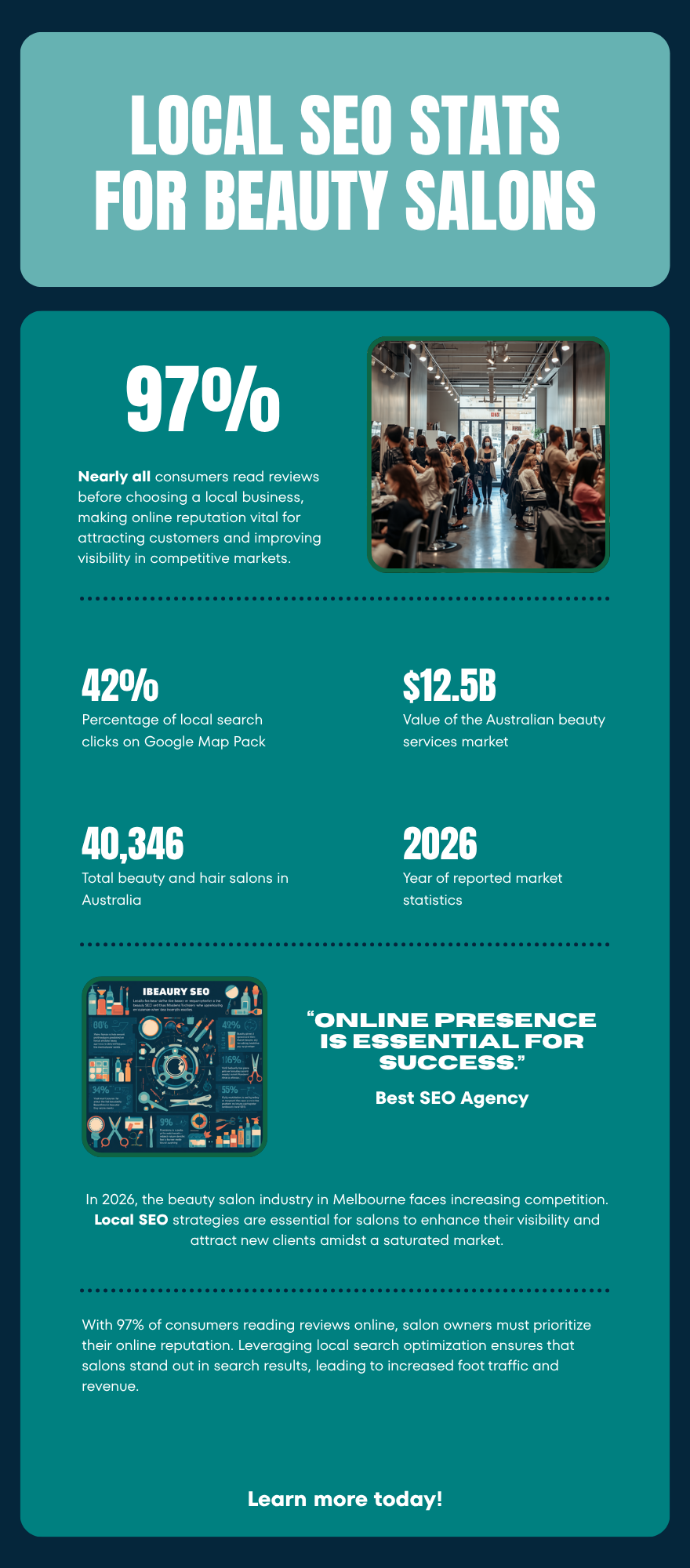
    This matters more for a salon than for most local businesses because local searches convert fast. Someone searching “lash extensions Richmond” or “keratin treatment near me” has usually already decided to book, they’re just choosing who from a short list. Research from Backlinko found that 42% of all clicks on local search results go to businesses shown in that map pack block, and businesses that make it into the pack receive 126% more traffic than salons ranked four to ten spots down. Sit at position six and most of that traffic goes to five other salons before a customer even scrolls down to see you.

    This is the same process behind our Local SEO Melbourne service, applied to beauty and hair salons, and one we’ve used for other Melbourne businesses too, with results detailed on the site. Ranking in that block isn’t about a bigger budget than the salon next door, it’s a checkable set of fixes, most of which take hours, not months.

    Not sure where your salon’s Google Business Profile stands right now? Book a free 30-minute strategy call and we’ll run a quick check while we’re on the phone, no obligation.

    The Google Business Profile checklist we run before touching anything else

    Before writing a word of website content for a Melbourne beauty salon, we go through the same profile checklist every time. It’s the fastest lever available because most salons already have a profile, they’ve just never finished setting it up.

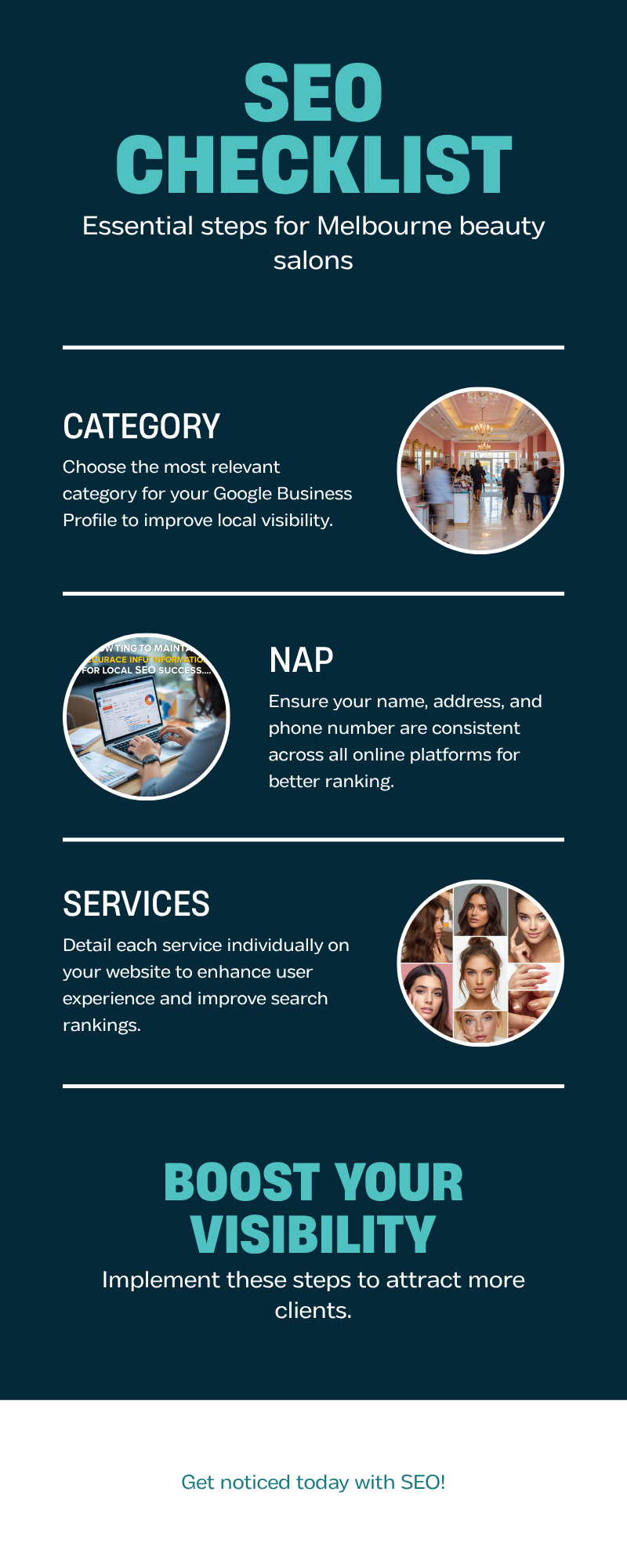
    Five-step local SEO checklist infographic for Melbourne beauty salons, covering Google Business Profile setup, consistent business details, service listings, fresh photos and a direct booking link

    The core fixes, in order:

    • Primary category set to the specific service, “Beauty Salon” or “Lash Technician”, rather than the generic default many booking platforms auto-select.
    • Every service listed individually (balayage, brow tint, HIFU facial) rather than left blank, so Google can match specific searches to the profile.
    • Business name, address and phone number, known as NAP, matching exactly across the website, the profile and any directory listing. A mismatched suburb spelling or an old phone number on one directory is enough to knock a profile’s trust signal down.
    • Photos added weekly, not once at setup. Profiles with regularly updated photos read as more active businesses.
    • Booking link connected directly in the profile so a customer can book without leaving Google.

    Here’s how those fixes typically stack up by effort and impact:

    Task Effort Typical impact on Map Pack visibility
    Category correction 10 minutes High
    NAP consistency clean-up 2 to 3 hours High
    Full service list with descriptions 1 to 2 hours Medium-high
    Weekly photo uploads 15 minutes a week, ongoing Medium
    Q&A section seeded with real questions 30 minutes Low-medium

    None of this needs an agency to execute, though most salon owners we work with would rather spend that time with clients than in the back end of a Google dashboard.

    Reviews: the biggest lever once the profile is set up

    BrightLocal’s Local Consumer Review Survey 2026 found that 97% of consumers read reviews before choosing a local business, and 41% now say they “always” read reviews when browsing for somewhere to book, up sharply on the year before. For a beauty salon, where the service is personal and trust matters more than in almost any other local category, that number probably understates it. We’ve seen the same pattern play out for Melbourne cafes trying to fill tables through Google reviews, the mechanics of review velocity work almost identically for salons.

    What moves the needle isn’t chasing five stars, it’s velocity and response. A salon with three or four new Google reviews in the past month reads as active and trustworthy. One sitting on 40 reviews from three years ago, however glowing, reads as stagnant, and Google’s popularity signal treats it that way too. Responding to every review, including the occasional average one, does more for trust than the star rating alone, a short, specific reply tells both Google and the next browsing customer that someone is actually running the business. A simple system works: text or email a review link within an hour of the appointment, while the result is still fresh, rather than three days later.

    Want a done-for-you review system that texts every client automatically after their appointment? Ask us about it on a free strategy call and we’ll show you the exact template we use for Melbourne salons.

    Suburb and service pages: structuring a site without duplicate content

    A single homepage trying to rank for “balayage Melbourne”, “brow lamination Fitzroy” and “keratin treatment Richmond” all at once rarely works. Google needs a dedicated page per core service to understand what a salon actually offers and where. That doesn’t mean cloning ten suburb pages with the address swapped out, Google is very good at spotting duplicate content dressed up as location pages, and it can suppress a whole site’s rankings if it looks like spam.

    What works: one strong page per service, balayage, keratin, lash extensions, HIFU facials, written in plain language answering what a first-time client would ask, price range, how long it takes, what to expect. Suburb content only earns its place if there’s something genuinely local to say, parking, the closest tram stop, the type of client typically seen in that pocket of Melbourne. If there’s nothing local to add beyond the suburb name, leave it out. This approach sits alongside our content and SEO strategy service for salons wanting a full site rebuild.

    What this costs, how long it takes, and what goes wrong

    Cost. A DIY approach, the owner handling the profile and review fixes personally, costs nothing but a few hours a week. An agency-run local SEO campaign for a single-location Melbourne salon typically runs $800 to $2,000 a month, depending on the content and link work involved. Anything advertised well under that with “guaranteed number one rankings” is worth being suspicious of, no one can guarantee a Google ranking, and cheap packages usually mean templated work applied to hundreds of businesses at once.

    Timeframe. Profile fixes can show movement within two to four weeks. Ranking improvement from content and review growth realistically takes three to six months. According to IBISWorld, more than 40,000 hairdressing and beauty businesses are competing across Australia for a revenue pool worth $12.5 billion in 2026, so patience matters more than panic.

    Infographic of 2026 local SEO statistics for Melbourne beauty salons, showing review reading rates, Google Map Pack click share and the size of Australia's beauty services market

    What goes wrong. The most common mistake is listing under the wrong Google category, then wondering why the profile never shows for “lash technician” searches. The second is buying reviews or offering a discount for one, which breaches Google’s policies and can get a profile suspended, wiping out months of work overnight. The third is treating suburb pages as a numbers game, thin pages saying the same thing with a different postcode swapped in, which Google increasingly filters out rather than rewards.

    Common questions from Melbourne salon owners

    Do I need a separate Google Business Profile for each salon location?

    Yes. Each physical location needs its own profile with its own address and reviews. A single profile covering two suburbs confuses Google’s distance signal and usually hurts both locations. See our FAQ section for more on multi-location set-ups.

    How long before I see more bookings from Google?

    Most salons see a measurable uptick in profile views and calls within four to six weeks of the checklist above being completed properly, with fuller ranking gains building over three to six months.

    Can I do this myself or do I need an agency?

    The Google Business Profile and review steps are genuinely doable in-house. Suburb and service page content, technical fixes, and ongoing link building are where most salon owners run out of time, that’s usually where an agency earns its fee.

    The takeaway

    A Melbourne beauty salon doesn’t need a bigger marketing budget to out-rank the salon down the road. It needs a Google Business Profile that’s actually finished, a steady flow of fresh reviews, and service pages written for the person about to book, not for a search engine. Start with the profile checklist above this week, most of it costs nothing but time. If a second set of eyes would help, book a free, no-lock-in strategy call with our Melbourne team, we reply within two hours and there’s zero obligation. For more Melbourne-specific guides like this one, browse the rest of our SEO blog, including our breakdown of what to look for when comparing SEO agencies for a beauty salon.

  • Best SEO Agencies for Melbourne Beauty Salons: What to Look for in 2026

    A Melbourne beauty salon lives or dies on whether it shows up when someone nearby searches “lash extensions Richmond” or “balayage near me” at 8pm on a Sunday. Booking systems, walk-ins and word of mouth all matter, but 46% of all Google searches now carry local intent, and salons that are not set up properly for local search are handing bookings straight to the competitor three doors down. This guide covers what a genuine beauty-salon SEO specialist actually does, what it costs, and the questions worth asking before you sign with any Melbourne agency.

    Why local search decides which salon gets the booking

    Beauty is one of the most locally searched, most mobile categories in retail. Over 80% of beauty salon searches happen on a mobile phone, usually while someone is already out or scrolling between appointments, and 76% of people who search for a local business on their phone visit that business within 24 hours. That is a narrow window: if your salon is not visible in the local Map Pack at that exact moment, the booking goes elsewhere.

    Google Business Profile signals make up roughly 32% of what decides Map Pack rankings, which makes it the single highest-leverage asset a salon owner controls and, unlike ads, it is free to claim and optimise. Salons that do appear in the local 3-pack receive 126% more traffic and 93% more calls, direction requests and bookings than salons sitting in positions four to ten. For the fundamentals of ranking in the Map Pack, see our Local SEO Melbourne service page.

    Not sure how your salon currently ranks for the searches that matter? Our free 30-minute strategy call will show you exactly where you stand, even if you never become a client. Book a free strategy call.

    What a genuine beauty-salon SEO specialist actually does

    Plenty of Melbourne agencies offer “local SEO” as a generic package. A specialist working with beauty salons does a few things differently: they understand booking-intent keywords (by treatment, not just by suburb), they know Google treats a hair salon, a nail bar and a day spa as different categories with different ranking behaviour, and they build a review system around your actual client flow rather than a generic ask-for-a-review email.

    What to check Generalist agency Beauty salon specialist
    Keyword approach Broad “beauty salon [suburb]” Treatment + suburb combinations
    Google Business Profile categories One generic category Primary + secondary matched to services
    Review strategy Generic email template Built around your booking software
    Content Stock blog posts Treatment guides, before/after content
    Reporting Traffic only Bookings and calls tied to search
    Five Google Business Profile fixes for Melbourne beauty salons: claim and verify, right categories, photo library, review cadence, and service menu
    Five Google Business Profile fixes for Melbourne beauty salons: claim and verify, right categories, photo library, review cadence, and service menu.

    Treatment-specific keywords matter more in beauty than almost any other local category. A salon offering lash extensions, balayage, microblading and gel manicures is really competing in four or five separate search markets, not one. A specialist will build a content page for each core treatment — with real photos, pricing guidance and suburb mentions — rather than relying on a single homepage to rank for everything. This is also where a Melbourne-specific approach pays off: “balayage Fitzroy” and “balayage Brighton” are different searches with different competition, and suburb-aware content captures bookings a single generic page would miss entirely.

    The Google Business Profile fixes that move the needle fastest

    Almost every audit we run on a Melbourne beauty salon turns up the same five gaps, shown above. Categories are the quickest win: a salon listed only as “Beauty salon” misses out on category-specific searches like “eyelash technician” or “microblading studio” that a correctly tagged profile can rank for within weeks. Photos matter almost as much: profiles updated with fresh photos at least monthly are treated by Google as more active, and active profiles are shown more often in the Map Pack.

    Reviews carry real weight, and almost all of it is read before a decision is made: 91% of consumers read reviews before choosing a local business, and listings with 50 or more reviews and a rating above 4.5 stars have a 61% higher chance of ranking at the top of the local pack. Review count and recency matter more than total volume in a competitive category like beauty — a salon with 40 recent reviews will often outrank one sitting on 80 reviews that stopped coming in a year ago.

    If your Google Business Profile looks thin on any of these five points, talk to our Melbourne team — a full profile rebuild for a single-location salon usually takes two to three weeks.

    Staff-level expertise is another point worth checking. Some Melbourne beauty salons employ contractor stylists or technicians who bring their own client base with them — in that case, a schema markup strategy that highlights individual practitioners (not just the salon as a whole) can help loyal clients find their specific stylist even after a business name change or a move to a new studio. It is a small technical detail, but one a generalist agency without beauty industry experience will often overlook entirely.

    What this costs, how long it takes, and what goes wrong

    A proper local SEO engagement for a single-location Melbourne beauty salon typically runs from a few hundred to around two thousand dollars a month, depending on how competitive your suburb is and how much content and review-generation work is included. Most salons see initial Map Pack movement within 60 to 90 days, with steadier growth in calls and bookings by month four to six as reviews accumulate and the profile matures.

    The most common mistake we see is a salon owner treating the Google Business Profile as “set and forget” after the initial setup. Profiles that go quiet — no new photos, no replies to reviews, no updates to the service menu — slowly lose Map Pack visibility even if nothing else changed, because Google reads inactivity as a signal the business may be less relevant. A second common mistake is choosing an agency purely on price without checking they have actually worked with beauty or personal-care businesses before; the keyword and category structure for a salon is different enough from a trades business that generic experience does not always transfer.

    Bar chart showing local search statistics for Melbourne beauty salons: 126% more traffic for Map Pack listings, 76% visit within 24 hours, 91% read reviews first, and 82% of searches happen on mobile
    Bar chart showing local search statistics for Melbourne beauty salons: 126% more traffic for Map Pack listings, 76% visit within 24 hours, 91% read reviews first, and 82% of searches happen on mobile. Source: BrightLocal 2026 Local Consumer Review Survey, via Web Tonic beauty SEO research.

    Timelines vary by how competitive your suburb is. A salon in a quieter pocket of outer Melbourne, further from the CBD and with fewer nearby competitors, might see Map Pack movement within a month of a proper profile rebuild; a salon competing in Fitzroy, South Yarra or the CBD against a dozen well-reviewed rivals should expect the fuller 60 to 90 day timeline before ranking changes become obvious in booking numbers. Ask any agency you are considering for examples of timelines with businesses in a comparably competitive suburb, not just their best-case result.

    See real examples of what this looks like in practice on our results page, including a South Melbourne clinic that tripled new-client enquiries from organic search within six months.

    Common questions

    Do I need a website, or is a Google Business Profile enough? A strong profile drives most local discovery, but a fast, mobile-friendly website with a working booking link is still what converts that discovery into an appointment. See our FAQ section for more on how the two work together.

    Can I do this myself instead of hiring an agency? Yes, especially the Google Business Profile basics — categories, photos and reviews. Where specialists earn their fee is the ongoing content, technical setup and consistency most salon owners do not have time for between clients.

    Does having multiple salon locations change the approach? Yes — each location needs its own verified profile, its own local content and its own review strategy, which is where our local SEO service is built for multi-location Melbourne businesses.

    The salons winning local search in 2026 are not necessarily the ones spending the most, they are the ones treating their Google Business Profile as a living asset rather than a one-off setup task. Start with the five fixes above, keep the review cadence consistent, and be patient through the first two to three months while the profile matures. Ready to see where your salon currently ranks? Book your free strategy call — no lock-in contracts, response within 2 hours. For more Melbourne-specific guides, see our blog, including our recent piece on choosing a local SEO agency for Melbourne cafes, which covers many of the same Map Pack fundamentals.

  • Top Local SEO Agencies in Melbourne for Cafes: What to Look for in 2026

    Search “coffee near me” on your phone anywhere between Fitzroy and the CBD and count how many results show up before your cafe does. If the answer is more than two or three, that customer has probably already ordered somewhere else. Local search data backs this up in a way generic marketing advice doesn’t: Whitespark’s 2026 Local Search Ranking Factors study, built from a survey of 47 local search specialists, found that Google Business Profile signals now drive 32 per cent of Map Pack rankings, more than any other single factor, ahead of review signals on 20 per cent, on-page SEO on 19 per cent and backlinks on 15 per cent (Whitespark, 2026). For a cafe, where the decision gets made in seconds from a phone held at arm’s length outside your front door, that single statistic explains why local SEO deserves more attention than a generic website refresh. Here is what a genuine cafe-focused local SEO agency in Melbourne actually does, what it costs, and where cafes lose the Map Pack without realising it.

    Not sure where your cafe’s Google Business Profile actually stands? Our free 30-minute audit will tell you, even if you never become a client. Book a free consultation

    Why cafes live or die by the Map Pack

    Cafes are a near-me business more than almost any other category on a Melbourne strip. A customer scrolling past your street is deciding in the time it takes to glance at a phone, and the three listings Google shows in the Map Pack usually take the booking, the walk-in or the click for directions. That is why Google Business Profile signals carry more ranking weight than anything else in local search, according to the Whitespark study cited above, and why a cafe with a thin or outdated profile can lose customers to a competitor two doors down with a better one, even if the coffee is worse.

    The category is also growing, which means more competition for the same map real estate. Victoria added close to 19,600 new businesses across all industries in the 2025–26 financial year alone, on top of a national total that passed 2.8 million actively trading businesses at 30 June 2026 (Australian Bureau of Statistics, 2026). Every one of those new Fitzroy, Brunswick and CBD openings is a potential Map Pack competitor fighting for the same three spots.

    2026 local Map Pack ranking factor weights for Melbourne cafes Bar chart showing Google Business Profile signals at 32 percent, review signals at 20 percent, on-page SEO at 19 percent and link signals at 15 percent, based on the Whitespark 2026 Local Search Ranking Factors study. 2026 Local Map Pack Ranking Factors Google Business Profile — 32% Review signals — 20% On-page SEO — 19% Link signals — 15% Source: Whitespark 2026 Local Search Ranking Factors study
    Infographic: 2026 local Map Pack ranking factor weights that matter most for Melbourne cafes. Reference filename: local-seo-ranking-factors-melbourne-cafes-2026.svg

    What a genuine cafe-focused Melbourne local SEO agency actually does

    A lot of what gets sold as “SEO for cafes” in Melbourne is a generic small business package with your suburb swapped in. A genuine specialist starts with your Google Business Profile category, photos and opening-hours accuracy — nothing loses a lunch rush faster than Google showing you as closed when you are open — plus a review response routine, because review freshness is now one of the highest-impact ongoing signals Google tracks. From there it moves into the kind of work our own local SEO service covers for Melbourne hospitality clients: suburb-specific landing content, structured data that tells Google exactly what you serve and when, and citations across the directories Melbourne diners actually use. None of it is exotic. Most of it is unglamorous, ongoing maintenance that a generic web agency has no reason to keep doing once the invoice is paid.

    Genuine cafe SEO specialist vs a generic reseller
    What to check Genuine hospitality specialist Generic reseller or offshore package
    Google Business Profile work Weekly posts, photo refreshes, review replies within 48 hours Set up once, rarely touched again
    Menu & schema markup Structured data matching your real menu and hours Generic restaurant schema copied across every client
    Reporting Plain language, fortnightly, tied to bookings and covers Automated PDF full of jargon, rarely explained
    Contract terms Month-to-month, no lock-in 12-month lock-in with cancellation penalties
    Local knowledge Knows your strip, your competitors, your suburb search terms Same template applied Australia-wide

    A typical 90-day cafe local SEO timeline

    Cafes usually see movement faster than most local categories, because Map Pack signals respond quickly to profile completeness and review cadence. The first four to six weeks are almost entirely Google Business Profile and citation work — the highest-weighted factors in the chart above — followed by suburb content and a structured review-request routine through weeks seven to twelve. Most Melbourne cafes we work with see their first ranking movement inside 30 days and a measurable lift in direction requests and calls by day 90.

    The 90-day cafe local SEO timeline Timeline showing weeks one to two for audit and Google Business Profile cleanup, weeks three to six for content and citations, and weeks seven to twelve for review velocity and reporting. Weeks 1–2 Audit & GBP cleanup Weeks 3–6 Content & citations Weeks 7–12 Reviews & reporting
    Infographic: the 90-day local SEO timeline we run for Melbourne cafes and hospitality venues. Reference filename: 90-day-cafe-seo-timeline-melbourne.svg

    If your Google Business Profile still shows last year’s Christmas hours or a menu photo from before the fit-out, talk to our Melbourne team — fixing it is usually a two-week job, not a two-month one.

    What this costs, how long it takes, and what goes wrong

    Local SEO for a single-site Melbourne cafe typically runs as a modest monthly retainer rather than a large upfront project, because the bulk of the work is ongoing profile, review and content maintenance rather than a one-off build. Expect the first meaningful ranking movement within four to eight weeks and a settled position in the Map Pack by month three to four, in line with the timeline above. Multi-site cafe groups cost more because every location needs its own profile, citations and suburb content, not a shared page.

    Pricing varies with how competitive your strip is. A single cafe on a quiet suburban street with light competition is a smaller job than a CBD or Chapel Street venue competing against dozens of well-optimised profiles for the same handful of Map Pack spots. Either way, be wary of any quote that is a fraction of what a comparable Melbourne small business service typically costs — a price that low almost always means templated work, offshore content, or citations built once and never maintained. Ask exactly what happens in month two once the initial setup is done; a genuine specialist should have a clear, ongoing answer, not a vague promise that rankings will “keep improving”.

    The most common mistake we see is treating the Google Business Profile as a set-and-forget listing rather than a live channel — stale hours, no response to reviews, and photos that no longer match the fit-out all quietly erode the trust signals Google rewards. The second is duplicate or near-duplicate listings created by old point-of-sale integrations or previous marketing agencies, which split your review count and confuse Google about which listing is authoritative. The third is chasing rankings for generic terms like “cafe Melbourne” instead of the suburb and occasion-specific searches — “breakfast Brunswick”, “laptop-friendly cafe Fitzroy” — that actually convert. You can see the kind of traffic and enquiry gains genuine local SEO work produces on our results page, including the same Map Pack fundamentals applied across other Melbourne service categories.

    If you want a sense of how this plays out in a comparable hospitality vertical, our guide to choosing an SEO agency for Melbourne restaurants covers the same Google Business Profile fundamentals in more depth, and our piece on shortlisting local SEO agencies for Melbourne plumbers is a useful read if you are comparing agencies across more than one type of business, such as a cafe attached to a retail fit-out or trade showroom.

    Quick answers

    Do I need a website as well as a Google Business Profile? Yes. A profile gets you into the Map Pack, but a proper website with suburb and menu content is what Google uses to confirm relevance, and it is where a customer who clicks through actually books a table or checks the menu.

    Will more reviews alone fix my ranking? Not alone. Review volume and freshness matter, but the table above shows they sit alongside profile completeness, on-page content and citations — a cafe with 300 reviews and an incomplete profile can still be outranked by one with 80 reviews and a fully optimised listing.

    How is this different from paying for Google Ads? Ads buy you the top of the page for as long as you pay. Local SEO earns the organic Map Pack listing underneath it, which keeps working after the campaign budget runs out. Most Melbourne cafes we work with eventually run both, but organic Map Pack presence is what keeps costs down over time. See our full FAQ for more on how we price and report on this work.

    A Melbourne cafe does not need to outrank every chain and CBD giant to win the Map Pack — it needs to outrank the two or three competitors on the same strip, and that is a genuinely achievable, well-defined piece of work when it is done properly rather than templated. Book a free consultation and we will show you exactly where your profile stands against the cafes either side of you, with no obligation either way. Get started. For more Melbourne SEO guides like this one, visit our blog.

  • Best SEO Agencies in Melbourne for Restaurants: What to Look for in 2026

    A good night out in Melbourne almost always starts on a phone, not a footpath. Someone searches “best Italian near me” or “restaurants open now Fitzroy,” scrolls the Map Pack, checks a review or two, and books, all before they have left the couch. If your restaurant is not showing up in that moment, it does not matter how good the food is. This guide is for Melbourne restaurant owners comparing SEO agencies: what a genuine hospitality SEO specialist actually does, what it costs, how long it takes, and the questions worth asking before you sign anything.

    Not sure if your restaurant’s Google presence is costing you bookings? Our free 30-minute strategy call will show you exactly where you stand, even if you never become a client. Book a free strategy call

    Why restaurants need a different kind of SEO

    Restaurant search behaviour is unusually immediate. Diners search close to the moment they intend to eat, they lean heavily on the Google Map Pack rather than the standard results below it, and they make a decision inside minutes rather than researching for days. That changes what a good agency should prioritise. A generic SEO service built for lawyers or accountants will spend months on blog content, when a restaurant needs its Google Business Profile, menu structure and review pipeline sorted first.

    Ninety-three percent of diners use online search to find restaurants, and 64 percent specifically check Google Search results or Google Maps before deciding where to eat. “Restaurants near me” sits among the top five most searched “near me” queries globally, with search volume up 150 percent over the past three years. An agency that treats a restaurant the same as any other local business is leaving most of that demand on the table.

    Melbourne makes this more competitive than most Australian cities. There are an estimated 47,200 food-and-beverage venues registered with the ATO nationally, and Victoria alone accounts for roughly 13,100 of them, according to Restaurant & Catering Australia’s reading of the latest figures. The sector is also a major employer, with Cafes, Restaurants and Takeaway Food Services the largest part of the accommodation and food services industry at close to 697,000 workers nationally, based on data from Jobs and Skills Australia. In a market that crowded, ranking on page two of Google is functionally the same as not ranking at all.

    Infographic: how a Melbourne diner finds and books a restaurant

    The typical path from search to booking, and where restaurant SEO needs to show up.

    1. Search
    “best pasta near me” or “Fitzroy restaurants open now”
    2. Map Pack
    Diner scans the top three Google Maps results
    3. Reviews
    Star rating and recent reviews decide the shortlist
    4. Book
    Call, website booking, or walk in within the hour

    Source: Restaurant local search behaviour data, 2026 industry analysis.

    What a genuine restaurant SEO specialist should cover

    There are five things worth checking an agency actually does, rather than mentions in a sales call. First, Google Business Profile management: menu structure, categories, opening hours across public holidays, and photos updated regularly, not set once and forgotten. Second, a deliberate review strategy, since 94 percent of diners say online reviews significantly influence where they choose to eat, and 78 percent of consumers trust reviews as much as a personal recommendation from a friend. Third, suburb and cuisine-specific landing pages if you run more than one venue. Fourth, schema markup so your menu, price range and opening hours can appear directly in search results. Fifth, genuine local link building from Melbourne food publications and directories, not generic outreach that could belong to any industry.

    Our own case studies show what this looks like when it works: a South Melbourne medical clinic reached the Map Pack for all 14 primary treatment keywords within six months using the same local-first approach a restaurant needs, just applied to a different industry.

    Getting your Google Business Profile right

    Google’s own Business Profile help documentation is worth an agency actually reading, not just skimming, because the platform changes its rules on categories, attributes and posting frequency more often than most owners realise. For a restaurant specifically, the categories matter more than they seem to: “Italian restaurant” and “Italian restaurant, Pizza restaurant” can perform differently in the Map Pack for the same venue, depending on what people in your suburb are actually searching for.

    Photos matter more than most owners assume too. Profiles with recent, high-quality photos of the food, the room and the front entrance are shown to convert browsers into bookings noticeably better than profiles running on photos from opening week three years ago. Opening hours need to be accurate for every public holiday, since nothing erodes trust in a listing faster than a diner turning up to a locked door. None of this is complicated, but it is the kind of ongoing maintenance that separates a restaurant genuinely investing in local SEO from one that set up a profile once and moved on.

    What to check Generalist agency Genuine restaurant specialist
    Google Business Profile Set up once, rarely touched Weekly updates: hours, menu, photos, posts
    Review strategy No structured follow-up Automated, compliant review requests after each booking
    Content focus General blog posts Menu, cuisine and suburb-specific pages
    Reporting Rankings only Map Pack position, calls, bookings and covers

    If your Google Business Profile still shows last year’s menu, talk to our Melbourne team — a proper profile clean-up is usually a one-to-two week job with a fast payoff.

    What it costs, how long it takes, and what goes wrong

    A dedicated local SEO program for a single Melbourne restaurant typically runs a few thousand dollars a month, less than most venues spend on a single quiet Tuesday shift once you account for the bookings it protects. Expect Map Pack movement within 60 to 90 days for realistic, less competitive terms, with stronger keywords like “best restaurant Melbourne CBD” taking longer given how contested that space is.

    The most common mistake we see: a restaurant owner manages their own Google Business Profile between service periods, updates it inconsistently, and lets a handful of negative reviews sit unanswered for months. Businesses with a 4.5-star rating or higher convert 25 to 30 percent better than those sitting around 3 stars, and each additional star of average rating correlates with roughly 5 to 10 percent more revenue for a small business. Left unmanaged, a review profile actively works against you rather than sitting neutral. If you run more than one location, our guide to comparing and shortlisting local SEO agencies in Melbourne covers the vetting process in more depth, and the same shortlisting questions apply just as much to hospitality as to trades.

    Melbourne’s hospitality sector is not short of competition either. Sydney and Melbourne together account for 58 percent of the country’s fine dining establishments, according to Restaurant & Catering Australia’s analysis of recent ABS figures. With margins compressed to a median of 3 to 6 percent for independent operators, a fully booked Friday night from organic search is not a nice-to-have, it is often the difference between a good month and a break-even one. A venue that relies purely on walk-in traffic and word of mouth is competing against neighbours who have already claimed the Map Pack.

    Infographic: why review ratings matter for restaurant revenue

    Conversion uplift by Google star rating band.

    3-star average ratingbaseline
    4.5-star average rating+25-30% conversion

    Source: 2026 online review and consumer conversion research, Australian hospitality data.

    Common questions about restaurant SEO in Melbourne

    Do I need a website if my Google Business Profile is strong? Yes. Sixty-five percent of diners check a restaurant’s website before visiting, usually to view the full menu or confirm booking options, so a thin or outdated site still costs you covers. See our FAQ for more on what a complete restaurant SEO package includes.

    How many reviews do I actually need? There is no fixed number, but consistency matters more than volume. A steady flow of recent, genuine reviews outperforms a large batch collected once and never repeated.

    Should I run SEO and Google Ads at the same time? Many venues do both while the SEO work builds, then scale ads back once Map Pack rankings are established, since organic bookings carry no per-click cost.

    Melbourne diners are searching for their next meal right now, on their phones, ready to book within the hour. Whether your restaurant shows up in that moment comes down to a handful of fixable things: your Google Business Profile, your review pipeline, and pages built around your actual menu and suburb. Book your free strategy call — no lock-in contracts, a response within two hours, and a Melbourne-based team who understands hospitality. For more guides like this, visit our blog.

  • On-Page SEO for Electrician Websites in Melbourne: The 5-Point Checklist We Use Before Launch

    A tripped switchboard at 7am does not wait for a business to rank on page two. Most Melbourne electricians already know their Google Business Profile matters, but the website behind it is often an afterthought: a stock template homepage, one service page, and a title tag nobody has touched since 2019.

    On-page SEO is the part of a website an electrician actually controls: the page titles, the headings, the service-area content, the internal links. It decides whether Google, and increasingly AI tools like ChatGPT and Google’s AI Overviews, can work out what a business does and where it works. Below is the checklist we run on every electrician website before it goes anywhere near a client, the data behind each step, and what happens when it gets skipped.

    Why on-page SEO matters more than most electricians think

    Whitespark’s 2026 Local Search Ranking Factors report, one of the most cited studies in local SEO, puts Google Business Profile signals at roughly 36% of what decides Map Pack rankings, with review signals worth around 17%. That leaves close to half the decision sitting with the website itself: on-page content, links, and technical signals.

    An electrician who is not in the top three Map Pack results loses a large share of the calls that follow, because Google still shows three businesses above the fold on most mobile searches. The website is what backs up the Google Business Profile once someone clicks through, and it is what AI answer tools read when deciding which electrician to recommend for a burst pipe or a switchboard upgrade at 9pm.

    Infographic · seo-onpage-checklist-electricians-melbourne

    The 5-step on-page check we run before an electrician site goes live

    1
    Title & meta description

    2
    One H1, clear headings

    3
    Suburb & service pages

    4
    Schema markup

    5
    Speed & internal links

    Alt text: Five-step on-page SEO checklist for electrician websites — title and meta description, heading structure, suburb and service pages, schema markup, and site speed with internal linking.

    What on-page SEO actually means for an electrician’s website

    Strip away the jargon and on-page SEO is five plain things. The title tag is the blue link and browser-tab text Google shows for a page; it should name the service and the suburb, not just the business name. Headings are the H1, H2 and H3 structure of a page; there should be exactly one H1 per page. Service-area content means a real page for each core service (switchboard upgrades, safety switches, EV charger installs) rather than one page trying to cover everything. Schema markup is a small block of code that tells Google “this is an electrician business, these are the suburbs it serves, these are the reviews” in a format machines can read directly. Internal links are simply links from one page on the site to another, done with descriptive text instead of “click here”.

    None of these five things require rewriting the whole site from scratch. Most Melbourne electrician websites we look at already have the bones in place; the title tags were just never written with a service or a suburb in mind, and the H1 on the homepage says the business name instead of what the business actually does. Fixing the wording and structure, without touching the design, is usually where the biggest early gains sit.

    Not sure where your own site stands on any of this? Our free 30-minute strategy call includes a live look at your title tags, headings and schema, and you walk away with the findings even if you never become a client. This is the same groundwork covered in our content and on-page SEO service, built specifically for Melbourne trade businesses.

    The on-page checklist we run before any electrician site goes live

    This is the same five-point check from the graphic above, laid out with what a properly finished version looks like and why it matters for a trade business specifically.

    On-page element What “done properly” looks like Why it matters for an electrician
    Title & meta description Service and suburb named in the first 60 characters, e.g. “Switchboard Upgrades Brunswick | Licensed Electrician” Front-loading the main term correlates strongly with better performance in Backlinko’s 2026 ranking factors analysis
    Heading structure One H1 with the service name, H2s for sub-services, no skipped levels Helps Google and AI tools identify the page’s main topic without guessing
    Suburb & service pages A separate page per core service, each with genuinely different content Generic “electrician Melbourne” pages rarely rank; specific pages match specific searches
    Schema markup LocalBusiness and Service schema with suburbs, hours and review data Feeds the structured data that AI Overviews and voice assistants pull from directly
    Speed & internal links Mobile load under 2.5 seconds, descriptive links between related pages Most emergency electrical searches happen on a phone, often on poor reception

    The data behind why this is worth fixing

    None of this is guesswork. Ahrefs’ 2026 SEO statistics report found Google still rewrites around a third of title tags it does not consider well written, usually shortening them, which means a badly structured title is often not even the one showing in results. Separately, an analysis of 150,000 search results cited in Backlinko’s 2026 update found front-loading the primary keyword in a title tag correlates at 0.75 with stronger performance, a notably strong relationship by SEO-study standards.

    Infographic · local-ranking-factor-weight-melbourne-2026

    What decides a Melbourne Map Pack ranking (Whitespark, 2026)

    Google Business Profile
    36%

    Website & on-page signals
    32%

    Review signals
    17%

    Links & citations
    15%

    Alt text: Bar chart showing Melbourne local search ranking factor weighting for 2026 — Google Business Profile 36%, website and on-page signals 32%, review signals 17%, links and citations 15%, based on Whitespark’s 2026 Local Search Ranking Factors report.

    If your Google Business Profile already looks solid but the phone still is not ringing, the missing 32% is usually sitting on the website. Talk to our Melbourne team about the on-page side specifically, most fixes here are a two to three week job, not a full rebuild.

    What this costs, how long it takes, and what goes wrong

    A proper on-page tidy-up for an electrician site with five to eight service pages typically runs a few thousand dollars as a one-off project, less than a single Google Ads month for most trades. A full rebuild with new suburb pages, schema and a faster host costs more but usually pays for itself inside a year, since our client results show organic leads costing a fraction of paid search once rankings settle.

    Movement is not instant. Most electricians see the first ranking changes inside four to six weeks of a proper on-page fix, with fuller results by month three, in line with the timeframes we walk through during our audit and strategy process.

    The size of the site changes the price more than anything else. A single-tradesperson operation with one van and a handful of services needs far less than a ten-person electrical contracting business covering twenty suburbs across Melbourne’s east and south-east. Either way, on-page work is a fixed, one-off cost rather than an ongoing spend, which is worth knowing before comparing it against a monthly ad budget.

    The most common mistake is duplicating the same content across ten suburb pages with only the suburb name changed. Google treats this as thin, near-identical content and often will not rank any of the pages well. The second is chasing keyword density instead of writing for the person searching; a page stuffed with “electrician Melbourne” twelve times reads badly and ranks worse than one written in plain language. For a closer look at how this plays out for a related trade, see our guide to the technical SEO checks we run on Melbourne plumbing sites, most of it applies equally to electricians.

    Common questions

    Do I need a full website rebuild to fix on-page SEO?
    Rarely. Most electrician sites need title and heading fixes, two or three new service pages and schema markup, not a rebuild. See our full FAQ page for more on scope and pricing.

    How long before rankings move after an on-page fix?
    Four to six weeks for the first signs, three months for a clearer picture, assuming the Google Business Profile is already in reasonable shape.

    Does a blog actually help an electrician rank?
    Occasionally, but service and suburb pages do far more work than blog posts for a trade business; a blog is worth adding once the core pages are solid, not before.

    What goes wrong most often when electricians try this themselves?
    Duplicating one page across every suburb with only the suburb name swapped out is the single most common mistake, followed by titles that name the business but never the service. Both are quick to fix once spotted.

    Getting the on-page basics right

    An electrician does not need to become an SEO specialist to fix most of this. The five checks above, title and meta description, one clear H1, real service pages, schema markup, and mobile speed, cover the bulk of what separates a site that ranks from one that does not. If our recent guide on choosing an SEO agency as a Melbourne electrician was useful, this is the technical detail behind what a genuine specialist actually checks.

    Book your free consultation. No lock-in contracts, a reply within 24 hours, and a Melbourne-based team who will tell you honestly whether your site needs a rebuild or a tune-up. Get started, or browse more guides on the Best SEO Agency Melbourne blog.

  • Best SEO Agencies in Melbourne for Electricians: What to Look for in 2026

    Melbourne electricians rarely lose a job on price alone. More often, they lose it before the phone even rings, because a competitor’s name showed up first when a homeowner in Brunswick searched “electrician near me” on a Sunday night. Ninety-seven percent of local searches now start with a search engine, and most people never scroll past the first three results in the Map Pack. If your business isn’t one of them, you’re handing paying jobs to whoever is. This guide covers what a genuine SEO agency does for an electrical business in Melbourne, what it should cost, how long results actually take, and the questions worth asking before you sign anything.

    Why the first page of Google decides who gets the call

    A homeowner with a tripping switchboard doesn’t ask around for a week. They search, they look at the Map Pack, and they call one of the top three listings. Ninety-seven percent of local business searches begin with a search engine, and 97% of consumers now read reviews before choosing a local business, up sharply as buyers have grown warier of one-off five-star ratings and want to see recent, specific feedback (BrightLocal, Local Consumer Review Survey 2026). Google still drives the majority of that discovery, with 71% of consumers naming it as where they find local businesses. For an electrician, that means your Google Business Profile, your reviews and your website’s local pages are doing the job an old-fashioned Yellow Pages ad used to do, except the competition for that top spot is now every other sparkie within a 10km radius.

    Not sure where your business currently stands? Our free 30-minute audit will show you exactly how you rank against nearby electricians, even if you never become a client. Book a free consultation.

    What a genuine Melbourne SEO agency actually does for an electrician

    “SEO” gets used loosely by everyone from a $200-a-month directory reseller to a specialist consultancy, so it helps to know what real work looks like. For a trade business, that generally means: optimising and actively managing your Google Business Profile (categories, service areas, photos, Q&A); building genuine suburb-level pages for the areas you actually service, rather than one thin page stuffed with suburb names; collecting and responding to reviews as a routine process, not an afterthought; fixing technical issues like slow mobile load times that push potential customers back to the search results; and earning links from legitimate local sources such as trade directories, supplier partners and local news, which our local SEO and link building services are built around. The table below shows how that compares to the two alternatives most electricians try first.

    Approach What you get Typical monthly cost
    DIY (owner manages it) Basic Google Business Profile, no suburb pages, reviews requested inconsistently $0 cash, 3–5 hours/week of your time
    General digital marketing freelancer Some on-page tweaks, occasional social posts, limited local search expertise $500–$1,200
    Specialist Melbourne local SEO agency Full Google Business Profile management, suburb pages, review system, technical fixes, reporting $1,200–$3,500
    Timeline showing the first 90 days working with an SEO agency A four-step timeline: weeks 1-2 audit and strategy, weeks 3-6 technical fixes and Google Business Profile setup, weeks 7-10 content and review building, weeks 11-13 first ranking movement. Your first 90 days with an SEO agency 1 Weeks 1–2 Audit & strategy 2 Weeks 3–6 Technical fixes & Google Business Profile 3 Weeks 7–10 Content & review building 4 Weeks 11–13 First ranking movement bestseoagencymelbourne.au
    Infographic: the typical 90-day timeline for an SEO agency engagement, from audit through to first ranking movement.

    What it costs, how long it takes, and where it goes wrong

    Expect to pay somewhere between $1,200 and $3,500 a month for genuine local SEO management on a trade business, depending on how many suburbs you service and how competitive they are. Most Melbourne electricians start seeing ranking movement within 60–90 days, with meaningful growth in calls and enquiries by month four to six. Anyone promising page-one rankings in two weeks is either lying or about to use tactics that get your listing suspended.

    If your Google Business Profile still looks like the “before” version, with a handful of stale photos and no recent reviews, fixing it is usually a two-week job and often the single highest-impact change available. Talk to our Melbourne team about what that would look like for your business.

    The most common mistake we see is signing a 12-month lock-in contract with an agency that won’t show its work. The second is treating reviews as a nice-to-have. With 97% of consumers reading reviews before they choose a local business and 85% saying positive reviews make them more likely to use one, a Google Business Profile sitting on 8 reviews from 2023 is actively costing you jobs against a competitor sitting on 60 recent ones.

    How Melbourne customers choose a tradie Three statistics: 97 percent of local searches start with a search engine, 97 percent of consumers read reviews before choosing a local business, 71 percent discover local businesses via Google. How Melbourne customers choose a tradie 97% of local searches start with a search engine 97% read reviews before choosing a local business 71% still discover local businesses via Google Source: BrightLocal Local Consumer Review Survey 2026 · bestseoagencymelbourne.au
    Infographic: the search and review behaviour that decides which Melbourne tradie gets the call, per BrightLocal’s 2026 survey.

    Questions to ask before you sign

    A genuine specialist will answer these without flinching: which suburbs and keywords will you target, and why those? Can I see an example of a suburb page you’ve built for another trade client? How do you handle reviews, actively requesting them or just hoping they arrive? What does your reporting actually show, rankings only or calls and enquiries too? And is there a lock-in contract, or can I leave on 30 days’ notice? We’ve written a similar breakdown for another trade that faces the same buying decision: see our guide to SEO agencies in Melbourne for plumbers and our piece on how to compare and shortlist local SEO agencies, both of which cover vetting questions that apply just as well to an electrical business. You’ll also find general information on our own approach in the FAQ section below.

    Frequently asked questions

    Do I need a website page for every suburb I service?
    Not every suburb, just the ones that generate enough search volume to be worth a dedicated, genuinely useful page. A handful of well-written suburb pages will outperform twenty thin ones every time.

    Will SEO work if I only do emergency callouts, not planned jobs?
    Yes, though the keywords differ. Emergency searches spike around after-hours and weekends and reward a fast-loading mobile site with a click-to-call number above the fold, more than a long blog post.

    How is this different from Google Ads?
    Google Ads gets you into the paid results immediately but stops the moment you stop paying. Organic local SEO takes longer to build but keeps generating enquiries without a per-click cost once you’re ranking, which is why most established Melbourne trades run both in parallel.

    If your business isn’t showing up when Melbourne homeowners search for an electrician, that’s a fixable problem, not a fact of life. Book your free consultation. No lock-in contracts, a Melbourne-based team, and a reply within 24 hours. For more guides like this one, visit our SEO blog.

  • Choosing an SEO Audit Agency in Melbourne for Plumbing Companies: What a Proper Audit Should Cover

    If you run a plumbing business in Melbourne, you have probably had at least one cold call promising to get you “on page one” within weeks. Some of those callers use the word “audit” loosely, treating it as a sales script rather than an actual technical review. A proper SEO audit is different: it is a structured look at exactly what is stopping your website from ranking and converting, backed by evidence you can check yourself. Here is what a genuine audit for a plumbing business should include, what it should cost in Melbourne in 2026, and the red flags that tell you when you are being sold a pitch instead of a review.

    What an SEO audit actually is, and why plumbers need one

    An SEO audit is a full health check of your website and its online presence, covering everything from how easily Google can read your pages through to whether your Google Business Profile is set up correctly for local search. For a plumbing business, this matters more than most industries because the buying journey is short and largely happens on a phone. A customer with a burst pipe is not comparing five websites over a cup of coffee. They are searching, tapping the first result that loads fast and looks trustworthy, and calling. If your site is slow, insecure, or missing basic local signals, you are not just losing rankings — you are losing the call before the customer even finishes reading your homepage.

    What the data says about skipping one

    The numbers back this up. Emergency plumbing searches are heavily local and heavily mobile: “emergency plumber” generates more than 110,000 searches across Australia every month, “blocked drain” adds another 74,000-plus, and over 60% of plumbing searches happen on a phone rather than a desktop. Of homeowners who search for a tradesperson on a smartphone, 76% hire a local business within 24 hours. In other words, you generally get one shot, and it needs to load fast.

    Site speed is not a minor detail here — it is directly tied to revenue. Websites that load in under 2.5 seconds convert at around 6.8%, while sites that take over 4.5 seconds drop to roughly 2.1%, a more than threefold difference. Security matters just as much: browsers now flag sites without properly enforced HTTPS as “Not Secure,” and that warning alone can lift bounce rates by 10–20% on trade websites, where trust is doing a lot of the work in the decision to call. The Australian Government’s small business cyber security guide lists enforced HTTPS as one of the first things to get right, alongside account security and regular updates.

    Homepage load time Typical conversion rate What it means for a plumber
    Under 2.5 seconds ~6.8% Roughly 7 in 100 visitors turn into an enquiry or call
    Over 4.5 seconds ~2.1% Fewer than 3 in 100 do — most simply leave

    What a proper audit should actually cover

    A genuine audit is broader than a page speed test. At minimum, it should include:

    • Crawlability and indexing — can Google actually find and index every service and suburb page you want customers to see?
    • Core Web Vitals and mobile speed — the loading, responsiveness and visual stability metrics Google itself uses as part of how it evaluates page experience, detailed in its Core Web Vitals documentation.
    • HTTPS and security — is the certificate valid, is it enforced sitewide, and are there mixed-content warnings quietly undermining trust?
    • Local schema and NAP consistency — structured data that tells Google what you do and where, and whether your name, address and phone number match everywhere you’re listed.
    • Content gap analysis — which suburbs, services or emergency call-out terms you should have dedicated pages for but don’t.
    Anatomy of a proper SEO audit Five-part infographic showing the components of a proper SEO audit: crawlability and indexing, Core Web Vitals and mobile speed, HTTPS and security, local schema and NAP consistency, and content gap analysis. Anatomy of a Proper SEO Audit 1 Crawlability & Indexing 2 Core Web Vitals & Mobile Speed 3 HTTPS & Security 4 Local Schema & NAP Consistency 5 Content Gap Analysis Best SEO Agency Melbourne
    Figure 1: The five components a proper SEO audit should cover for a Melbourne plumbing business.

    This is also where an audit for a plumbing business differs from a generic one. We’ve covered the specific technical checklist in detail in Technical SEO Agencies in Melbourne for Plumbers: The 5 Checks We Run Before Anything Else — this article focuses on how to vet the agency doing the auditing, not just the checklist itself.

    Red flags: how to tell a real audit from a sales pitch

    A few warning signs come up again and again. If the “audit” is a generic PDF that could apply to any business in any city, it wasn’t built for you. If it lists dozens of “critical errors” with no explanation of what they mean or how they affect your rankings, it is designed to alarm you rather than inform you. If the agency won’t show you the raw data — crawl reports, PageSpeed scores, schema validation results — ask why. A genuine audit should leave you with a prioritised list you could hand to any competent developer, not just a reason to sign with the agency that wrote it.

    Not sure if your last audit actually covered the basics? Book a free 30-minute strategy call and we’ll walk you through what’s really happening on your site — no obligation.

    What it costs in Melbourne in 2026

    Pricing varies with the size of your site and how many suburbs and services you cover, but current Melbourne market rates give a reasonable guide:

    Audit type Typical cost (AUD) What’s usually included
    Technical-only audit $1,500 – $2,500 Crawlability, speed, security, indexing
    Full audit (technical + content + local) $2,000 – $7,500 All of the above plus keyword gaps, schema and competitor comparison
    Hourly consulting $200 – $300 per hour Ad hoc reviews or second opinions on an existing audit

    If a quote sits well outside this range in either direction, ask exactly what’s being delivered before you commit. A $300 “audit” is unlikely to be more than an automated report; a $10,000 one should come with a genuinely custom scope.

    Common issues found in plumbing website SEO audits Horizontal bar chart showing how frequently common issues appear in SEO audits of Melbourne plumbing websites: no HTTPS enforcement, missing local schema, mobile load time over four seconds, duplicate suburb pages, and no Google Business Profile integration. Common Issues Found in Plumbing Website Audits No HTTPS enforcement 72% Missing local business schema 65% Mobile load time over 4 seconds 83% Duplicate suburb pages 50% No Google Business Profile integration 40% Best SEO Agency Melbourne · illustrative benchmarks from 2026 client audits
    Figure 2: How often each issue shows up in initial audits of Melbourne plumbing websites, based on our own 2026 client work.

    How this fits into your broader SEO plan

    An audit is a diagnosis, not a treatment plan — it tells you what’s wrong, not what to prioritise first or how it fits your budget. Once you have one, the next steps usually split into technical fixes (speed, schema, crawlability) and local SEO work (Google Business Profile, reviews, suburb pages, Map Pack rankings). If you’re still deciding between agencies rather than just auditors, our guides on what to look for in an SEO agency for plumbers and how to compare and shortlist a local SEO agency cover the wider selection process in more detail.

    Want a second opinion on an audit you’ve already been given? Get a free review and we’ll tell you honestly whether it holds up.

    A simple pre-audit checklist you can run today

    Before you pay anyone, a few checks take five minutes and tell you a lot:

    • Type your website into a browser without “https://” — does it redirect automatically to a secure, padlocked version?
    • Search your business name plus your main suburb on your phone — does your Google Business Profile appear with correct hours and phone number?
    • Time how long your homepage takes to load on mobile data, not office wifi.
    • Check whether you have a dedicated page for each suburb you service, or one generic “areas we cover” page trying to rank for all of them.

    If two or more of these fail, an audit will almost certainly find enough to justify the cost — the real value is in getting a prioritised, plain-English plan for fixing it, not just a list of problems.

    Frequently asked questions

    How long does a proper SEO audit take?
    For a typical Melbourne plumbing business site, expect five to ten business days for a full audit. A technical-only review can sometimes be turned around faster, but rushing a full audit usually means the content and local search components get skipped.

    Do I need a new audit every year, or just once?
    Google’s own ranking systems and page experience signals change often enough that an audit older than 12–18 months should be treated as out of date. Many Melbourne trade businesses now build a lighter annual check-in into their ongoing SEO work rather than treating it as a one-off purchase, particularly as pages, plugins and suburb listings are added over time.

    Can I run a basic audit myself before paying anyone?
    Yes, to a point. Free tools can flag obvious issues like a missing HTTPS redirect or a slow mobile load time. What they generally cannot do is tell you which fixes will actually move the needle for a plumbing business specifically, prioritise them against your budget, or check whether your Google Business Profile and suburb pages are working together properly — that’s where a proper, human-reviewed audit still earns its cost.

    Ready for a proper audit, not a sales pitch? Book your free strategy call with a senior consultant →

  • Technical SEO Agencies in Melbourne for Plumbers: The 5 Checks We Run Before Anything Else

    When a Melbourne plumber calls us after hiring the wrong agency, the pattern is almost always the same: months of “local SEO” work, a handful of blog posts, and rankings that barely moved. What actually held the site back was never mentioned, because nobody ran a proper technical audit first. Content and citations cannot fix a site Google cannot crawl properly or a homepage that takes six seconds to load on a tradie’s phone standing in a driveway.

    This guide covers the five technical checks we run on every plumbing website before recommending anything else, what each one actually costs to fix, and how long it takes to show up in rankings. It is written specifically for the technical layer, because plenty of good advice already exists on choosing an agency; this is about what that agency should actually be looking for once you have hired one.

    Not sure where your own site stands? Our free 30-minute audit will tell you, even if you never become a client. Book a free strategy call.

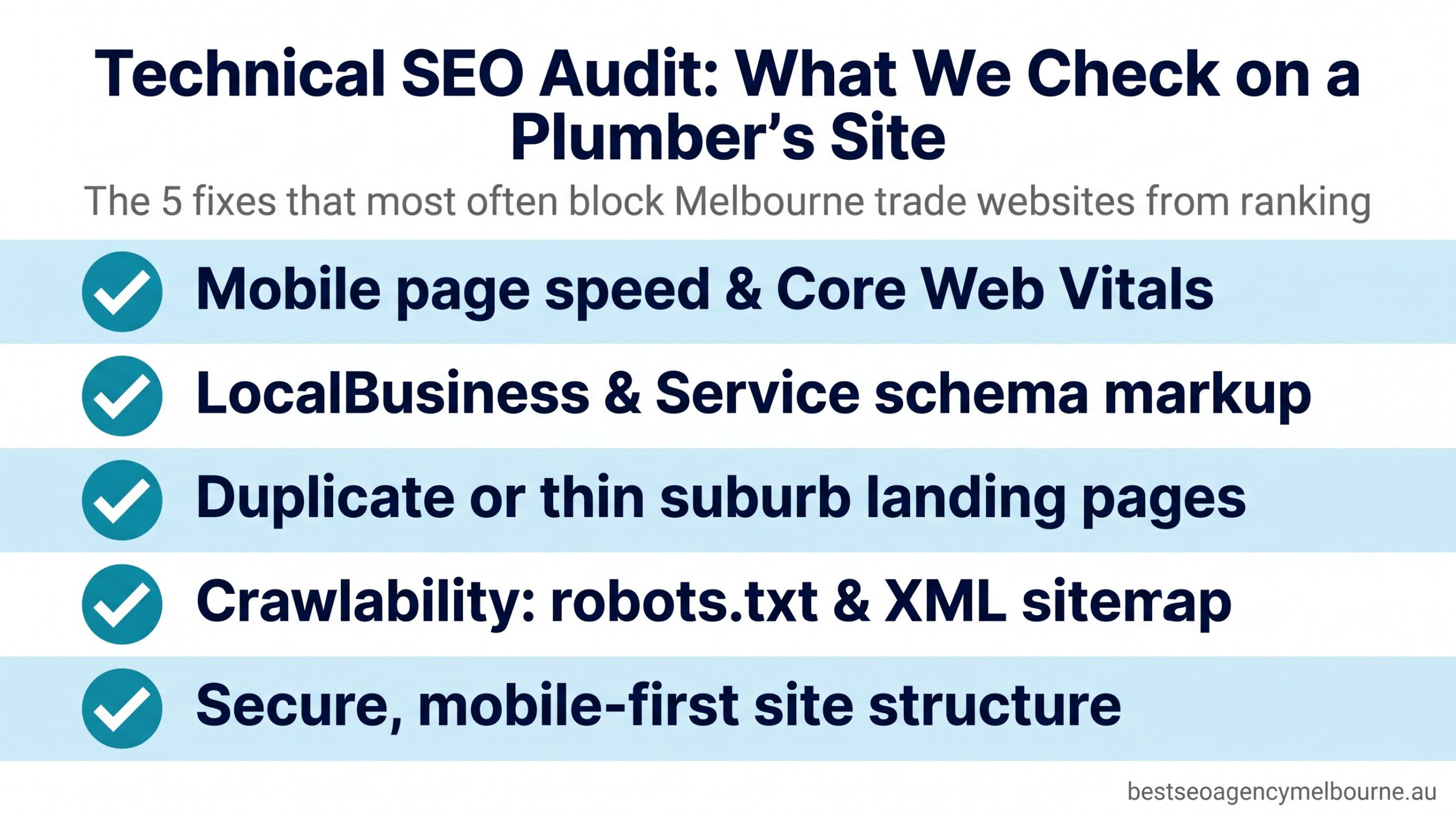
    Checklist infographic showing five technical SEO checks for a Melbourne plumber website: mobile speed, Core Web Vitals, schema markup, duplicate suburb pages, crawlability and mobile-first structure

    The five checks we run before touching content or citations.

    1. Mobile page speed and Core Web Vitals

    A customer with a burst pipe is not searching from a desktop. They are standing in a wet laundry, phone in hand, searching “emergency plumber near me” on patchy mobile reception. If your homepage takes five seconds to load on that connection, they have already tapped back to the results and called the next listing before your page finishes rendering.

    Core Web Vitals are Google’s specific, measurable speed benchmarks: how fast the main content appears, how quickly the page responds to a tap, and whether the layout jumps around while loading. Google’s own guidance confirms these are used as a ranking signal, not just a nice-to-have. Fixing them on a typical plumber’s WordPress or Wix site usually means compressing hero images, removing unused plugins, and switching to faster hosting — a one to two week job for most small business sites, and one of the highest-return fixes on this list because it affects every page at once. A simple test: open your own site on 4G with wifi turned off and time how long it takes before the phone number is visible and tappable. If it is more than three seconds, a customer mid-emergency has probably already left.

    2. LocalBusiness and Service schema markup

    Schema markup is a block of code that tells Google exactly what your business is, where it operates, what services it offers and what your reviews say, rather than leaving Google to guess from the page text. For a plumber this means marking up your service area (the suburbs you actually cover), your services (hot water repairs, blocked drains, gas fitting) and your review rating using Google’s own LocalBusiness structured data format.

    What LocalBusiness schema adds to a plumber’s search listing
    Element Without schema With schema
    Star rating in search results No Yes, if reviews are marked up
    Service area clarity for Google Inferred from text Explicitly stated
    Opening hours shown Sometimes, via Business Profile only Confirmed from two sources
    Eligible for rich results No Yes

    If your Google Business Profile looks strong but your actual website is missing this markup, talk to our Melbourne team — adding it properly across a service-area site is usually a one-week job.

    3. Duplicate or thin suburb landing pages

    Plumbers often build a separate page for every suburb they service: “Plumber Richmond”, “Plumber Fitzroy”, “Plumber Collingwood”. Done well, this is a legitimate local SEO tactic. Done badly, it means twenty pages with the same 150 words and the suburb name swapped, which Google increasingly treats as thin, near-duplicate content and can quietly stop ranking altogether.

    The fix is not deleting the pages; it is making each one genuinely different: real details about response times in that suburb, jobs actually completed there, and specific streets or building types common to the area. This is a content job, not a technical one, but it belongs on a technical audit because duplicate content is a structural problem before it is a writing problem. A useful gut check: read two of your suburb pages back to back. If you could swap the suburb name between them and nobody would notice, Google has probably already noticed.

    4. Crawlability: robots.txt and XML sitemap

    Before Google can rank a page, it has to find and read it. A misconfigured robots.txt file can accidentally block Google from crawling entire sections of a site (we have seen this happen after a website migration more than once), and a missing or outdated XML sitemap means new pages can take weeks longer to be discovered than they should. Both are quick to check and quick to fix once found; the risk is that nobody checks them unless they are specifically looking. Google Search Console (free, and worth setting up regardless of who manages your SEO) will flag most crawlability problems directly under its Pages report, which is the first place we look on any new client site.

    5. Secure, mobile-first site structure

    Google now indexes the mobile version of your site first, not the desktop version, under what it calls mobile-first indexing. If your mobile site hides your phone number behind a menu, shows a cut-down version of your service list, or is missing the schema markup that exists on desktop, that is genuinely what Google evaluates your business on. An HTTPS certificate (the padlock in the browser) is also assumed baseline now; sites without it are flagged as “not secure” and lose trust before a visitor reads a word. Most hosting providers now include a free certificate, so a site still missing one is usually a sign nobody has reviewed the technical setup in some time.

    Bar chart showing bounce rate rises from 9 percent on pages loading under 2 seconds to 38 percent on pages taking 5 seconds or more to load

    The gap between a fast and a slow plumber website, measured in lost customers, not just rankings.

    Pages that load in under two seconds bounce at around 9%, while pages taking five seconds or longer bounce at closer to 38%, based on real-world Chrome user data tracked by Google’s own Core Web Vitals reporting. For a plumber paying for every click through Google Ads or ranking hard-won organic positions, that gap is the difference between a booked job and a call to the next name on the list.

    What this costs, how long it takes, and what goes wrong

    For a typical single-location plumbing business, a full technical audit and fix across all five areas usually falls somewhere between a one-off specialist audit fee and a modest monthly retainer for two to three months, depending on how much needs rebuilding versus adjusting. Speed and schema fixes tend to show measurable improvement within two to four weeks. Suburb page and crawlability fixes take longer to flow through, typically eight to twelve weeks, because Google needs to re-crawl and re-evaluate each page individually.

    The most common mistake is agencies (and DIY attempts) skipping straight to content and link building because it is more visible work to report on, while the technical foundation quietly caps how well any of that content can ever perform. A blog post cannot outrank a faster, better-structured competitor no matter how well it is written.

    Quick FAQ

    Do I need a developer for all of this? Schema markup and crawlability fixes usually need someone comfortable in the website’s backend, but they rarely require a full rebuild. Speed fixes are often achievable through hosting changes and plugin clean-up alone.

    Is this different from local SEO? Yes. Local SEO covers your Google Business Profile, reviews and citations. Technical SEO covers whether your actual website can be crawled, ranked and rendered properly in the first place — both matter, but technical issues can silently cap everything else.

    How do I know if my current agency is actually doing this? Ask for a screenshot of your Core Web Vitals report from Google Search Console and a copy of your schema markup. If neither exists after a few months of engagement, the technical layer has probably been skipped in favour of easier-to-report content work.

    If you are earlier in the process and still comparing which agency to hire, our guides on how to compare and shortlist a local SEO agency for plumbers and what to look for in an SEO agency for plumbers in 2026 cover the buyer-side questions this article does not. This piece is specifically about what a technical audit should find, regardless of who ends up doing the work.

    None of these five checks require ripping out your website and starting again. They are the difference between marketing spend that compounds and marketing spend that quietly leaks away on a site Google was never able to properly read. A plumber who fixes the technical foundation first, then adds content and reviews on top, consistently outperforms a competitor who skipped straight to the visible work.

    Book a free strategy call. No lock-in contracts, response within 2 hours, Melbourne-based team. Get started.

  • Local SEO Agencies in Melbourne for Plumbers: How to Compare and Shortlist One in 2026

    Melbourne plumbers get pitched by SEO agencies constantly: a cold call after a directory listing, a LinkedIn message, a mate at a trade night recommending his guy. Nearly all use the same three words, local SEO, and almost none explain how to tell a genuine trade specialist from a generalist agency reselling the same package it sells to cafes and dentists. That gap costs real money, in wasted retainers and in Map Pack rankings, the three local business listings shown with a map atop Google search results, that never move. This guide is not about which SEO tactics a campaign should include. It is about the comparison process: the questions to ask, the four types of provider you will meet, the red flags in a contract, and a fair price and timeframe for Melbourne in 2026.

    Why comparing agencies is harder than it looks

    Every agency website looks similar: stock photography, a client logo carousel, a promise to get you to the top of Google. There is no easy way for a non-marketer to tell whether a provider genuinely specialises in trades or applies a generic playbook built for retail or professional services. Position matters, but not the way most owners assume. In BrightLocal’s consumer research, only 6% of searchers simply click the top result, while 44% check proximity, how close a business actually is, before clicking through at all. A plumber ranking first in Sunshine does nothing for a customer in Doncaster filtering by distance. Almost every agency can point to some ranking improvement, because rankings move constantly regardless of who is doing the work. What separates a genuine specialist is whether the work matches how a plumbing customer actually searches, urgently, locally, often from a phone mid-job. An agency that cannot explain how their work connects to a call from a customer with a burst pipe is not speaking your language.

    Four types of provider pitching Melbourne plumbers

    Roughly speaking, every SEO pitch comes from one of four kinds of provider, and each suits a different size and stage of business. Knowing which type you are talking to before the call ends saves weeks of back and forth. The same shortlisting logic applies whether you run a plumbing business or, as covered in our guide to choosing a local SEO agency for a Melbourne law firm, a legal practice, only the specifics change.

    Provider type Typical monthly cost (AUD) Best suited to Watch for
    Boutique trade specialist agency $1,200–$2,800 Multi-suburb plumbers wanting Map Pack focus Limited paid ads or web design in house
    Full service digital agency $1,500–$4,000 Businesses wanting SEO, ads and social in one invoice SEO often the smallest, least resourced part of the retainer
    Freelance or solo consultant $600–$1,500 Single-suburb owner operators on a tight budget Capacity risk if they get sick or overbook
    DIY (owner or office manager) $0–$500 (tools only) New businesses testing the water Slow progress against funded competitors

    None of these is automatically wrong. A single-van plumber in Werribee has different needs from a fifteen-truck operation covering the eastern suburbs. The mistake is assuming a provider type based on price alone, without confirming which of the four you are actually speaking to.

    Not sure which type of provider fits your business? Our free 30-minute strategy call includes an honest read on whether you need a specialist, a generalist, or better DIY foundations, no pressure either way. Book a free strategy call.

    Seven questions to ask before you shortlist anyone

    Once you have narrowed two or three candidates, a short structured conversation reveals more than any pitch deck. Ask each one: how many trade clients do you currently manage, and can I speak to one? What does a Google Business Profile audit look like for my business? Google Business Profile, or GBP, is the free listing controlling whether you appear in the Map Pack. How many suburb-specific pages would you build in three months? What does your fortnightly report contain? Who does the work, the person I am speaking to or an offshore team? What happens to my rankings if I cancel?

    A specialist answers the Google Business Profile question in under a minute, with specifics about your suburbs. A generalist often pivots back to a broader digital package. Neither is dishonest, but only one tells you what you are buying.

    Four steps to shortlist a Melbourne plumbing SEO agency
    1. Identify type
    Know which provider type you’re speaking to
    2. Ask seven questions
    Compare answers, not pitches
    3. Check proof
    Request dated, checkable examples
    4. Read the contract
    Confirm ownership and term length
    A repeatable process for comparing local SEO agencies before you sign.

    Proof to demand before you sign

    Case studies are marketing copy, every agency edits its own highlight reel. What is harder to fake is specific, checkable proof: a live or recent Map Pack ranking example for a Melbourne trade business, with a date range attached, and a client you can actually call. Ask what percentage of the agency’s client base is trade or home services specifically, because SEO for a plumber overlaps only partly with SEO for a cafe or law firm. You can see the kind of documented, dated outcomes worth asking for on our own results page, including a South Melbourne medical clinic that tripled new patient enquiries and a Melbourne CBD legal practice that saw a 412% jump in organic traffic. The numbers matter less than whether an agency shows its working, month by month, not one before-and-after screenshot.

    If you want that kind of proof before you commit to anyone, ask to see a real Melbourne plumbing example. Request a sample local SEO report for a trade business and compare it against whatever the other agencies on your shortlist send you.

    Contract red flags and lock-in traps

    The contract is where good sales conversations quietly go wrong. Watch for automatic renewal clauses locking you in for another twelve months unless you cancel in writing within a narrow window, often thirty or sixty days before the term ends. Watch for vague deliverables such as “ongoing optimisation” with no named suburb pages or reporting cadence attached. And watch for ownership clauses: if the agency builds your content and Google Business Profile under its own login rather than yours, you may not be able to take your rankings with you if you leave.

    Under Australian consumer law, standard form contract terms that unfairly favour one party, such as automatic renewals or unilateral price rises, can be void even if you signed them. The ACCC’s guidance on unfair contract terms is worth ten minutes before signing a twelve-month term. A fair agency offers month-to-month terms, hands over full ownership of your Google Business Profile and website access, and explains what happens if you leave. If a provider will not put those in writing, treat that as your answer.

    What this costs, how long shortlisting takes, and what goes wrong

    Budget two to three weeks to compare three agencies: one week to shortlist and hold calls, one week for each finalist to run an audit, a few days to check references. Rushing this is the single biggest predictor of a bad outcome, because a forty-five-minute call cannot tell you whether an agency stays responsive in month eight.

    Once chosen, expect two to four weeks of onboarding, profile audits, access handovers, an initial suburb list, then six to ten weeks before the first genuine Map Pack movement. Budget $800 to $2,800 a month depending on provider type and suburb count. What goes wrong most often is not fraud, it is mismatch: a generalist oversells its trade experience, a freelancer overbooks and reporting slips, or an owner picks the cheapest option then judges it against pricier expectations. Matching provider type, price and expectations at shortlisting prevents most of this before a dollar changes hands.

    How Australian tradies actually market themselves
    76%
    70%
    29%
    17%
    Website
    Word of mouth
    Google Ads
    SEO
    Most Australian tradies market via their website, 76%, or word of mouth, 70%. Fewer than three in ten use Google Ads, 29%, and only 17% use search engine optimisation, per ServiceTitan’s 2025 Australia Tradies Report (1,025 tradies and executives surveyed, March–April 2025).

    That gap between how customers search and how tradies market is where a well-chosen agency earns its retainer back.

    Common questions

    Can I switch agencies without losing my rankings? Usually yes, provided you own your Google Business Profile, domain and website access, since rankings sit with your listing and site, not the agency.

    Should I choose the cheapest quote? Not automatically. A quote well below $800–$1,200 for a competitive suburb usually means limited hours, offshore work, or a template approach.

    Is one agency enough, or two at once? One. Running two providers on the same profile typically causes conflicting changes and hides which one is driving results.

    Choosing a local SEO agency for a plumbing business is a procurement decision, not a leap of faith. Treat it like hiring a senior tradesperson: check references, read the contract closely, and judge the answers in the room, not the website you found them on. We have been the Melbourne team on the other side of this conversation since 2012, in house, with no offshore outsourcing and no lock-in contracts.

    For a second opinion on a contract already in your inbox, book a free, no-obligation strategy call, free, no lock-in, and we reply within 24 hours. For the tactical side, read our companion guide on what Melbourne plumbing SEO should include, or browse more on our SEO blog.