Tag: Shopify SEO

  • How to Recover Rankings After a Shopify Replatform: A 2026 Guide for Melbourne Stores

    Your Melbourne store just moved to Shopify and the numbers are heading the wrong way. Search Console shows fewer impressions, the phone has gone quiet, and someone in the business is asking why the new site “broke” everything the old one used to rank for. This is one of the most common calls our team takes, and the good news is that a replatform does not have to mean a lasting ranking loss. Most of the damage comes from a small, fixable set of mistakes: missing redirects, rewritten product URLs, and metadata that never made the trip across. This guide covers why rankings drop after a Shopify migration, how long recovery genuinely takes, and the fixes that get a Melbourne store back to where it was, and often further ahead.

    Not sure whether your Shopify move is actually recoverable or something more serious? Our free 30-minute audit will tell you, even if you never become a client. Book a free consultation

    Why rankings drop after a Shopify replatform

    A replatform changes more than the shopfront. Product, collection and blog URLs are usually rebuilt around Shopify’s own structure, which means a page that ranked for three years at one address can suddenly live at another. If the old address returns a 404 instead of forwarding visitors and Google to the new one, every backlink and every scrap of ranking history pointing at it goes to waste.

    Metadata is the second casualty. Title tags, meta descriptions and structured data that were fine-tuned over months are easy to lose in a rebuild, especially when a theme swap or app installation overwrites them by default. Page speed can move in either direction too. Shopify’s hosting is generally fast, but a heavy theme, unoptimised images or a stack of speed-draining apps will undo that advantage quickly. Anyone weighing up a migration is really weighing up a technical SEO project, not just a platform swap, and it pays to treat it that way from the start.

    Internal linking is the quiet one. Old sites accumulate links between related products, categories and guides over years. Rebuild the site structure and those internal pathways often vanish, which makes it harder for Google, and shoppers, to find the pages that used to convert well.

    How much traffic loss is normal, and when it signals a real problem

    Some wobble is expected. A temporary dip of 10 to 15 percent in the first couple of weeks is considered normal while Google recrawls and re-indexes the new site, according to 2026 analysis from Search Engine Journal. A sustained drop beyond 30 percent, on the other hand, is treated as a sign of a genuine technical problem rather than a normal transition. Separate 2026 research from SEO.Domains puts it in sharper terms: 60 to 80 percent of all site migrations produce measurable traffic loss, and only around one in ten migrations ends with rankings actually improving.

    The scale of the drop tracks directly with execution quality. A 2026 AI-driven analysis reported by MarTech Cube links poorly executed migrations to a 20 to 40 percent loss in organic traffic, and separate figures show that badly handled moves can shed 20 to 60 percent of traffic within days when redirects are missing or broken. Nearly half of poorly executed migrations never fully recover their previous traffic levels. The table below summarises what a normal transition looks like next to a migration that has gone wrong.

    Signal Normal transition Migration gone wrong
    Traffic dip in week 1-2 10-15%, then recovering 30%+ and still falling
    Search Console coverage report Old URLs shown as redirected Old URLs shown as “not found (404)”
    Ranking movement by week 6 Back near pre-migration positions Still 10+ positions lower
    Backlink profile Redirected to new equivalent pages Pointing at dead or generic pages

    The recovery timeline you should expect

    With a complete, clean redirect map, Shopify’s own migration guidance puts ranking normalisation at four to six weeks, and Google’s Search Central documentation on site moves describes a similar four to twelve week window for a well-executed move, noting explicitly that “301 and other permanent redirects don’t cause a loss in PageRank.” Stores that plan the move properly typically see a dip of 10 percent or less and recover somewhere between one and six months, depending on how many pages and how much non-branded search traffic the store relies on.

    Infographic: the Shopify replatform SEO recovery timeline

    What Melbourne stores can expect after moving platforms, from redirect to full recovery.

    Weeks 1-2
    Crawling and indexing fluctuate as Google finds the new URLs
    Weeks 4-8
    Rankings stabilise where the 301 redirect map is complete
    Months 1-3
    Well-executed moves are usually fully recovered
    Months 6-12
    Poorly executed moves may still be clawing back lost rankings

    Source: Shopify SEO Migration Guide 2026; Google Search Central site move documentation 2026.

    If your Search Console graph looks like the “months 6-12” box above, talk to our Melbourne team — fixing a broken migration is usually a two to four week job, not a rebuild.

    The redirect and metadata checklist that actually protects rankings

    Partial redirect maps are the single biggest cause of migration traffic loss, according to Google’s Search Central guidance on site moves. Every URL that carried ranking value on the old site needs a permanent 301 redirect to its closest equivalent on Shopify, with no chains and no temporary redirects standing in for the real thing. If your store already has a solid product catalogue, our guide on internal linking strategy for large product catalogues is worth reading alongside this one, since a migration is the moment those internal pathways are most likely to break.

    Checklist item Why it matters
    Full 301 redirect map, old URL to new Passes ranking signals and link equity across, per Google’s own guidance
    Title tags and meta descriptions carried over Prevents Google re-evaluating pages from scratch
    Product and collection schema reinstated Keeps star ratings, price and stock showing in results
    Updated XML sitemap submitted in Search Console Speeds up discovery of the new URL structure
    Redirects kept live for at least 12 months Google needs repeated crawls, and old backlinks keep pointing at the old address

    Infographic: traffic impact by migration quality

    Organic traffic loss ranges reported for well-executed versus poorly executed Shopify migrations.

    Well-executed migration (clean 301s)2-10%
    Poorly executed migration (missed redirects)20-60%

    Source: SEO.Domains migration recovery analysis 2026; MarTech Cube SEO migration risk study 2026.

    What this costs, how long it takes, and what goes wrong

    A proper migration audit and redirect map for a mid-sized Melbourne store, somewhere in the range of 200 to 2,000 products, typically takes two to four weeks of dedicated work before launch, plus another four to eight weeks of monitoring afterwards. Stores that skip the audit and redirect their homepage only, hoping Shopify will “figure out” the rest, are the ones we see with the 20 to 60 percent traffic drops described above.

    The most common mistakes we see in Melbourne stores that have already replatformed: redirecting every old URL to the new homepage instead of its true equivalent, which Google treats as a soft 404; forgetting that collection page URLs changed structure entirely; and losing product schema because a new theme does not support it out of the box. Every one of these is fixable without another full rebuild, which is the part most business owners do not realise until someone tells them. It is also worth reviewing your Shopify SEO checklist for Melbourne online retailers, since several of the same fixes apply whether you are launching fresh on Shopify or repairing a migration that already happened.

    Our own case work backs this up. One Melbourne retailer we work with grew organic revenue from $310,000 to $2.1 million within 14 months, largely through the kind of category architecture and redirect discipline described here. You can see the detail on our results page, and the same principles apply just as much to fixing a migration as to growing from scratch. Our process for a recovery project starts with the same free audit as any new engagement, so you know exactly what broke before anyone touches your store.

    Common questions about Shopify migration SEO

    Will my rankings ever fully recover? In most cases, yes, provided the redirect map is complete and stays live. The exception is when competitors have moved into the ranking gap during the recovery window, which is why speed matters. See our full FAQ for more on typical SEO timelines.

    Should I redirect every old URL to my new homepage? No. A blanket homepage redirect is one of the most common causes of lasting ranking loss, because Google treats it as a sign the original page no longer exists in any real form.

    How do I know if my migration was done properly? Check Search Console’s Coverage report for your old URLs. If they show as redirected, that is a good sign. If they show as “not found,” you have gaps to fix.

    A Shopify replatform does not have to cost you the rankings you spent years building. Most of the damage traces back to a handful of fixable gaps: missing redirects, lost metadata and broken internal links, and every one of them has a known fix with a realistic timeline attached. If your store is still waiting on recovery, get a second set of eyes on it. Book your free consultation — no lock-in contracts, a reply within 24 hours, and a Melbourne-based team who has fixed this exact problem before. For more guides like this one, visit our blog.

  • Shopify SEO Checklist for Melbourne Online Retailers: 6 Fixes Before You Spend on Ads

    Most Melbourne online stores are leaking traffic they already paid to earn. A customer finds a product on Google, the page takes four seconds to load, and they bounce back to the results before your add-to-cart button even renders. That is not a marketing problem. It is an SEO problem, and on Shopify it is usually one of six fixable things.

    This checklist is written for Melbourne retailers running Shopify stores who want more sales from organic search without adding to their ad spend. We will walk through what to fix, roughly what it costs to fix it, and how long the results take to show up.

    Not sure where your own store stands? Our free 30-minute audit will tell you exactly which of these six items is costing you the most, even if you never become a client. Book a free consultation.

    1. Fix duplicate product and collection URLs

    Shopify creates more than one URL for the same product the moment it sits in two collections, which is common for stores selling anything with variants (size, colour, bundle). Google sees two web addresses showing near-identical content and has to guess which one matters. Often it picks neither, and both versions rank worse than a single clean page would.

    The fix is a canonical tag pointing every duplicate back to one preferred URL, plus a tidy-up of your collection structure so a product is not filed in five places at once. For a mid-sized catalogue (200 to 800 products) this is usually a half-day to full-day job. You can spot the problem yourself by searching site:yourstore.com.au "product name" in Google and checking whether more than one result comes back for what should be a single page.

    2. Get images loading in under two seconds

    Product photography sells the item, but an oversized image file slows the whole page down, and speed is now a ranking factor as well as a conversion one. Pages that load in under two seconds bounce at around 9%; pages that take five seconds or more bounce at closer to 38%, according to 2026 page speed benchmark data.

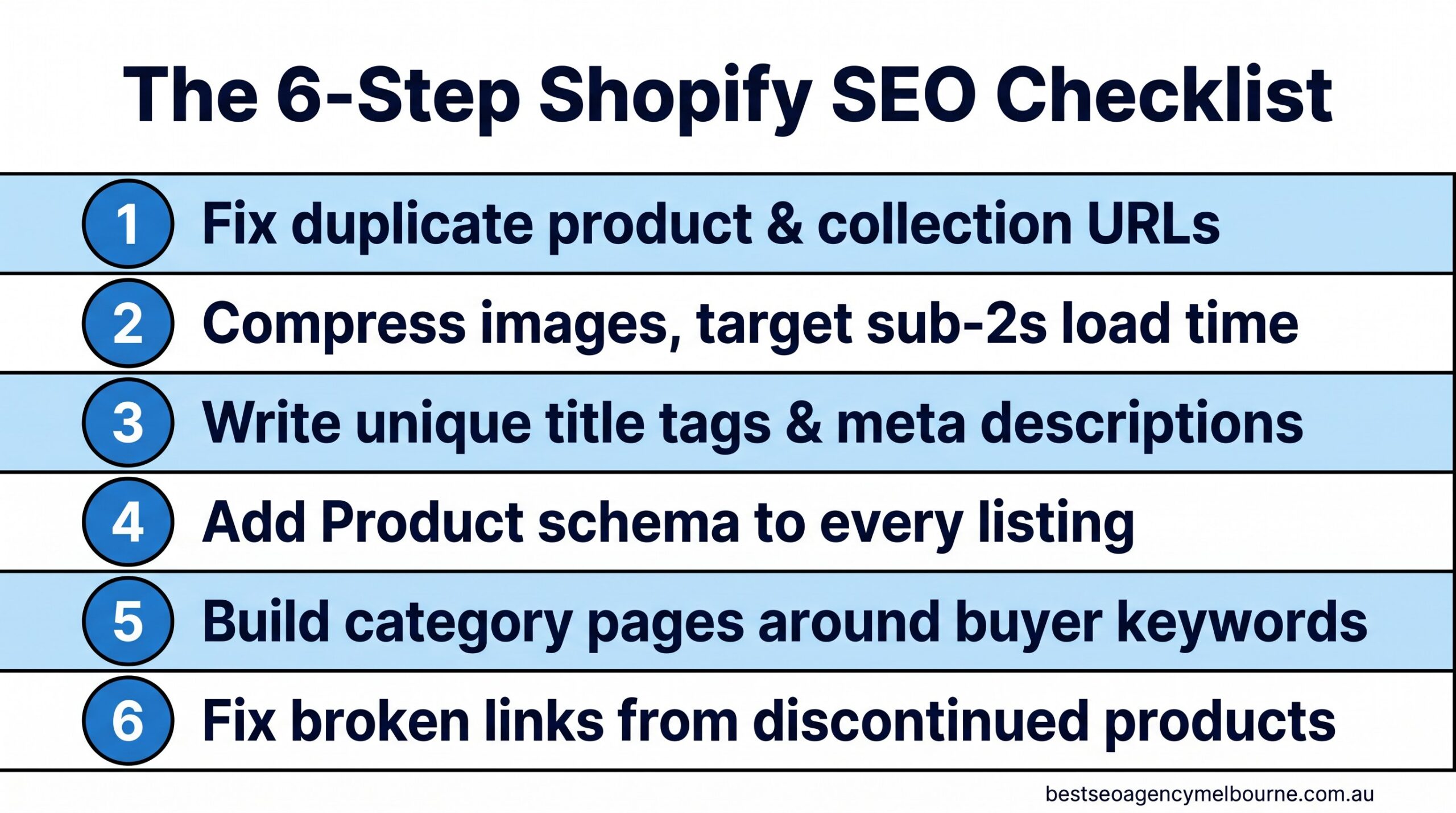
    Six-step Shopify SEO checklist infographic showing fixes for duplicate URLs, image compression, title tags, product schema, category pages and broken links for Melbourne online retailers

    The six fixes in this checklist, in the order we recommend tackling them.

    Compressing product images (Shopify apps like TinyIMG or built-in image optimisation can do this without a developer) and switching to next-gen formats such as WebP typically claws back one to two seconds of load time on a store that has never had this done before.

    3. Write title tags and meta descriptions that are not the product name twice

    The single most common Shopify SEO fault we see in Melbourne stores is a title tag that just repeats the product name with no context: “Blue Cotton Shirt – Blue Cotton Shirt”. Google uses the title tag to decide what a page is about and to write the blue clickable headline in search results. A better pattern includes the product, a distinguishing detail, and the brand: “Blue Cotton Shirt – Breathable Summer Fit | Store Name Melbourne”.

    This is a content task, not a technical one, and it is the cheapest item on this list to fix. A store with 300 products can realistically rewrite its top 50 highest-traffic title tags and meta descriptions in a week. Start with the products that already get traffic but few sales; a stronger title and description often lifts the click-through rate on a page Google already ranks, which is faster than trying to rank a brand-new page from nothing.

    4. Add Product schema to every listing

    Schema markup (also called structured data) is a small block of code that tells Google specific facts about a page: this is a product, it costs this much, it is in stock, and it has this star rating. Without it, Google has to infer those details from the page text, which it does imperfectly. With it, your listing can show a price, a rating and stock status directly in the search result, which is proven to lift click-through rate.

    What Product schema can add to a Shopify listing
    Element Shown in search results without schema Shown in search results with schema
    Price No Yes, as a visible line
    Star rating No Yes, if reviews are present
    Stock status No Yes (“In stock”)
    Typical CTR uplift Baseline 20-30% higher, per structured data research

    If your Google Business Profile listing or product pages look like the plain “before” example in that table, talk to our Melbourne team — adding Product schema across a Shopify catalogue is usually a two-week job, not a rebuild.

    5. Build category pages around what buyers actually search for

    Product pages rank for specific items. Category (collection) pages are what rank for the broader, higher-volume searches like “women’s linen shirts Melbourne” or “waterproof dog beds Australia”. A collection page with no written content beyond a product grid gives Google almost nothing to work with, so it under-ranks for exactly the searches that bring the most traffic.

    Adding 150 to 300 words of genuinely useful buying-guide content above or below the product grid, built around the terms real customers use, is one of the highest-return fixes on this list because it targets searches with real commercial intent.

    Bar chart showing organic search drives 33 to 43 percent of Australian ecommerce traffic and converts at 2.5 to 3.5 percent, higher than the 1.4 percent site-wide average

    Organic search is the highest-converting channel most Melbourne Shopify stores have, and it does not stop working when you pause spending.

    Australians spent a record $82.6 billion shopping online in 2025, with 24% of all retail spend now happening online, according to the Australia Post eCommerce Report 2026. Organic search conversion rates on Shopify typically sit between 2.5% and 3.5%, well above the 1.4% site-wide average, according to Shopify’s own 2026 conversion benchmark data. Every category page you improve is competing for a genuinely large and growing pool of buyers.

    6. Fix broken links from discontinued products

    Every retailer discontinues stock, and every discontinued product page that is simply deleted becomes a dead link, a 404 error for anyone who had it bookmarked, shared it, or found it in a search result that has not updated yet. Dead links waste the ranking value that page had built up and create a poor experience for shoppers who arrive expecting to buy something that no longer exists.

    The fix is a 301 redirect from the old product URL to its closest live replacement or the relevant category page, set up every time a product is discontinued rather than in an annual clean-up.

    What this costs, how long it takes, and what goes wrong

    For a Melbourne store with 200 to 500 products, working through all six items typically costs somewhere between a solo freelancer’s day rate for a light pass and a few thousand dollars for a full technical and content overhaul, depending on how much of the catalogue needs rewriting. Expect the technical fixes (schema, redirects, canonical tags) to show up in Google Search Console within two to four weeks, and the content fixes (title tags, category pages) to move rankings over eight to twelve weeks as Google re-crawls and re-evaluates the pages.

    The most common mistake we see is stores treating this as a once-off project rather than an ongoing habit. New products get added every month without title tags being checked, and by month six half the catalogue has drifted back into the same problems. Building these six checks into your product upload process is what actually protects the ranking gains. Once they are in place, a Shopify blog set up for SEO is a good next step for reaching shoppers earlier in their search. If your store is not showing up on Google at all, start with our guide to why your Shopify store isn’t ranking. If your products are missing from Shopping results, work through our guide to products not showing in Google Shopping. Selling to New Zealand too? See Shopify Markets SEO for Australia and New Zealand.

    Quick FAQ

    Do I need a developer to fix Shopify SEO issues? Most of this checklist (title tags, image compression, category content) can be done inside Shopify’s standard editor or with well-reviewed apps. Schema markup and canonical tag clean-ups usually benefit from a specialist, particularly on larger catalogues. See our full FAQ for more on how engagements typically run.

    Does this checklist apply to WooCommerce? The ideas are the same, but the settings live in different places. See our WooCommerce SEO checklist for Melbourne stores for the exact menu paths.

    Will this work for a store with under 50 products? Yes, smaller catalogues actually see faster results because there is less to fix and Google can re-crawl the whole site more quickly.

    Should I fix all six at once or one at a time? If budget is tight, start with title tags and image compression first. Both are quick to implement and tend to move rankings fastest, which makes it easier to justify tackling the remaining items afterwards.

    If you are still comparing agencies before committing budget to any of this, our guide on how to choose an SEO agency in Melbourne without signing a 12-month mistake covers the questions worth asking before you sign anything. And if product page copywriting is your bigger gap than the technical side, our guide to writing for humans and Google at the same time is a useful next read.

    None of these six fixes require a full site rebuild, and none of them require pausing your ad spend while you sort them out. They are the groundwork that makes every other marketing dollar you spend work harder, because a store that ranks well and loads fast converts better regardless of where the visitor came from.

    Book your free consultation. No lock-in contracts, reply within 24 hours, Melbourne-based team. Get started.