If you run a real estate agency in Melbourne, most buyers and sellers now start their search on Google, not with a phone call to your office. The trouble is that most agency websites are built to look good, not to be found. Listing pages, suburb guides and agent profiles often sit with little thought given to what Google needs to rank them. That gap is what on-page SEO fixes, and it is also where real estate businesses waste money on agencies that do not understand the property market. This guide covers what on-page SEO means in plain terms, what a genuinely useful Melbourne SEO partner looks like, what it costs, how long it takes, and where most realtors go wrong.
What on-page SEO actually means for a real estate agency
On-page SEO is everything you control directly on your own website that helps Google understand and rank your pages. It is different from off-page work like building links from other sites, and different from paid ads, which stop working the moment you stop paying. For a real estate agency, on-page SEO covers things like:
- Title tags: the blue clickable headline in Google search results. Each listing, suburb page and service page needs its own (for example, “3 Bedroom Family Homes in Brunswick | Your Agency Name”).
- Meta descriptions: the short summary under the title in search results. It does not directly affect rankings, but a clear, specific description earns more clicks, which sends a positive signal to Google.
- Headers (H1, H2, H3): the heading structure of a page. One clear H1, with H2s breaking up sections, helps readers and search engines follow the content.
- Image alt text: a written description of every photo, originally built for vision-impaired visitors using screen readers, and also read by Google to understand what an image shows. Property photos with proper alt text (“Renovated kitchen with island bench, Hawthorn townhouse”) can appear in Google Image search too.
- Internal linking: linking your suburb, service and blog pages to each other with descriptive text.
- Schema markup: a small block of code that labels content for Google in a structured way, for example marking a page as a property listing with a price and suburb, rather than Google guessing from plain text.
- Page speed: how quickly a page loads on mobile, which matters because most buyers browse listings on their phone between inspections.
Google’s own SEO starter guide covers these fundamentals in more depth, though it is written for a general audience rather than real estate specifically.
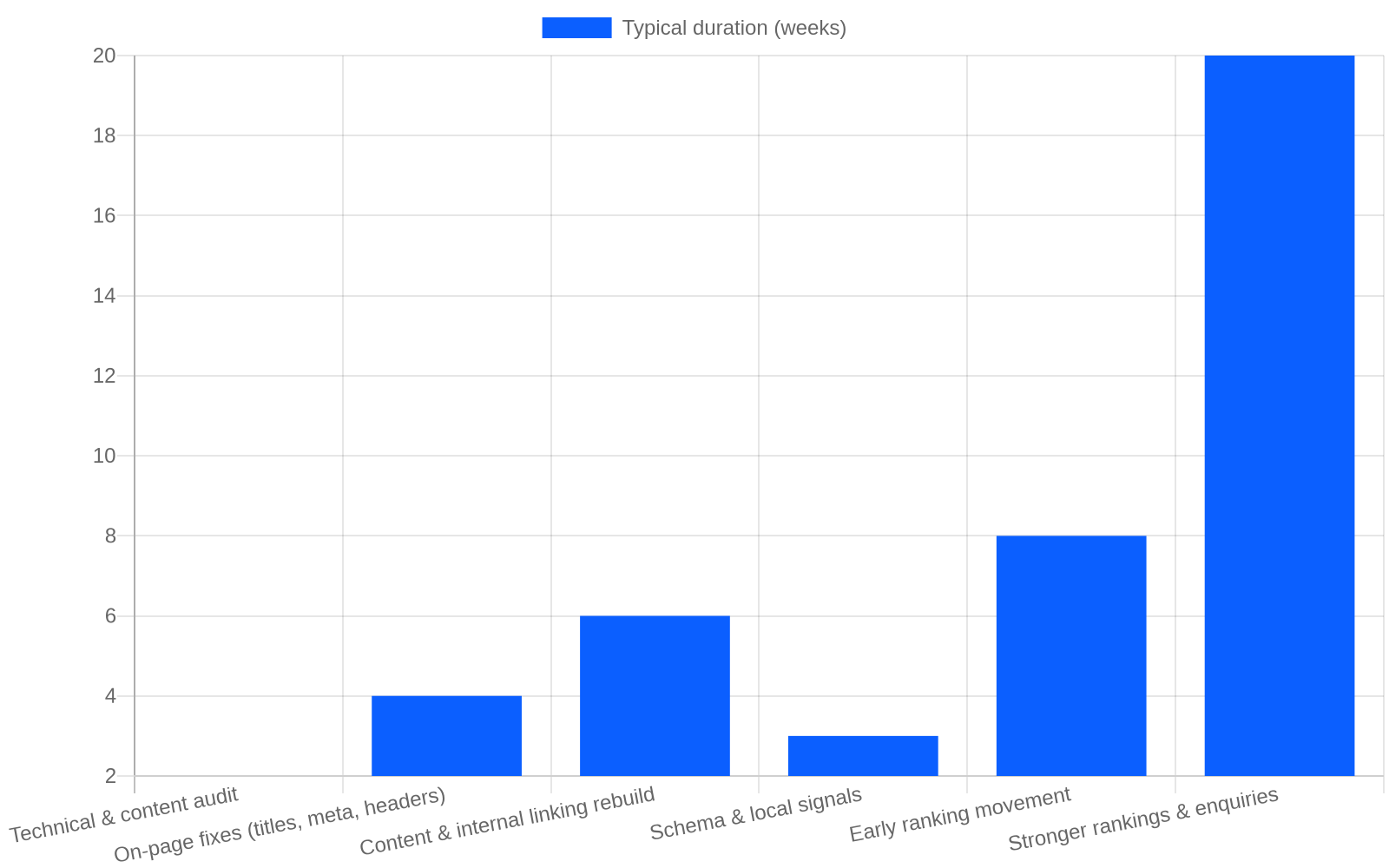
Infographic: a realistic on-page SEO timeline for a Melbourne real estate agency, from the first audit through to measurable ranking gains.
Not sure where your agency’s website currently stands? A free 30-minute audit will show you exactly which pages are costing you enquiries. Book your free strategy call here.
What to look for in an on-page SEO agency or partner
Plenty of agencies claim to “do SEO.” Far fewer understand how a real estate business actually generates leads, through suburb-specific searches, listing visibility and local trust signals. Before signing anything, compare your options against what actually matters.
| What to check | DIY / in-house | Generalist marketing agency | Specialist SEO agency |
|---|---|---|---|
| Understands suburb-level property search behaviour | Sometimes, but time-poor | Rarely | Should be core expertise |
| Writes content for individual listings and suburb pages | Ad hoc | Generic templates | Structured, ongoing |
| Reporting you can actually read | N/A | Often vague | Plain-language and regular |
| Contract terms | N/A | Often 6 to 12 month lock-in | Best providers offer month-to-month |
| Typical monthly investment | Staff time only | $800 to $2,000 | $1,500 to $5,000+ |
| Time to see ranking movement | Slow, inconsistent | 3 to 6 months, variable | Usually 2 to 4 months for early signals |
Ask any agency to show real, current suburb or listing pages they have written for a property business, not just ranking screenshots. A partner who understands real estate should explain how they’d structure your site across your service suburbs in the first meeting, not a follow-up proposal.
Red flags to walk away from
Some warning signs are consistent across every industry, and real estate is no exception:
- Guaranteed page one rankings. No one, including Google, can guarantee a ranking position. Anyone promising a specific rank by a specific date is either inexperienced or being dishonest.
- No audit before a quote. A genuine SEO partner needs to see your current site before pricing any work. A flat quote with no audit usually means a generic package, not a plan built for your agency.
- Long lock-in contracts. Results should speak for themselves within a reasonable window. Agencies that need a 12-month contract to keep you are often protecting themselves from churn, not protecting your results.
- Backlinks from unrelated, low-quality sites. Links from gambling or overseas directory sites pointing at your domain are a shortcut that can get your site penalised.
- No mention of your Google Business Profile. For an agency with a physical office, your Google Business Profile and on-page local signals need to work together. An agency that only talks about your website is missing half the picture.
What this costs, how long it takes, and what usually goes wrong
For a small to mid-sized Melbourne agency, ongoing on-page and content SEO typically runs $1,500 to $5,000 a month, depending on how many suburbs and services you cover. Larger multi-office agencies sit at the higher end, or above it.
Expect the first few weeks to go into a technical and content audit, followed by fixes to titles, meta descriptions, headers and page speed. Content rebuilding for priority pages usually takes another month or two, with early ranking movement on suburb-specific searches showing within 8 to 12 weeks. Broader terms like “real estate agent Melbourne” are far more competitive and can take six months or longer, which is why suburb and property-type specific pages matter so much for a smaller agency.
The most common failure is chasing broad, generic keywords instead of specific phrases buyers actually type, like “townhouse for sale Coburg” rather than just “real estate agent.” A close second is thin, duplicated content across suburb pages, where only the suburb name changes, a pattern Google rarely ranks well. The third is treating on-page SEO as a one-off project rather than an ongoing discipline.
Once you know what good work costs and how long it takes, it’s easier to spot a proposal that overpromises. If you’d like a second opinion on a quote you’ve received, book a free 30-minute strategy call, no obligation either way.
Why this matters more than ever for Melbourne real estate
Attention in the Melbourne property market is harder to earn than it used to be, and the data backs that up. According to the REIV Research Bulletin, Victoria’s auction clearance rate sat at 69.9 per cent in July 2026, with the median Victorian property taking 45 days to sell privately in the same month. That is a competitive, fast-moving market where visibility windows are short.
Separately, PropTrack’s 2026 Buyer Impact Model, built by REA Group and independently validated by Deloitte, found that buyer engagement is recorded on 9 in 10 properties that go on to sell, and eventual buyers view roughly 28 times more property images than people who do not end up buying. That’s a strong argument for proper on-page work: well-written headings, accurate alt text on every photo, and fast-loading pages keep a genuinely interested buyer engaged with your listing rather than bouncing back to search results.
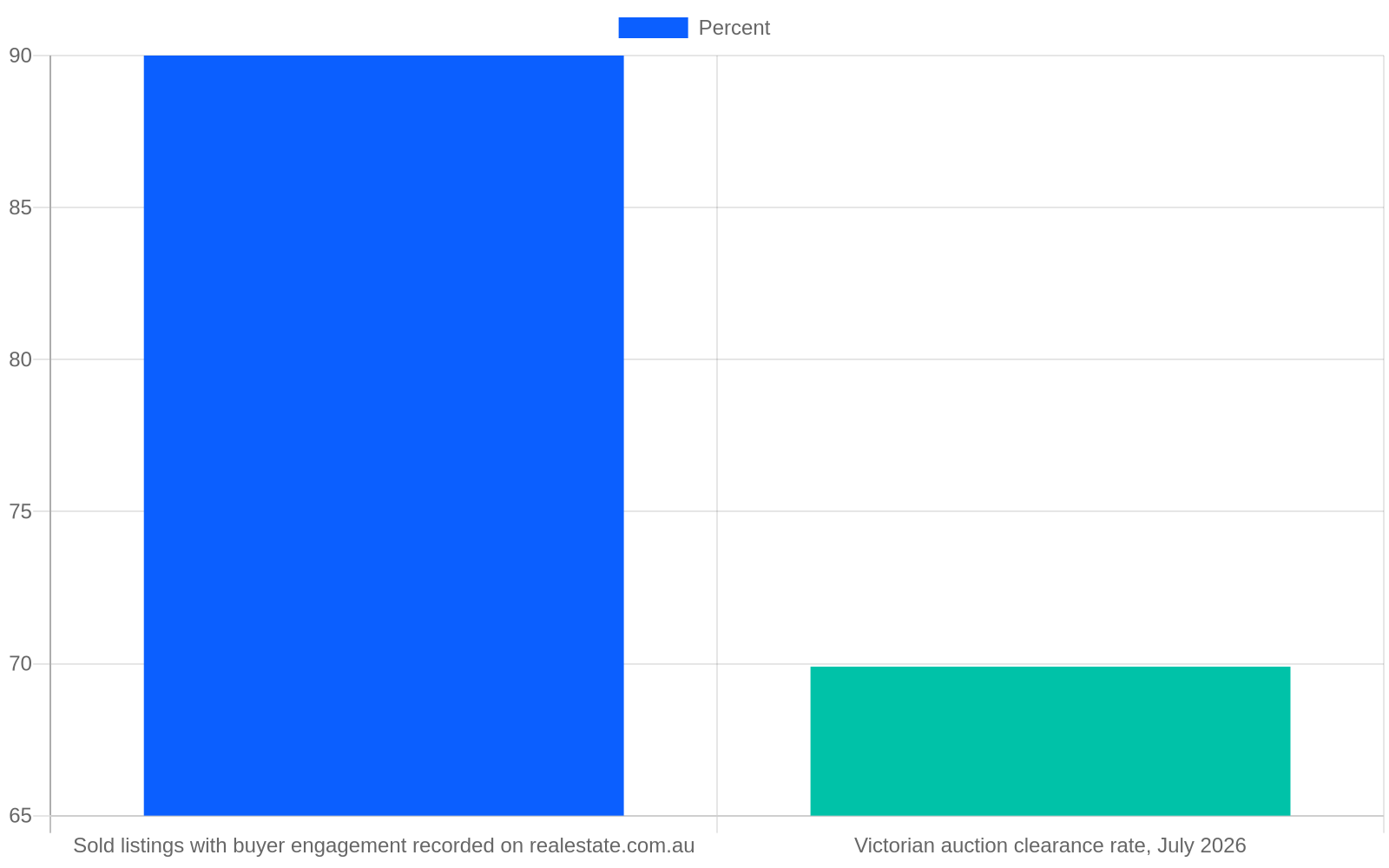
Infographic: key 2026 Melbourne property market figures that show why on-page visibility and content quality matter for real estate agencies.
We’ve applied the same approach across other Melbourne service industries, including a CBD law firm that saw a 412 per cent increase in organic traffic. See how that played out in our case studies, with the real estate version following the same principles, applied to listings and suburbs.
Common questions from Melbourne real estate agencies
Is on-page SEO different from Google Ads? Yes. Ads put you at the top of results only while you keep paying. On-page SEO improves your organic, unpaid rankings, which keep working after the initial investment, though it takes longer to build.
Do we need a separate page for every suburb we service? Generally yes, if the content is genuinely useful and specific to that suburb rather than a copy-paste template. A thin, near-duplicate page can do more harm than having no page at all.
How do I know if our website already has decent on-page SEO? A proper audit will tell you, but warning signs include duplicate title tags, missing alt text on listing photos, and suburb pages with barely 100 words of content. See our FAQ section for more on how we assess this.
Choosing the right on-page SEO partner comes down to one thing: do they understand how Melbourne property buyers actually search, or are they applying a generic template? A good partner shows you real suburb and listing pages they’ve built, explains costs and timeframes honestly, and never locks you into a long contract. To see how our in-house Melbourne team approaches this for real estate clients, book your free consultation. No lock-in contracts, a reply within 24 hours, Melbourne-based team. For more guides, visit our SEO blog, including our piece on choosing a local SEO agency for Melbourne law firms, which covers similar ground.
Leave a Reply