A concreter in Dandenong and a builder in Brunswick can do equally good work, yet only one of them shows up when a homeowner in either suburb searches “concreter near me” tonight. That gap rarely comes down to the quality of the work. It comes down to whether Google can find, trust and recommend the business at the exact moment someone is ready to hire a contractor. Construction is one of Australia’s largest industries by business count, with 462,939 construction businesses trading nationally as of June 2025, according to the Australian Bureau of Statistics. In a market that crowded, local search visibility is often the difference between a full pipeline and a quiet phone. Here is what local SEO actually involves for a Melbourne construction company, in plain terms, and roughly how long each part takes.
What local SEO actually means for a construction business
Local SEO is the work that decides whether your business appears in the three-listing “map pack” and the local results Google shows when someone searches for a builder, plasterer, electrician or landscaper near them. It is different to general SEO, which focuses on ranking a website nationally for broad terms. For a construction company that only services Melbourne and its surrounding suburbs, the map pack matters more than a page one ranking for a generic keyword nobody in Ferntree Gully is actually typing into Google.
Three things drive it. The first is your Google Business Profile, the free listing that appears with your reviews, photos and opening hours whenever someone searches your business name or your trade plus a suburb. The second is the consistency of your business details across the web, directories, supplier listings, industry associations and old profiles you may have forgotten about. The third is the signal your own website sends about exactly which suburbs and services you cover, which most construction sites get wrong by writing one generic page for the whole of Melbourne instead of pages built around the areas they actually service.
Not sure where your business currently stands on any of this? Our free 30-minute audit will tell you, even if you never become a client. Book a free consultation and we will walk through your current Google Business Profile and website together.
The five things that actually move the needle
Most construction companies waste money on generic SEO packages before the basics are even in place. These are the five areas worth fixing first, in the order we typically tackle them for local SEO clients in the trades and construction space, and the same fundamentals sit behind the case studies on our results page.
| Local ranking factor | Why it matters for a construction company | Where to fix it |
|---|---|---|
| Google Business Profile completeness | Incomplete profiles rank behind competitors who have filled in services, hours, service areas and licence details | Google Business Profile dashboard |
| Reviews and response rate | Review volume and recency are one of the clearest trust signals Google and homeowners both use | Post-job follow-up process |
| NAP consistency (name, address, phone) | Mismatched details across directories confuse Google about which listing is genuine | Directories, supplier listings, old profiles |
| Project photos and service-area pages | Real project photos and suburb-specific pages tell Google which jobs you actually do, and where | Website and Google Business Profile |
| Site speed and technical health | A slow, broken site loses the ranking benefit that good local signals have earned it | Hosting and website build |
Google Business Profile deserves the most attention because it is free, it is usually the first thing a homeowner sees, and most construction businesses only fill in half of it. Add every service you actually offer rather than a single generic category, list your licence or registration number if your trade requires one, and upload real photos from finished jobs rather than stock images. A profile like this, kept current, does more for a builder’s phone than most paid advertising.
Citations matter too, even though they are the least glamorous part of the list. Directories like hipages, Houzz, True Local and the Yellow Pages still carry weight, and industry bodies such as the Housing Industry Association or Master Builders Victoria are worth claiming a listing on if your business is a member. The goal is simple: your business name, address and phone number should read identically everywhere they appear online. A single old address from a previous office, sitting quietly on a directory from years ago, can confuse Google about which listing to trust.
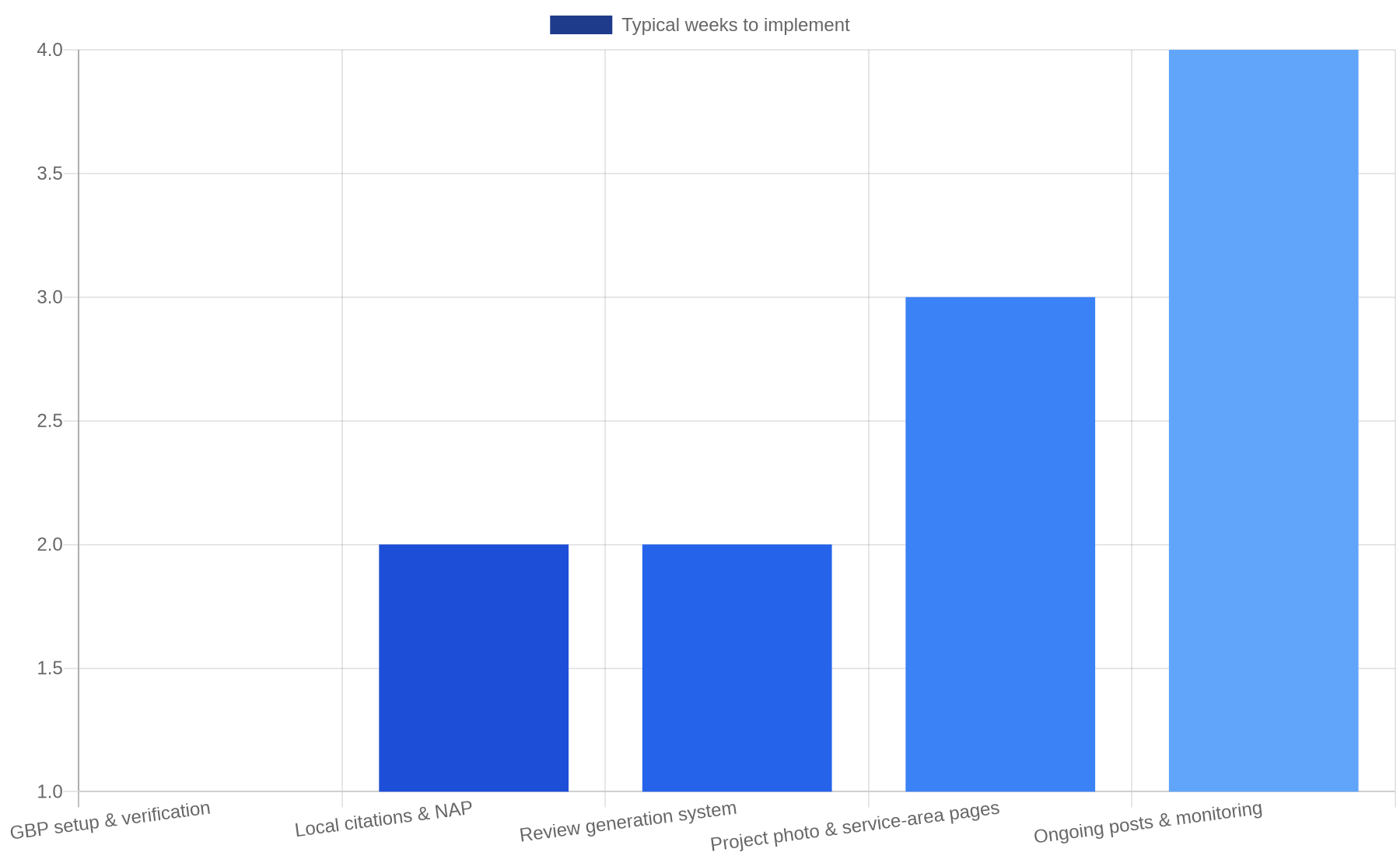
A typical rollout order for a Melbourne construction company starting from scratch. Businesses with an existing Google Business Profile can usually skip straight to reviews and service-area pages.
Why this matters more than most business owners think
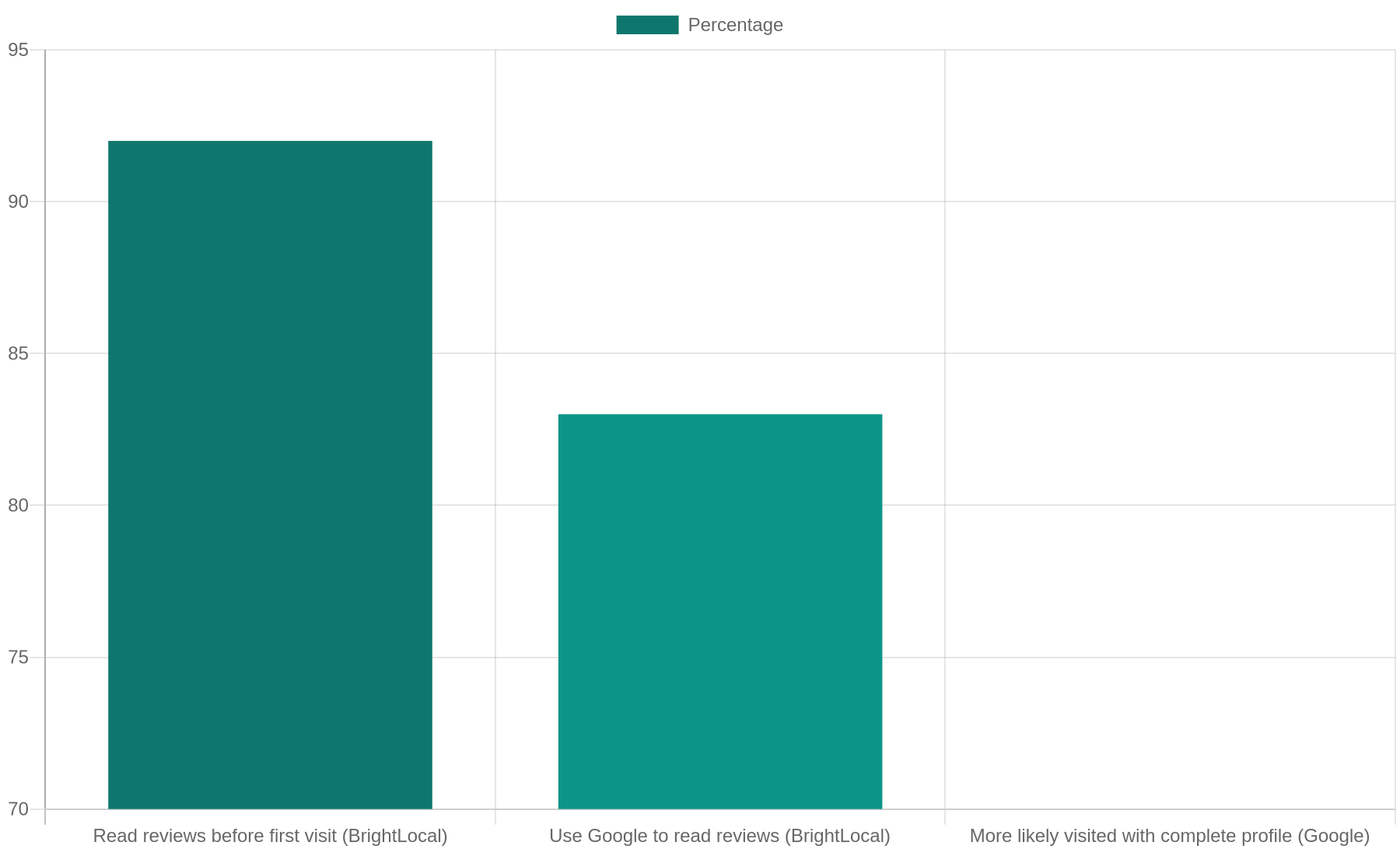
The research backs this up clearly. In its 2024 Local Consumer Review Survey, BrightLocal found that 92% of consumers read reviews of a local business before their first visit or enquiry, and 83% of them do that reading on Google specifically. Google’s own guidance for businesses states that a complete, verified Business Profile makes a business roughly 70% more likely to attract a visit than an incomplete one. For a construction company, a “visit” is a phone call, a quote request or a message asking whether you cover a particular suburb. If your profile is thin and your reviews are three years old, you are handing that enquiry to whichever competitor turned up first.
If your Google Business Profile still looks like the “before” example above, three-year-old reviews and a handful of blurry photos, talk to our Melbourne team. Fixing it properly is usually a two to three week job, not a months-long project, and it is often the single highest-return piece of marketing a small construction business can do.
What this costs, how long it takes, and what goes wrong
A single-location Melbourne construction or trade business can expect to pay somewhere between $800 and $2,500 a month for an ongoing local SEO program, depending on how many suburbs and services are being targeted and how competitive they are. A landscaper working across six or seven eastern suburbs sits comfortably in that range. Builders and larger renovation companies competing across multiple council areas, or fighting for visibility in the inner city, usually sit at the higher end because there are simply more competitors to outrank. Most businesses see the first movement in map pack visibility within 6 to 10 weeks, with meaningful enquiry growth by month four or five. Highly competitive categories, like general builders in the inner suburbs, can take longer, and anyone promising page one rankings inside a fortnight is not being straight with you.
The most common mistakes we see are not exotic. Businesses create a second Google Business Profile after moving office and end up with two competing, half-updated listings, both diluting the other’s reviews and rankings. Owners ask happy clients for reviews inconsistently, so the profile goes quiet for months at a time and then gets a sudden cluster, which looks unnatural to both Google and prospective customers. Website content gets written once, for “Melbourne”, instead of for the dozen suburbs a business actually services, which means the site never appears for any of them specifically. And plenty of construction companies hire a generalist digital marketing agency that has never dealt with builder’s licence numbers, trade certifications or the way homeowners actually search for renovation work, which shows up as generic copy that could belong to any industry from hairdressing to plumbing.
Common questions
How long before a construction company sees results from local SEO? Most Melbourne clients see initial map pack movement within 6 to 10 weeks and a clear increase in phone enquiries by month four. See our FAQ for more on typical timelines across services.
Do separate job sites count as separate locations for Google? No. Google Business Profile is built around your registered business address or a defined service area, not individual project sites, so a construction company should run one profile per genuine office location, not one per job.
Is local SEO worth it for a two or three person building crew? Often, yes, because smaller crews rely more heavily on a steady stream of local enquiries than large builders with existing referral networks, and the fixes above cost far less than most owners assume once the basics are in place.
For a broader look at hiring the right specialist rather than doing this in-house, our guide to choosing an SEO agency as a builder covers the questions worth asking before you sign anything. The same local SEO fundamentals covered here also apply, suburb by suburb, in our local SEO checklist for Melbourne beauty salons, if you want to see how the same system plays out in a different trade.
The takeaway
Local SEO for a construction company is not complicated, but it does need to be done properly and kept current. Get your Google Business Profile complete, keep your business details consistent everywhere they appear, ask every satisfied client for a review, and build pages for the actual suburbs you service. Book your free consultation today. No lock-in contracts, a reply within 24 hours, and a Melbourne-based team who understands the trades. Get started, or read more on our SEO blog.
Leave a Reply