Blog

  • What Is Answer Engine Optimisation (AEO) and Why It Matters Now

    When a Melbourne customer asks ChatGPT “who’s a good electrician near me” or types a question into Google and gets an AI-written summary instead of the usual list of blue links, does your business show up anywhere in the answer? For most small and medium business owners, the honest answer is “we don’t actually know.” Answer Engine Optimisation, or AEO, is the practice of shaping your website so these AI systems can find, understand and quote your business when someone asks a question your customers are already asking. It’s a close cousin of search engine optimisation (SEO), not a replacement for it, but it plays by some different rules. This article explains what AEO means in plain English, why 2026 is the year it stopped being optional, what it costs, and how a Melbourne business can get started.

    What answer engine optimisation actually means

    Answer Engine Optimisation is the work of structuring and writing your website content so that AI tools, not just traditional search engines, can confidently pull your business into the answers they give people. Think of an “answer engine” as any tool that gives someone a direct answer instead of a list of links to click through: Google’s AI Overview (the AI-written summary box that now appears above normal search results for many queries), ChatGPT, Perplexity, and Microsoft’s Copilot are all answer engines.

    A quick note on jargon, because this topic is full of it. An LLM (large language model) is simply the computer program behind tools like ChatGPT that reads huge amounts of text and generates answers in plain sentences. A featured snippet is the short, highlighted answer box Google has shown for years above regular results. Structured data is hidden code added to a web page that spells out, in a format machines understand, what the content actually means, for example “this is a business, its phone number is X, it’s open these hours.” AEO leans heavily on structured data, clear headings, and direct answers to real questions, because that is the kind of content answer engines can lift and cite with confidence.

    Why it matters now, not in a few years

    A side-by-side diagram comparing traditional search results, a list of ten blue links, with an answer engine optimisation result, a single AI-generated answer citing a few sources

    Not sure if your Melbourne business is showing up when people ask ChatGPT or Google’s AI Overview for a recommendation? Our free $1,200 audit will tell you exactly where you stand. Claim Your Free Audit

    The shift away from clicking through a list of links is not a future trend, it has already happened to a measurable degree. According to a 2026 study by SparkToro using Similarweb clickstream data, Google searches in the United States ended without any click at all 68.01% of the time between January and April 2026, up from 60.45% in 2024 (Search Engine Land). In other words, more than two out of every three searches are now answered on the spot, with no visit to any website at all.

    At the same time, Comscore’s Q2 2026 AI Intelligence Report found that Google’s AI Overview appeared in 39.4% of US desktop searches in June 2026, up from just 25.8% in July 2025 (Search Engine Land). And it isn’t only Google: OpenAI announced that ChatGPT reached 900 million weekly active users in February 2026 (TechCrunch). That’s hundreds of millions of people asking a chatbot questions they might once have typed into Google, including questions like “who’s a reliable plumber in the inner north” or “best cafes for a work meeting in the CBD.”

    How answer engines decide what to cite

    Answer engines don’t invent facts out of thin air (at least, not on purpose). They draw on real web pages, weigh them for trustworthiness and clarity, and then summarise or quote the ones that answer the question most directly. That means the old habit of stuffing a page with keywords and hoping for the best does very little for AEO. What helps is writing content that answers a specific question in the first sentence or two, backing claims with real data, using structured data so machines can read your business details precisely, and building genuine authority through other credible sites linking to yours, something our authority link building service is built around.

    Since structured data and clear, direct answers are the two levers that matter most here, that’s exactly what we check first in a free audit, before recommending a single dollar of work. Claim Your Free Audit

    The table below summarises the shift in plain numbers, each one sourced from the reports already mentioned above.

    Metric Previous period 2026 figure Source
    Google searches in the US ending with no click 60.45% (2024) 68.01% (Jan–Apr 2026) SparkToro / Similarweb
    Google desktop searches showing an AI Overview (US) 25.8% (Jul 2025) 39.4% (Jun 2026) Comscore Q2 2026 AI Intelligence Report
    ChatGPT weekly active users worldwide N/A 900 million (Feb 2026) OpenAI, reported by TechCrunch

    A bar chart showing answer engine optimisation statistics for 2026, including Google zero-click searches rising to 68.01 percent and AI Overview coverage of US desktop searches rising to 39.4 percent

    None of this means traditional SEO is dead. Google’s own structured data documentation makes clear that the same markup which helps your site earn rich results in standard search also feeds its AI systems. A page that ranks well and reads clearly for a person tends to do well with answer engines too. AEO is less a separate discipline and more a sharper focus within good SEO Content Strategy, which is why we treat it as part of the same content strategy work we’ve always done for Melbourne clients, not a brand-new service with a brand-new invoice attached.

    What this costs, how long it takes, and what goes wrong

    Business owners usually want to know three things before touching any of this: the cost, the timeframe, and the risk. On cost, AEO work is typically bundled into existing SEO content and technical work rather than charged as a separate line item, because the two overlap so heavily: better structured data, clearer answers, and stronger authority links help both. Expect it to form part of an ongoing content and technical SEO program rather than a one-off fix.

    On timeframe, be wary of anyone promising AI citations within days. Answer engines need to crawl, trust, and re-index your content, which realistically takes a similar few months to traditional SEO gains, a pattern we’ve covered in detail in our realistic SEO timeline guide. What goes wrong most often is businesses chasing AEO by publishing thin, generic FAQ pages stuffed with questions nobody actually asks. Answer engines are good at spotting padding, and thin content can hurt your standing in ordinary Google results too. The fix is the same one that has always worked: answer real questions, with real numbers, written by someone who actually understands the business.

    If you’ve ever stared at a spreadsheet of rankings and traffic and wondered what any of it means for your bottom line, our guide to reading an SEO report without a marketing degree breaks down exactly which numbers matter. And if the idea of adding “AI search” to an already long list of marketing worries feels overwhelming, that reaction is fair. This is precisely why Melbourne businesses lean on a local team rather than trying to track every algorithm shift alone. Since this work sits on the same foundation as proven SEO, the case studies on our results page reflect the same approach now being extended to answer engines. We’ve been doing this kind of content and authority work from our Melbourne office since 2012, and it shows in outcomes rather than promises.

    Frequently asked questions

    Is AEO replacing SEO? No. Answer engines still rely on the same signals good SEO has always valued, clear writing, real authority, and technical health, so the two work together rather than competing. Our FAQ page covers more detail on how our Melbourne team approaches this.

    Can I do AEO myself with a WordPress plugin? You can make a start with structured data plugins and clearer headings, but the content and authority side, the part that actually earns citations, generally needs dedicated writing and link-building work.

    Will AEO hurt my website traffic if answer engines give my answer away for free? It’s a fair worry given the zero-click numbers above. In practice, appearing in an AI answer with your business named builds awareness and trust even without a click, and the same content usually keeps performing well in ordinary Google results too.

    The takeaway is simple: Answer Engine Optimisation isn’t a gimmick or a rebrand, it’s a direct response to how a growing share of Melbourne customers are already finding businesses in 2026. Ignoring it means being invisible in the exact moment someone asks for a recommendation. Our Melbourne-based team has no lock-in contracts, replies to enquiries within 24 hours, and has helped more than 500 local businesses reach page one, so there’s little to lose by finding out where you currently stand. Claim Your Free Audit today, and for more guides like this one, visit our blog.
  • What “Guaranteed Rankings” Really Means (And Why to Be Wary)

    “We guarantee you’ll rank #1 on Google within 30 days.” If a Melbourne business owner has been pitched by more than two SEO providers, there is a good chance one of them has said something close to this. It is one of the oldest lines in the industry, and it is worth understanding exactly why it cannot be true, because the reasoning tells you a lot about what genuine SEO work actually looks like.

    This guide explains what a guaranteed-rankings promise really means, what Google itself says about it, and the questions that separate an honest SEO provider from one about to waste your budget.

    Why no one, anywhere, can guarantee a ranking

    Google’s own official guidance for businesses evaluating an SEO provider states it plainly: “No one can guarantee a #1 ranking on Google.” Google goes further, warning businesses to “beware of SEOs that claim to guarantee rankings, allege a ‘special relationship’ with Google, or advertise a ‘priority submit’ to Google.” That is not marketing caution from Google, it is a direct statement from the company that controls the ranking algorithm nobody outside Google fully sees.

    The reason is structural, not a matter of effort or skill. Google’s algorithm weighs hundreds of signals, changes constantly, and responds to what every other website on the internet is doing at the same time as yours. An agency can control your website. It cannot control your competitors, and it cannot control the next Google update. A guarantee promises certainty over something nobody, including Google’s own engineers in any complete sense, can fully predict.

    Visual summary: real SEO timeline vs a guaranteed-rankings promise

    A genuine campaign: Steady, compounding growth in rankings and traffic from month 1 through month 12 and beyond.
    A “guaranteed #1 in 30 days” promise: A brief artificial spike, usually from manipulative tactics, then a cliff-edge drop when Google’s next update lands. Rankings often never recover.

    Not sure whether your current agency’s promises hold up? Our free 30-minute audit will show you exactly where your site really stands, even if you never become a client. Book a free consultation.

    What the data actually shows about ranking timelines

    Ahrefs, one of the most widely used SEO data platforms, has tracked this at scale, and the numbers are blunt: only 5.7% of newly published pages reach Google’s top 10 for any keyword within a year of publication. That figure covers millions of real pages, not a cherry-picked sample. If ranking in the top 10 within twelve months is genuinely difficult for over 94% of new content, a promise of the #1 position specifically, inside 30 days, is not an aggressive target. It is not a real offer at all.

    Visual summary: why no one can guarantee a #1 ranking

    5.7% of new pages reach the top 10 within a year

    94.3% take longer than a year, or never reach page one for that keyword at all.

    Source: Ahrefs SEO Statistics, cited 2026

    How the “guarantee” trick usually works

    When an agency does briefly deliver a top ranking after promising it, it is almost always through one of a small set of manipulative shortcuts, not genuine authority. Common versions include targeting an invented, near-zero-competition keyword nobody actually searches, so the “#1 ranking” is real but worthless; buying low-quality links in bulk, which can produce a short-term spike before Google’s spam systems catch up; or quietly ranking a page for your brand name, something you would have ranked for anyway with no agency involved.

    All three produce a screenshot the agency can show you. None of them produce more phone calls or bookings, which is the only ranking result a business actually needs. Google’s guidance lists several concrete warning signs worth checking your own provider against: SEOs who email you out of nowhere claiming your site “isn’t indexed,” firms that won’t explain their methods in plain language, and anyone requesting unnecessary access to your Google Search Console account.

    If you’re already worried your current provider fits that pattern, ask to see exactly what changed on your site and why. Talk to our Melbourne team, a second opinion costs nothing and usually takes less than half an hour.

    What actually happens when the guarantee runs out

    The pattern is consistent enough that it is worth walking through. In month one, the agency picks a low-competition, low-value keyword phrase, or targets your own brand name, and pushes a page to the top of Google for it using aggressive link tactics. You get a screenshot. In month two, the phone still isn’t ringing any more than before, because nobody was searching that phrase in the first place, but the “guarantee” was technically met, so there is nothing to argue about contractually.

    By month three or four, Google’s spam-detection systems, which run continuously and specifically target the exact link patterns used to force a quick ranking, catch up. The ranking drops, sometimes taking other pages on the site down with it. Recovering from that kind of penalty is slower and more expensive than building the ranking properly would have been the first time, because a site first has to be cleaned up before any genuine SEO work can even begin. Melbourne business owners in this position often end up paying two agencies, the one that caused the damage and the one hired afterwards to fix it.

    This is why the timeframe question matters so much when interviewing a provider. A realistic answer acknowledges that early months are about foundations, technical fixes, content and a small number of achievable rankings, with broader visibility building from there. That is a slower story to tell a prospective client than “guaranteed #1,” which is exactly why the guarantee is such an effective, and dishonest, sales tool.

    What honest SEO providers say instead

    An honest provider talks in ranges and mechanisms, not guarantees. Expect language closer to “based on your current site and competition, we’d expect meaningful movement within four to six months, with results compounding from there,” alongside a clear explanation of what they are actually doing each month and why. Google’s own recommended questions for vetting an SEO provider include asking for examples of previous work and success stories, whether they follow Google’s Search Essentials, what results and timeframe they realistically expect, and asking to check their business references directly with former clients.

    What a guarantee-selling agency says What an honest agency says
    “We guarantee #1 in 30 days” “Expect meaningful movement in 4–6 months, compounding after that”
    “We have a special relationship with Google” “We follow Google’s published Search Essentials, same as everyone else”
    Vague monthly invoice, no detail Fortnightly, plain-language report on exactly what changed
    Needs full Search Console access, won’t say why Explains exactly what access is needed and what it’s used for

    In Australia, a guarantee that cannot reasonably be fulfilled can also cross into false or misleading advertising under consumer law. The ACCC’s guidance on false or misleading claims makes clear that businesses, including marketing agencies, must be able to substantiate the promises they make in their own advertising. If an SEO firm’s own sales pitch could not survive that test, it is a reasonable warning about how the rest of the engagement will go.

    Questions Melbourne business owners ask

    If an agency can’t guarantee rankings, how do I know they’re any good? Ask for real, verifiable client examples and what happened to those clients’ traffic and enquiries over six to twelve months, not a single screenshot of a ranking. Our own guide to reading an SEO report without a marketing degree covers exactly what to look for.

    Is a “guaranteed” agency always a scam? Not necessarily malicious, but always a red flag. Some genuinely don’t understand how the algorithm works well enough to know they’re overpromising, which is arguably worse than knowing and doing it anyway.

    What should I do if I’ve already signed with one? Ask for a plain-language explanation of every change made to your site so far. If the answer is vague, or involves tactics like the ones described above, our piece on white hat versus black hat link building is a good next read before deciding whether to stay.

    See more on how genuine engagements are structured on our services page, real outcomes on our results page, and more common questions on our FAQ page.

    The bottom line

    A guarantee sounds reassuring, but in SEO it is usually the clearest sign something is wrong. Real rankings come from real authority, built over months, not manufactured overnight and then quietly lost. Book your free consultation and get a plain assessment of where your site actually stands. No lock-in contracts, a reply within 24 hours, Melbourne-based team. Get your free audit, or read more on our blog.

  • SEO Case Study: How a Melbourne Business Doubled Leads in 6 Months

    “Double your leads in six months” sounds like the kind of promise you should be suspicious of, and often you should be. But it is also a genuinely achievable outcome for a Melbourne small business that commits to a proper SEO programme, not a one-off blog post or a rushed website tidy-up. This is a walkthrough of what that six-month process actually looks like in practice: the phases involved, what it costs against paid ads, and where most businesses lose momentum before they see the result.

    The starting point: why leads plateau in the first place

    Most Melbourne businesses that come to us with flat lead numbers are not starting from zero. They usually have a functional website, a handful of ranking keywords, and a trickle of enquiries that never grows no matter how much they post on social media. The problem is rarely a single broken thing. It is usually a combination of thin content, no tracking discipline, and a site that was never built with search intent in mind. Two businesses can look almost identical on the surface, similar traffic, similar design, similar service pages, and still be six months apart in results, purely because one of them treats SEO as a standing weekly habit and the other treats it as a project that finished the day the website relaunched. Claim your free audit and we will show you exactly which of those three is holding your numbers flat. Free Audit.

    The six-month timeline that actually moves the needle

    Every genuine SEO engagement that produces a doubling of leads follows roughly the same three phases, whether the business is a trades company, a retailer or a professional service.

    Figure 1

    The 6-month SEO growth timeline

    How a Melbourne business takes organic leads from flat to doubled

    MONTH 1-2

    Audit and foundations

    Technical fixes, tracking set up, keyword map built

    MONTH 3-4

    Content and on-page

    Priority pages rewritten, new content published weekly

    MONTH 5-6

    Authority and conversion

    Backlinks earned, CTAs and forms optimised, leads compound

    Typical result: enquiries doubled within six months of consistent execution

    bestseoagencymelbourne.com

    Positive ROI on this kind of programme typically lands somewhere in the six to twelve month window (SEOprofy, 2026), and a six-month doubling sits at the faster end of that range, achievable when the business starts with reasonable existing content rather than a brand new site. For a more conservative view of how long results take when a site is starting from scratch, our earlier piece on Why SEO Takes Time: A Realistic Timeline For Your Melbourne Business is worth reading alongside this one.

    A realistic before-and-after pattern

    To make this concrete, here is the pattern we see repeatedly across trades, retail and professional-service clients who complete all three phases without stopping early. In month one, the audit typically finds twenty to forty pages with duplicate or missing title tags, a contact form with no lead-source tracking, and two or three keyword clusters worth targeting that nobody had written content for yet. By month three, the rewritten priority pages start appearing on page one for their supporting keywords, usually still below the fold, while the flagship pages remain unchanged in ranking. That flat middle stretch is normal and it is exactly when businesses are tempted to give up.

    By month five or six, the compounding effect becomes visible: earlier content starts earning backlinks naturally, internal links between older and newer articles push authority around the site, and the flagship pages that looked stuck in month three move into the top five results. Enquiry volume in this pattern does not rise in a straight line, it stays flat for roughly ten weeks and then climbs sharply once several pages cross into page-one territory at once. Businesses expecting steady week-on-week growth are often disappointed by month two and delighted by month five.

    What this costs, and why the maths usually favours SEO

    The most common objection we hear is that SEO is slower than paid ads, which is true in the first month and increasingly false after that. Organic leads through SEO cost businesses roughly $31 each on average, compared with around $181 per lead through paid search (HubSpot, cited in SEOprofy, 2026), because a page you own keeps earning clicks long after you stop actively paying for placement.

    Figure 2

    SEO vs paid ads: cost per lead and ROI

    Melbourne small business benchmarks, 2026

    COST PER LEAD

    $31

    SEO

    $181

    Paid ads

    AVERAGE ROI

    748%

    SEO

    200%

    Paid ads

    bestseoagencymelbourne.com · Source: HubSpot / SEOprofy, 2026

    Channel Average cost per lead Average ROI Speed to result
    SEO ~$31 ~748% 6-12 months, compounds after
    Paid search ~$181 ~200% Immediate, stops when spend stops

    Real numbers matter more than industry averages, though, which is why it is worth checking your own site’s Core Web Vitals and current rankings before assuming any of this applies to you as-is. If your team hasn’t set clear internal targets yet, How to Set Realistic SEO KPIs and Goals is a good next read; it covers how to translate a timeline like this into numbers your team can actually track month to month.

    Setting up tracking before you start

    None of the above matters if you cannot prove it happened, which is why tracking is part of month one, not an afterthought. At minimum, a Melbourne business starting this process needs three things working before any content goes live: a properly configured Google Analytics 4 property with conversion events set up for form submissions and click-to-call buttons, a call-tracking number on the website so phone enquiries can be attributed to organic search rather than lumped in as “unknown,” and UTM-tagged links on anything you promote elsewhere so paid, social and organic traffic do not get muddled together in your reports.

    Most businesses we audit have Google Analytics installed but not configured to count anything meaningful as a conversion, which means six months of genuine lead growth can be sitting in the data with nobody able to see it. Fixing this takes an afternoon, not a project, and it is the difference between being able to say “leads doubled” with a number attached versus just a feeling that the phone has been ringing more. If your current reporting cannot answer “how many enquiries came from Google last month,” that is the very first thing to fix, before a single new page gets written.

    Where businesses lose momentum, and what goes wrong

    The single biggest reason a six-month plan turns into a twelve-month plan is stopping content publication after month three because “nothing has happened yet.” Rankings for new or rewritten pages typically take eight to twelve weeks to settle, so pulling the plug in month three is like turning off the oven halfway through baking. The second most common issue is tracking: businesses that cannot say how many leads came from organic search cannot prove the doubling happened even when it did, because a contact form with no source tracking looks identical whether the enquiry came from Google, a referral or a business card. A third, quieter issue is scope creep in reverse: businesses that keep changing the target keywords every few weeks based on a gut feeling never let any single page accumulate enough signals to actually rank. See real, verified outcomes across other industries on our results page, including law, e-commerce and medical clients we have worked with directly.

    Quick answers

    Is doubling leads in six months realistic for every business? Not every business, but most with a functioning website, a real service to sell, and the patience to keep publishing through months two and three. A brand new site with no existing content or rankings usually needs closer to nine to twelve months.

    What counts as a lead for this kind of tracking? Usually a phone call, form submission or booking that can be traced back to organic search traffic, not raw website visits. Vanity traffic numbers without a lead source are close to meaningless for this purpose.

    Do I need to keep paying for SEO once leads double? Rankings decay without maintenance as competitors publish new content and Google’s algorithm shifts, so most businesses move to a lighter maintenance retainer rather than stopping entirely.

    What if leads have not doubled by month six? It is worth a proper review rather than a shrug. Check whether content actually published every week as planned, whether tracking was configured correctly from month one, and whether any technical issues such as slow page speed or indexing errors crept in along the way. Most shortfalls trace back to one of those three, not to SEO simply not working.

    The takeaway

    Doubling organic leads in six months is not a trick; it is what a disciplined audit, content and authority-building process produces when a business sticks with it past the slow first two months. The businesses that see it happen are the ones that keep publishing when the dashboard still looks flat in week eight. Get your custom proposal and a realistic timeline for your own site. No lock-in contracts, reply within 24 hours, Melbourne-based team. Claim Your Free Audit, or browse more SEO guides on our blog.

  • Calculating Customer Lifetime Value From Organic Search

    Most Melbourne businesses can tell you how many visitors their blog got last month. Very few can tell you what those visitors are actually worth over the following year. That gap matters, because a channel that looks cheap on a cost-per-click spreadsheet can be the most valuable one in the business once you follow a customer past their first purchase.

    This guide walks through how to calculate customer lifetime value (CLV) for the traffic your Melbourne business earns through organic search, why organic-acquired customers tend to behave differently to paid ones, and how to use the number once you have it. It is written for business owners and marketing managers who already have Google Analytics running, not for data scientists, so every step uses figures most businesses already collect.

    What customer lifetime value actually measures

    Customer lifetime value estimates the total revenue, or gross profit, a business can expect from one customer for as long as they keep buying. The standard formula looks like this:

    CLV = Average order value × Purchase frequency × Gross margin × Customer lifespan (years)

    Applied to organic search specifically, the same formula is run only on the customers who arrived through unpaid search engine optimisation work, so you can compare that channel’s real return against paid search, email or social, rather than judging it purely on how many sessions it generated.

    The four inputs used to calculate organic search customer lifetime value Four inputs of organic search CLV Average order value What organic buyers spend Purchase frequency How often they buy again Gross margin What is left after costs Customer lifespan Years they keep buying
    Infographic: the four inputs used to calculate customer lifetime value for organic search, average order value, purchase frequency, gross margin and customer lifespan.

    Not sure your Google Analytics setup can even separate organic customers from the rest? Our free $1,200 audit will tell you exactly what is trackable right now. Claim your free audit.

    Why organic-acquired customers tend to be worth more

    The pattern shows up consistently once businesses start splitting lifetime value by channel. A 2025 analysis of 200 e-commerce brands found that customers acquired through organic search carried a 34% higher 12-month lifetime value than customers acquired through paid search, alongside a 22% lower churn rate and a 12% higher average order value. A separate 2025 study of subscription businesses found organic customers reached a median month-nine retention rate of 42%, against 31% for paid and 28% for social.

    There is a reasonably simple explanation. Someone who searches for a solution, reads several results, and chooses your business is further along in deciding what they want than someone who clicked a scroll-stopping ad. That decision-making effort tends to translate into a customer who is a better fit, and who sticks around longer.

    Trust plays a part too. Search behaviour research consistently shows that people treat an organic listing as something the business earned, while a paid result is understood as something the business bought. That distinction affects how much benefit of the doubt a new customer extends when their first order does not go perfectly, and it shows up later as fewer refund requests and higher repeat purchase rates among organically acquired customers.

    Channel 12-month LTV 24-month LTV Churn rate Average order value
    Organic search $476 $812 18% $94
    Email $523 $942 14% $108
    Paid search $355 $562 26% $81
    Social $298 $411 34% $72

    Email still edges out organic on raw lifetime value in this dataset, which makes sense given it is usually built from people who already bought once. The point is not that organic beats every channel on every measure. It is that organic search consistently outperforms paid search and social on both value and retention, which most cost-per-click reporting never shows you. That pattern shows up in WordStream’s conversion rate benchmarking data too: organic search converts at roughly 2.4%, against 1.9% for paid search, a gap of about 26%.

    Organic search versus paid search: conversion rate and traffic share, 2024 to 2026 data Organic vs paid search: two metrics that matter Conversion rate 2.4% Organic 1.9% Paid Share of website traffic 53.3% Organic 15% Paid
    Infographic: organic search converts at a higher rate and drives more total website traffic than paid search, based on 2026 benchmark data.

    Google’s own Economic Impact reporting puts average paid search returns at roughly $8 for every $1 spent, which sounds compelling until you compare it against organic’s much lower ongoing cost once a page is ranking. HubSpot’s sales benchmark research found inbound leads, the kind organic search typically generates, close at a noticeably higher rate than outbound leads, which is the sales-side mirror of the lifetime value gap shown above.

    If your reporting still stops at sessions and rankings, talk to our Melbourne team about building lifetime value into your monthly numbers. It usually only needs a handful of new fields in your existing analytics setup.

    How to actually calculate it for your business

    You do not need enterprise software to get a workable number. Most Melbourne businesses can build a first version with data they already have.

    • Tag organic customers at the source. Use Google Analytics 4’s default channel grouping, or a UTM-based system, to flag every customer whose first session was organic search.
    • Pull 12 months of order history for that group. Total revenue divided by number of unique customers gives you a rough average order value and repeat purchase pattern.
    • Apply your gross margin. Revenue alone overstates value once you account for cost of goods, delivery or service delivery time.
    • Estimate lifespan from churn. A simple approximation is one divided by your churn rate. An 18% annual churn rate suggests a lifespan of roughly five and a half years.
    • Compare the result against paid and social. The number only becomes useful once it sits next to the other channels you are spending money on.

    Discount the result if you are presenting it to a finance team. A 24-month projected value is typically 15% to 25% lower once discounted back to today’s dollars, using your business’s cost of capital or a 10% benchmark rate if you do not have one.

    Once you have a first figure, run it every quarter rather than treating it as a one-off exercise. Lifetime value shifts as your product mix changes, as pricing moves, and as your content targets a different stage of the buying decision. A business that only calculates it once tends to trust an increasingly outdated number, which defeats the purpose of measuring it in the first place.

    Using the number to guide your SEO investment

    Once you know what an organic customer is worth over 12 or 24 months, you can work backwards to a sensible acquisition budget. If an organic customer is worth $812 over two years and your business can profitably spend up to a third of that on acquisition, that gives you roughly $270 to invest in the content, technical work and links needed to earn that customer, spread across the length of time it takes search rankings to mature.

    This is also the calculation that settles arguments between channels. A marketing manager comparing a $50 cost-per-lead from paid search against a higher blended cost per organic lead is not comparing like with like unless lifetime value sits alongside both numbers. Once it does, a more expensive organic lead that sticks around twice as long and refunds less often is very often the better investment, even before accounting for the fact that organic rankings keep working after you stop paying for the content that earned them.

    What goes wrong when businesses skip this

    The most common mistake is judging SEO purely on cost per click against paid search, which makes organic search look slow and expensive in month one, because the cost is mostly the time and fees spent building it. Our guide on setting realistic SEO KPIs and goals covers why that comparison misleads most business owners early on.

    The second mistake is reporting rankings and traffic without ever connecting them to revenue. If your monthly report only shows keyword positions, ask your agency to show you the same numbers this article covers, tied to actual sales. Our piece on how to read an SEO report without a marketing degree is a useful companion to this one if that conversation feels overdue.

    Common questions

    How long of a data history do I need before this number means anything?

    Twelve months is a reasonable minimum, since it captures a full purchase or renewal cycle for most businesses. Six months can work as an early estimate if you are prepared to revise it once a full year of data is available, particularly for businesses with a seasonal sales pattern.

    Does this apply to service businesses, not just e-commerce?

    Yes. Replace order value with average project or retainer value, and purchase frequency with repeat engagement or contract renewal rate. A Melbourne accounting firm or law practice can run the same four-input formula against clients who first found them through search, and it usually shows an even wider gap against paid channels, since professional services rely heavily on trust built before the first enquiry.

    What if my organic traffic is too small to measure reliably?

    A smaller sample simply means wider error bars, not that the exercise is pointless. Even a rough estimate, refreshed quarterly as more data comes in, beats reporting that stops at session counts. Treat the first calculation as a working draft rather than a final answer, and tighten it as your organic customer base grows.

    Lifetime value is the number that finally lets you compare SEO against every other channel on equal terms, rather than arguing about cost per click. Once you can see what an organic customer is actually worth over a year or two, the investment case for search tends to make itself. Claim your free $1,200 audit. No lock-in contracts, a Melbourne-based team, and a response within 24 hours. More guides like this are on our blog.

  • Why SEO Takes Time: A Realistic Timeline For Your Melbourne Business

    A cafe fit out business in Richmond signed with an SEO agency in March, expecting to see it on page one of Google by June. By July, rankings had barely moved, and the owner nearly cancelled the contract. What she didn’t know is that Google itself says a change to a website can take anywhere from a few hours to several months before it shows up in search results, and the pages sitting on page one today are, on average, five years old. If you are a Melbourne business owner working with an agency, understanding why SEO takes time, and what a realistic timeline actually looks like, is the difference between sticking with a strategy long enough for it to work and giving up just before it does.

    What actually happens in the first 90 days

    Most SEO campaigns start with a technical audit rather than a flood of new rankings. In month one, your agency should be fixing the things that stop Google from reading your site properly: broken links, slow loading pages, missing title tags, and pages that have not been added to Google’s index, the database it pulls search results from. None of this shows up as a ranking change yet. It is groundwork.

    By months two and three, content and on page work begin: rewriting service pages, adding location specific pages if you serve suburbs like Box Hill or Werribee, and building out the blog. This is usually when small movements start, a few search terms creeping from page three to page two, more impressions in Google Search Console, but rarely a flood of new enquiries yet.

    The graphic below sets out what a realistic twelve month run looks like. It will not be identical for every business, a more competitive industry or a newer website will sit further to the right, but the shape rarely changes.

    A realistic SEO timeline for Melbourne businesses: months 1 to 12 Four stage timeline showing month 1 technical audit, months 2 to 3 content and on page work, months 4 to 6 early ranking movement, and months 7 to 12 compounding growth. A realistic SEO timeline Month 1 Months 2 to 3 Months 4 to 6 Months 7 to 12 Technical audit.Fixing crawlerrors, slowpages andmissing tags. Content andon page work.Service pages,location pagesand blog posts. Early movement.Terms shift frompage threetowards pageone. Compoundinggrowth. Rankingsand enquiriesbuild if the workcontinues.

    Infographic: a realistic SEO timeline for Melbourne businesses, from technical audit through to compounding organic growth.

    If your SEO has been running for a few months and you are not sure whether the lack of movement is normal or a warning sign, you are welcome to claim a free audit. There is no cost and no lock in contract, and we will walk you through exactly what stage your site is at.

    Why SEO takes longer than paid advertising, explained in plain terms

    It helps to compare SEO with Google Ads, because the difference explains most of the frustration business owners feel. Paid advertising is rented visibility, when you stop paying, you disappear from the results. Search engine optimisation, usually shortened to SEO, is the practice of improving a website so it appears higher in Google’s unpaid, or organic, results without paying for each click. It behaves more like building a reputation than buying a billboard, which is part of why it takes longer.

    What you’re comparing Google Ads SEO
    Time to first traffic Same day Typically 2 to 4 months
    Time to meaningful volume 1 to 2 weeks 6 to 12 months
    If you stop paying for the work Traffic stops almost immediately Rankings usually persist for months
    Cost pattern Pay per click, ongoing Pay for the work, the traffic itself is free

    Neither approach is wrong, plenty of Melbourne businesses run both at once, but they solve different problems. If you need enquiries this week, paid advertising is the tool for the job. If you want a website that keeps generating enquiries in three years without ongoing ad spend, SEO is doing something paid ads cannot, and that compounding effect is what takes time to build. You can see what this looks like in practice through the real results from Melbourne businesses we’ve worked with.

    What the data says about realistic SEO timelines

    It is not just agencies saying SEO takes time, the data backs it up. Ahrefs, a widely used SEO data platform, analysed millions of pages and found that only 1.74 percent of newly published pages reach the top 10 results for their target keywords, the search terms people actually type into Google, within a year. Of the pages that do eventually rank in the top 10, 40.82 percent got there within their first month, but that is a small, fast moving slice of a much larger, slower moving group. The rest take considerably longer, or never get there without ongoing work.

    Page age matters too. Ahrefs found the average page ranking first for its keyword is now five years old, up from two years old in 2017 (Ahrefs ranking data study). Google’s own guidance backs up why patience matters: the search engine says a change to your site can take anywhere from a few hours to several months to show up in results, and recommends waiting a few weeks before judging whether a change has worked (Google Search Central). None of this means SEO does not work, it means it works on a longer clock than a lot of business owners expect when they sign up.

    Average age of the number one ranking Google page: 2017 versus 2025 Bar chart showing the average age of the page ranking first on Google was two years in 2017 and has grown to five years in 2025, based on Ahrefs ranking data. Average age of a #1 ranking Google page Source: Ahrefs ranking data study 2 years 2017 5 years 2025

    Infographic: the average age of a number one ranking Google page has grown from two years in 2017 to five years today, based on Ahrefs ranking data, one reason realistic SEO timelines run longer than most business owners expect.

    If you are trying to work out whether your website’s progress lines up with the numbers above, book a free fifteen minute timeline review. There is no lock in contract, and we will benchmark your site against this data honestly rather than telling you what you want to hear, through our free SEO audit.

    What SEO costs, how long it takes, and what goes wrong

    For a single location Melbourne business in a moderately competitive industry, a monthly SEO retainer commonly sits between 800 and 2,500 dollars, depending on how much content, technical work and link building is included. Multi location businesses, or those competing in crowded categories like plumbing or family law, usually pay more, because there is more work and more competition to out rank.

    On timing, a fair rule of thumb: expect the first three months to be almost entirely invisible from the outside, months four to six to bring the first real ranking movement and a small lift in enquiries, and months seven to twelve to be where most of the return shows up, provided the work has been consistent. A business in Dandenong chasing a broad, competitive term will generally take longer than one chasing a specific, local phrase with less competition.

    Here is where it goes wrong, almost every time. The most common mistake is switching agencies every two or three months because rankings have not moved yet, which resets the clock rather than speeding it up, since a new agency often starts with another audit rather than picking up the previous work. The second is treating SEO as a one off project, stopping content and technical work the moment rankings improve, only to watch a competitor take the position back within a few months. The third is agreeing to unrealistic promises up front, guaranteed page one rankings within thirty days are not something any legitimate agency can deliver, and should be read as a warning sign. For a second opinion on what normal progress actually looks like, see our guide on how to set realistic SEO KPIs and goals.

    Questions worth asking your agency about your timeline

    A short conversation early on saves months of frustration later. Worth asking your agency:

    • What should I expect to see by month three, and by month six?
    • Which search terms are realistic within a year, and which will take longer?
    • How will you report progress in a way I can actually understand? Our piece on how to read an SEO report without a marketing degree is a useful checklist to bring to that conversation.
    • What happens to my rankings if I pause or end the contract?
    • Is my industry usually faster or slower than most, and why?

    A good agency answers these plainly. If every answer is a variation of “trust the process” with no numbers attached, that is worth noticing. Browse what a proper SEO engagement should include on our services page.

    Common questions about SEO timelines

    How long until my Melbourne business sees leads from SEO?
    Most businesses see the first genuine increase in enquiries between months four and six, with the bulk of the return building through months seven to twelve. Competitive industries and newer websites sit at the slower end.

    Should I change agencies if nothing has happened after two months?
    Generally no. Two months sits within the technical and content foundation stage described earlier, and switching now usually means starting the audit over again with a new provider.

    Does SEO ever really finish?
    Not in the way a website build finishes. Search engines keep changing, competitors keep publishing, and rankings can slip if the work stops. Most Melbourne businesses treat it as ongoing maintenance, not a project with a fixed end date.

    For more questions like these, visit our FAQ section.

    SEO takes time because it is not a switch you flip, it is trust you build with Google, one page and one signal at a time. The businesses that get the best return usually treat the first six months as setup rather than failure, and keep going once things start moving. Want to read more first? Browse more guides on our blog. Ready to see where your business stands right now? Book your free SEO audit today, no cost and no lock in contract, just a plain answer.

  • How to Read an SEO Report Without a Marketing Degree

    You open the PDF, see a wall of graphs labelled “impressions,” “CTR” and “average position,” and close it without really knowing whether your agency did anything useful this month. You are not alone, and it is not a sign you are bad with numbers. Most SEO reports are written by SEO people, for SEO people.

    This guide translates that report into plain English: what each number means, what’s normal, what should worry you, and which questions to ask if something does not add up. No marketing degree required.

    What’s actually in your SEO report

    Strip away the branding and most SEO reports cover the same four things, usually in this order:

    1. Visibility and traffic. How often your site showed up in Google (impressions) and how many people clicked through (organic sessions). Impressions climbing while clicks stay flat usually means rankings are improving but titles are not earning the click yet.
    2. Keyword rankings. Where your pages sit for the search terms that matter, tracked week to week. Watch movement on terms a buyer would actually type, not easy, low-value keywords added to pad the list.
    3. Technical health. Crawl errors, page speed and mobile usability. Maintenance work, not growth, but a spike here often explains a sudden dip elsewhere in the report.
    4. Leads and conversions. Enquiries, calls and form submissions from organic search. This is the number that should matter most, because unlike a ranking position, it is hardest to inflate.

    If your report only ever covers the first two and skips the last, that is worth raising with whoever manages your account: a report without a lead number is a report about effort, not results, which is exactly what our SEO Reporting & Analytics service is built to fix. Prefer a second opinion first? Our free 30-minute audit walks through your current report line by line, no obligation attached.

    The jargon decoded: what each metric actually means

    Google Search Console’s own help documentation defines these terms precisely, and it is worth knowing the official definitions because agencies do not always use them consistently. Here is the plain-English version of the metrics you will see most often.

    Term What it actually means What’s normal for a Melbourne SMB
    Impressions A user saw a link to your site in Google search results, whether or not they clicked it. Should trend up steadily; big weekly swings usually track seasonality, not agency performance.
    Clicks Someone clicked through from Google to your website. Should broadly follow impressions, unless CTR is falling (see below).
    Click-through rate (CTR) Clicks divided by impressions. The percentage of people who saw you and clicked. Varies enormously by position and industry; see the CTR chart below.
    Average position Your average ranking spot across every search where you appeared, where 1 is the very top result. A single number can hide a lot; ask for position by specific keyword, not just the average.
    Organic sessions Visits to your site that arrived via unpaid Google search, as opposed to ads or social. The traffic number that should move in the same direction as rankings.
    Backlinks Other websites linking to yours, treated by Google as a vote of trust. Slow, steady growth from relevant sites beats a sudden spike from unknown ones.
    Core Web Vitals Google’s measures of loading speed, interactivity and visual stability on your site. Should sit in the “good” band; a report that never mentions this is skipping maintenance.

    If a term in your report is not in this table, it is fair to ask your account manager to define it in one sentence before approving any spend based on it.

    Good signs versus red flags

    Once you know what the numbers mean, the next skill is pattern-reading. A single bad month rarely matters; a pattern across three or four does.

    Good sign Red flag
    Rankings and traffic for buyer-intent keywords improve, even slowly Only vanity keywords (“best,” generic industry terms) are highlighted, never your money terms
    The report explains what changed and why, in plain language The report is graphs only, with no written explanation of cause and effect
    Leads or enquiries are tracked and discussed, even when the number is soft A bad month is quietly dropped from the report instead of being explained
    Backlinks are named or at least categorised by type and source quality “200 backlinks built” with no detail on where they came from
    Technical issues are flagged as they appear, not after they’ve hurt rankings Core Web Vitals and crawl errors never appear in the report at all

    None of this means every soft month is a problem; SEO genuinely moves in fits and starts. The difference between a normal dip and a red flag is whether your agency can explain it without you having to ask twice. Unsure which column your report falls into? Our results and case studies show a healthy pattern, and a free, no-obligation audit can tell you where yours sits.

    Why position 1 gets 20% of the clicks and position 11 gets almost none

    Rankings matter because of how sharply attention drops off after the first few results. According to Advanced Web Ranking’s 2026 organic CTR study, the average click-through rate on Google is around 20% for position 1, roughly 10% at position 2, under 4% at position 3, and well under 1% once a page drops to page two (position 11 and beyond).

    Position 1: ~20% average CTR  |  Position 2: ~10%  |  Position 3: ~4%  |  Page two (11+): under 1%

    That gap is why “we moved you from position 14 to position 6” is genuinely significant, even though both numbers sound similarly obscure on the page. Google’s own SEO Starter Guide notes that some changes affect Search results within hours, while others take months, and recommends waiting several weeks before judging whether a change has worked. If your agency is promising page-one results inside a fortnight, that promise is not coming from Google’s own documentation.

    For a deeper look at a realistic timeline month by month, our earlier guide on setting realistic SEO KPIs and goals covers the targets worth tracking in the first three, six and twelve months.

    What goes wrong: vague reports, vanity metrics and hidden bad news

    A surprising amount of report confusion is not actually your fault. HubSpot’s 2026 State of Marketing report found that 33% of marketers themselves say measuring marketing ROI is one of their biggest ongoing challenges. If professional marketers struggle to prove what is working, it is no surprise a report read once a fortnight is hard going, and exactly why vanity metrics creep in. Three things tend to go wrong in practice:

    • Vague reports. Graphs with no commentary, so you cannot tell whether a dip is a problem, a seasonal pattern, or an industry-wide algorithm update.
    • Vanity metrics standing in for real ones. Total keywords tracked or “visibility score” figures that sound impressive but do not map to enquiries or revenue.
    • Bad months quietly disappearing. A metric that dropped last month is simply absent this month, rather than explained.

    This is not unique to SEO, and it does not mean every agency is doing it deliberately. It does mean the burden of asking clear questions often falls on you as the client, which is exactly what the next section is for.

    Six questions to ask your agency about your next report

    You do not need to become an SEO expert to hold your agency accountable, just a short list of direct questions:

    1. Which specific keywords moved this month, and are they ones a buyer would actually search?
    2. How many enquiries or leads came from organic search, not just from the website overall?
    3. If a number went down, what caused it, and what are you doing about it?
    4. Are there any outstanding technical issues, and how are they being prioritised?
    5. Can you show me this in Google Search Console directly, not just in your own dashboard?
    6. What does a realistic result look like in three, six and twelve months from now?

    An agency that answers these plainly is behaving the way our on-page SEO fundamentals guide assumes a good agency should. One that gets defensive, or reaches for more jargon, is telling you something too.

    Frequently asked questions

    Why does my ranking position vary between what my agency shows me and what I see when I search?
    Google personalises results by location, search history and device, so your own search is not a reliable check. Ask for an unpersonalised rank tracker or the position data straight from Search Console instead.

    How often should I actually expect a report?
    Fortnightly is common and reasonable; monthly can work if the commentary is thorough. Weekly SEO reports are rarely useful, since meaningful movement takes longer than seven days to show up.

    My report looks fine, but I’m still not getting enquiries. What does that mean?
    Usually visibility is improving faster than conversion, which points at your website or offer rather than your rankings. See our FAQ section for more on how this is typically diagnosed.

    The takeaway

    You do not need a marketing degree to read an SEO report. You need to know that impressions and clicks measure visibility, rankings measure position, and enquiries measure whether it is working, plus the confidence to ask what changed and why.

    If your current reports still leave you guessing, our team will walk through your last three months of data for free, no lock-in contract, with a response within one business day. Book your free SEO report review and bring your questions, or visit our SEO blog for more guides like this one.

  • How to Set Realistic SEO KPIs and Goals

    “Get us to page one” is not a KPI, it is a wish. Most Melbourne business owners who feel let down by SEO were never actually given realistic targets in the first place, just vague promises and a monthly traffic screenshot that nobody quite knows how to interpret. This guide walks through how to set SEO KPIs and goals that are grounded in real 2026 data, so you can tell the difference between a campaign that is working and one that is simply keeping you busy.

    Why “more traffic” is not a KPI

    A key performance indicator, a KPI, is simply a number you agree in advance to track progress against. “More traffic” fails as a KPI because it has no baseline, no timeframe and no target. A proper SEO KPI names the metric, the current baseline, the target, and the date by which you expect to hit it, for example: organic leads from 8 to 20 per month by month six. Everything else in this guide builds on that structure.

    Before setting any target, get an honest read on where you currently stand. Our free 40-point SEO audit benchmarks your current rankings, traffic and technical health in 48 hours, so your KPIs start from real numbers rather than guesswork.

    A realistic SEO timeline, month by month

    Setting a KPI for month two that only makes sense for month eight is the single biggest cause of SEO disappointment. Search engines need time to recrawl, reassess and re-rank a site, and that process follows a fairly consistent shape across industries.

    A Realistic SEO Timeline Months 1-2 Technical foundation + tracking set up Months 3-4 Early ranking movement appears Months 5-6 First page-one rankings land Months 7-12 Traffic and leads compound bestseoagencymelbourne.com
    A realistic month-by-month SEO timeline, from technical setup through to compounding results.

    Industry-wide, SEO usually takes three to six months to show meaningful ranking movement and six to twelve months to deliver a measurable lift in leads and revenue. Highly competitive Melbourne categories such as legal or finance can take longer again. If your current agency is promising page-one rankings in the first four weeks, that KPI was never realistic to begin with, and it is worth asking what they are actually optimising for.

    The five KPIs worth tracking

    Not every metric deserves equal weight. These five give a genuinely rounded view of SEO performance, in rough order of what actually predicts revenue:

    • Organic leads or enquiries — the number that ultimately matters, tracked through form fills, calls and bookings attributed to organic search.
    • Non-branded keyword rankings — movement on terms that do not already contain your business name, since branded searches reflect existing awareness, not new SEO wins.
    • Organic click-through rate — whether people are actually clicking your result once it appears, not just whether it shows up.
    • Page-one visibility for priority terms — how many of your target keywords sit on page one, tracked monthly against your original list.
    • Technical health score — Core Web Vitals, crawl errors and indexation status, the leading indicators that predict future ranking movement.

    You can track organic clicks, impressions and average position yourself for free using Google Search Console, Google’s own reporting tool for site owners. Pair it with your analytics platform so that organic clicks can eventually be tied to actual enquiries, not just sessions, since sessions alone tell you nothing about revenue.

    Why click-through rate belongs in your KPI set

    Ranking on page one is not the same as getting the click. Google’s own click behaviour data shows the top organic result earns roughly 39.8% of clicks, the second position 18.7%, and the third 10.2%. In practice, that means moving from position 5 to position 2 can matter more for actual traffic than moving from position 12 to position 8.

    Google Organic Click-Through Rate by Position, 2026 39.8% Position 1 18.7% Position 2 10.2% Position 3 bestseoagencymelbourne.com
    Google organic click-through rate by ranking position, 2026 data.

    There is a further wrinkle worth building into your 2026 KPIs. An Ahrefs analysis of 300,000 keywords, published on the Ahrefs blog in February 2026, found that Google’s AI Overviews correlate with a 58% reduction in click-through rate for top-ranking pages on informational queries. If your KPIs only track rankings and not actual clicks, you can look successful on paper while traffic quietly declines. A KPI scorecard that only ever reports “we are ranking number 1” without also reporting the click-through rate on that ranking is telling you half a story. If you want a second opinion on whether your own click-through rates look healthy for your industry, talk to our Melbourne team, it is usually a quick diagnosis.

    What this costs, how long it takes, and what goes wrong

    What does it cost? Ongoing SEO retainers in Melbourne typically scale with competitiveness and the number of priority keywords being tracked. A properly scoped campaign should include KPI reporting as standard, not as a paid add-on, and you should be able to see the underlying numbers yourself rather than relying on an agency’s own dashboard screenshot. Ask specifically whether reporting includes raw Search Console and analytics access, not just a branded PDF summary.

    How long until KPIs are met? Expect first-page movement on medium-competition terms around months four to six, with full return on investment usually landing in the twelve to eighteen month range for a comprehensive strategy according to industry benchmarking.

    What goes wrong? The most common mistake is changing the KPI every month to whatever metric happens to look good, chasing traffic one month and rankings the next. The second most common mistake is setting a single, vague target with no monthly milestones, which makes it impossible to catch a stalling campaign early enough to fix it.

    KPI Weak way to track it Better way to track it
    Organic leads Total site traffic Form fills and calls tagged as organic in analytics
    Rankings One “main” keyword A basket of 15-30 priority terms, tracked monthly
    Click-through rate Not tracked at all Search Console CTR by page, reviewed monthly
    Technical health Ignored until something breaks Core Web Vitals checked monthly

    A worked example KPI scorecard

    Concrete numbers make this easier to apply. Imagine a Melbourne trades business starting from a baseline of 6 organic leads a month, ranking for 4 of its 20 priority keywords on page one, and an average click-through rate of 12% on the terms it does rank for. A realistic six-month scorecard might set organic leads at 14 per month, page-one keyword count at 10 of 20, and click-through rate at 18%, with a written note of which pages and terms are driving each number. At twelve months, a mature scorecard might target 25 leads, 15 of 20 priority terms on page one, and continued click-through rate improvement as titles and meta descriptions are refined based on real Search Console data.

    The exact numbers will differ for every business and every industry, but the structure should not: a named metric, a real baseline, a specific target, and a date. Anything vaguer than that is not really a KPI, it is a hope, and a hope cannot tell you whether to keep paying an agency or walk away.

    Building your own KPI scorecard

    Start with a single page listing five metrics, a real baseline for each pulled from your analytics and Search Console, and a target date. Review it monthly, not daily, since SEO data is noisy week to week, and reserve a deeper quarterly review for checking whether the targets themselves still make sense as your business and competitors change. If you already have some on-page fundamentals in place, our on-page SEO fundamentals guide is a good companion checklist, and if link building is part of your plan, see our guide on how to get quality backlinks for a Melbourne business for what a healthy monthly KPI looks like there too.

    Frequently asked questions

    What is a good first KPI for a brand new SEO campaign? Technical health and indexation status are the right starting KPIs, since nothing else can improve until Google can properly crawl and index your site.

    Should rankings or traffic be the primary KPI? Neither, on their own. Organic leads should be the primary KPI, with rankings, traffic and click-through rate treated as supporting indicators that explain why leads are moving.

    How often should KPIs be reviewed? Monthly is the sweet spot for most Melbourne small businesses, frequent enough to catch problems, infrequent enough to avoid reacting to normal week-to-week noise. See our FAQ page for more on how our own reporting cadence works.

    What if my KPIs are not on track halfway through the campaign? A properly built scorecard is diagnostic, not just a scoreboard. If leads are behind target but page-one rankings and click-through rate are on track, the issue is usually on-site conversion rather than SEO itself, which points to a different fix entirely.

    Realistic SEO KPIs protect you from two opposite failure modes: agencies that overpromise and vanish when targets are missed, and campaigns that quietly underperform because nobody set a number to measure against in the first place. Ready to build a KPI scorecard for your own business? Claim your free $1,200 SEO audit, no lock-in contracts, response within 24 hours, from a Melbourne-based team. Browse more guides like this one on our blog.

  • Broken Link Building: An Underused SEO Tactic Explained

    Somewhere on a Melbourne business website, a supplier page links out to a company that closed down two years ago, or a blog post cites a report that has since been taken offline. That dead link is a small SEO opportunity sitting in plain sight, and almost nobody goes looking for it. Broken link building means finding those dead links on other people’s websites, then offering your own relevant page as the replacement. It is one of the oldest link acquisition tactics in SEO, and it is still one of the most underused, mostly because it takes patience rather than budget, not because it stopped working.

    What broken link building actually is

    The process is simple in concept. You find a page on someone else’s website that links out to a page that no longer exists, you check that you have (or can create) genuinely useful content on the same topic, and you email the site owner to let them know their link is dead, suggesting your page as a replacement. It works because you are doing the site owner a favour first. A broken link is bad for their own visitors and their own search rankings, so a polite, specific heads-up is welcome in a way that a generic “will you link to me” email is not.

    A simple example makes this concrete. Say a Melbourne trade association publishes a resource page listing suppliers and industry bodies, and one of those links has pointed to a defunct government safety register for three years. Nobody at the association has noticed, because nobody clicks every link on a resource page that gets updated twice a year. An email pointing out the exact dead link, with a current, genuinely useful replacement page attached, gets read and often gets actioned within days, because it costs the association nothing and fixes something that was quietly embarrassing them.

    This is different to general backlink outreach, where you are asking for something with nothing obvious in it for the other person. It also sits firmly on the white-hat side of the line covered in our guide to white hat versus black hat link building, since you are improving the other site rather than manipulating it.

    Not sure how many broken links are already pointing away from pages that could be sending traffic to a competitor instead of you? Our free audit will show you. Book a free consultation.

    Why it works: the scale of link rot online

    Broken link building only works because dead links are genuinely everywhere, not just occasionally. Ahrefs analysed link data pointing at more than two million websites going back to January 2013 and found that at least 66.5% of those links are now dead. Counting temporary errors and other issues, 74.5% of the links in that sample are effectively lost for ranking purposes, and the single biggest cause, at 47.7%, is simply that the destination page was removed (Ahrefs, 2024).

    Independent research backs this up. Pew Research Center found that a quarter of all webpages that existed at any point between 2013 and 2023 were no longer accessible as of October 2023, and the older the page, the worse the odds: 38% of pages from 2013 are gone entirely, compared with 8% of pages from 2023. Even reference-heavy content is not immune. Pew found that 23% of news webpages and 21% of government webpages contain at least one broken link, and 54% of Wikipedia articles have at least one dead reference link (Pew Research Center, 2024). Every one of those broken references is a page you could be quietly slotted into, if you find it before someone else does.

    How much of the web is dead links Bar chart: 66.5 percent of links pointing to sites since 2013 are dead, 74.5 percent are effectively lost including temporary errors, 54 percent of Wikipedia articles have at least one dead reference link. Sources: Ahrefs 2024, Pew Research Center 2024. How Much of the Web Is Dead Links 66.5% Links dead since 2013 74.5% Effectively lost (incl. errors) 54% Wikipedia refs dead Sources: Ahrefs 2024, Pew Research Center 2024 · bestseoagencymelbourne.com
    At least 66.5% of links pointing to websites since 2013 are dead, 74.5% are effectively lost once temporary errors are included, and 54% of Wikipedia articles have at least one dead reference link. Sources: Ahrefs (2024), Pew Research Center (2024).

    How to find broken links worth targeting

    Not every dead link is worth chasing. The best targets are on pages that are topically close to your own content, still receive traffic or hold genuine authority, and are on sites you could plausibly get a reply from. Chasing a broken link on an abandoned blog that has not published in four years wastes the same amount of research time as chasing one on an active industry resource page, for a much lower chance of a reply, so qualify the site before you qualify the link. The table below sets out the main ways to find them and when each is worth the effort.

    Method How it works Best for
    Backlink checker on competitor content Run a competitor’s best-performing page through a backlink tool, then check which of its inbound links are now broken elsewhere Finding sites already willing to link to content like yours
    Resource and “links” pages Search for industry resource pages, then manually check every outbound link for a 404 Niche, high-authority Melbourne and Australian directories
    Wikipedia reference links Check reference sections on relevant Wikipedia articles for dead citations Topics with strong original data or a detailed guide to offer as a replacement
    Old guest posts and press mentions Search for your own brand or old campaign links that have since broken due to a site redesign Recovering links you already earned once
    The broken link building process Four steps: find a relevant broken link, confirm it is genuinely dead, prepare a matching replacement page, send a short helpful outreach email. The Broken Link Building Process 1 Find a relevant broken link 2 Confirm it is genuinely dead 3 Prepare a matching replacement page 4 Send a short, helpful email bestseoagencymelbourne.com
    The broken link building process: find a relevant broken link, confirm it is genuinely dead, prepare a matching replacement page, then send a short, helpful outreach email.

    If chasing down dead links across dozens of sites sounds like more time than your team has to spare this quarter, talk to our Melbourne team about running it for you alongside your existing content plan.

    How to pitch a replacement link without sounding like spam

    The email that gets replies is short, specific and genuinely useful on its own, even if the site owner never links to you. Name the exact page the broken link sits on, name the exact link that is dead, and only then mention your own page as an option, not a demand. Site owners who maintain resource pages and Wikipedia editors both see dozens of low-effort link requests a week. The ones that stand out are the ones that read like a favour, not a pitch, because that is exactly what they are.

    A useful structure is three short sentences: what you noticed, why it matters to their visitors, and what you are offering as a fix. Something like: “I noticed the link to [dead resource] on your [page name] page returns a 404. I imagine that’s not great for visitors landing there from search. If it’s useful, [your page] covers the same topic and is current as of 2026.” No preamble about who you are, no attached media kit, no follow-up sequence of four emails. One honest email, sent to the right person, outperforms a templated sequence sent to a generic contact form every time.

    What this costs, how long it takes, and what goes wrong

    Broken link building is labour, not media spend, so the cost is almost entirely the time spent finding genuine opportunities and writing outreach that does not read like a template. Expect a realistic campaign to land a handful of quality links per month rather than dozens, since only a fraction of broken links you find will belong to sites worth pursuing, and only a fraction of those outreach emails will get a reply. Most agencies fold it into a broader monthly link building retainer rather than pricing it as a standalone service, since the research skills overlap heavily with other white-hat outreach work.

    The tooling matters less than the judgement applied to it. A backlink checker will surface thousands of candidate broken links in minutes, but most of them sit on low-authority or abandoned sites not worth an email. The time that actually earns links goes into manually shortlisting the handful of genuinely relevant, genuinely active sites from that list, and writing each outreach email as though only one person will ever read it, because only one person will.

    What goes wrong most often is treating volume as the goal. Sending fifty generic “your link is broken” emails a week, with no real replacement content behind them, damages your sender reputation and gets your domain quietly ignored by webmasters who talk to each other more than you would expect. The second common mistake is pitching a replacement page that does not actually cover the same ground as the dead link. If the original page was a detailed guide and your replacement is a thin product page, the site owner will notice, and you will not get a second chance with that contact.

    See how broken link building fits into a wider strategy on our services page, and check our results page for real numbers from Melbourne link building campaigns. For more on the topic, our FAQ covers common link building questions, and you can browse further reading on the SEO blog.

    The bottom line

    Broken link building is one of the few SEO tactics that gets easier every year the internet exists, simply because more pages die every year than get carefully redirected. Most Melbourne businesses skip it because it takes patience rather than budget, which is exactly why the opportunity is still there for the ones who do it properly, one honest email at a time.

    Book your free consultation. No lock-in contracts, reply within 24 hours, Melbourne-based team. Get started.

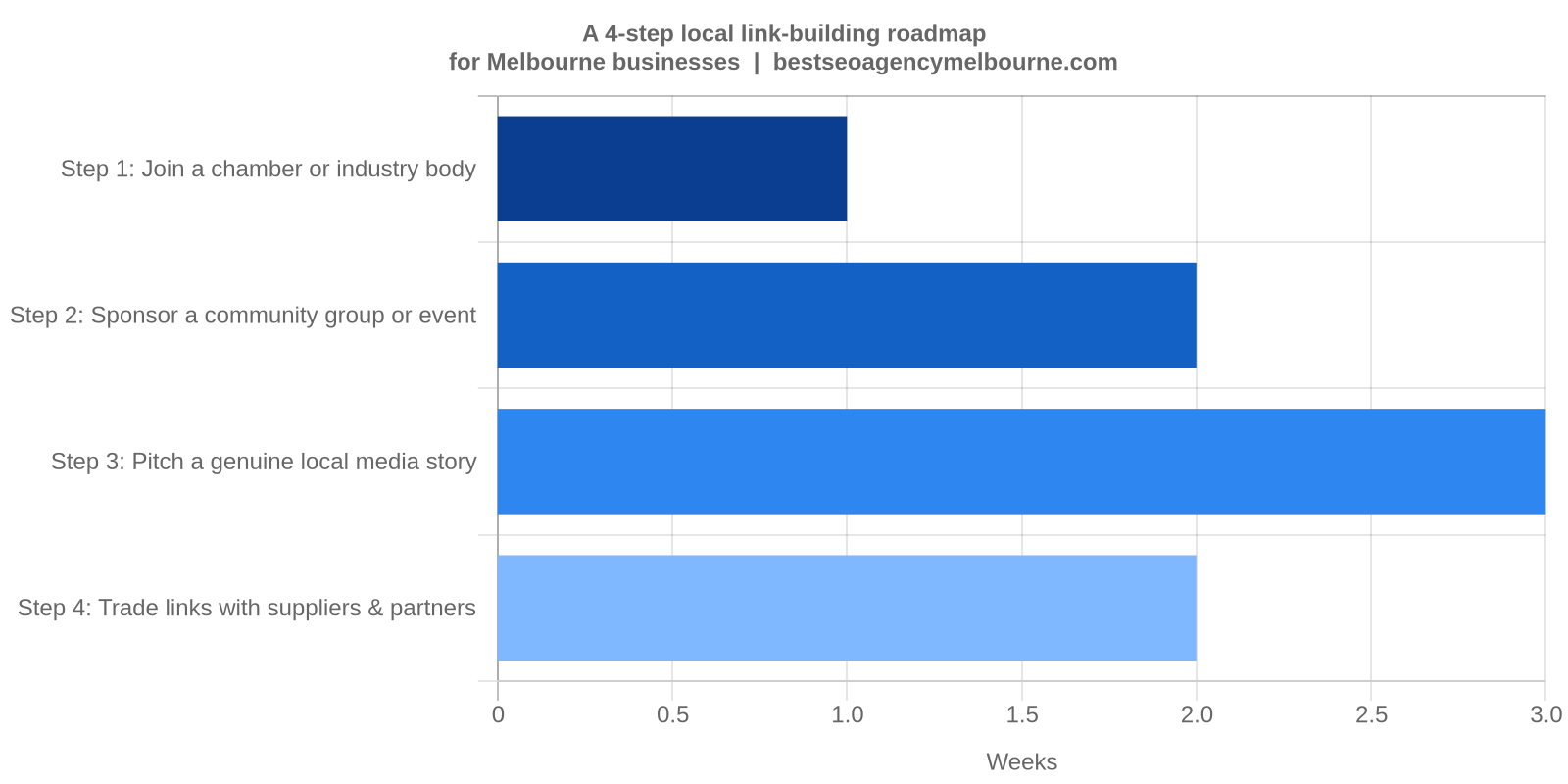
  • Local Link Building: Partnering With Melbourne Organisations

    Most Melbourne businesses trying to build backlinks start with a spreadsheet of guest post outreach emails and end up with ten links from sites they have never heard of and would never actually recommend to a customer. There is a quieter, sturdier way to build authority that Google trusts and competitors cannot easily copy: link back to your website from the real Melbourne organisations you already deal with. A chamber of commerce, a local charity you sponsor, the supplier who stocks your products, the industry body you pay membership fees to every year. This article covers exactly how to turn those existing relationships into backlinks that hold their value for years, what it costs, and how it differs from the guest posting and generic outreach we have covered elsewhere on this blog.

    Why generic backlinks are losing their power

    For years, the fastest way to rank was to accumulate as many backlinks as possible, regardless of where they came from. That approach is increasingly a liability rather than an asset, as we explained in our guide to white hat versus black hat link building. Google’s systems are far better at spotting a link from an irrelevant overseas directory than they were five years ago, and a pile of low-quality links can now do more harm than good.

    Local, relevant links behave completely differently. A link from the Victorian Chamber of Commerce and Industry, a local business association, or a community group you actually sponsor tells Google something a random directory link cannot: that a real, geographically relevant organisation vouches for your business. That is a much harder signal to fake, and a much easier one for a small Melbourne business to earn honestly. A cafe in Brunswick sponsoring the local primary school fete will never show up on a spammy link list, but it is exactly the kind of link Google’s systems are designed to trust.

    What a genuine local partnership backlink actually looks like

    A partnership backlink is not a favour, and it should never feel like begging. It is a link that exists because of a real, ongoing relationship: your business appears in a chamber of commerce member directory because you pay membership dues, your logo and link sit on a local football club’s sponsors page because you sponsor the club, or an industry association lists you as a certified member because you hold that certification. None of these require asking a stranger for a favour. They require formalising relationships that, in many cases, Melbourne businesses already have but have simply never asked to be linked from.

    Take a plumber in Dandenong who has bought parts from the same wholesaler for eight years. That wholesaler almost certainly has a “find a tradie” or “our stockists” page. A five-minute email is often the only thing standing between that relationship and a genuine, permanent backlink. We built on this same idea in our piece on what actually counts as a quality backlink for a Melbourne business, and local partnerships are consistently the highest-quality, lowest-effort category once the relationships already exist.

    Horizontal bar chart showing a four-step local link building roadmap for Melbourne businesses, from joining a chamber of commerce through to trading links with suppliers and partners.

    Not sure which of your existing relationships could already be earning you a backlink? Our free 30-minute audit reviews this as standard, even if you never become a client. Claim your free audit.

    Four places to find a genuine local backlink

    Melbourne’s business community is larger than most owners realise, which means there are more potential partners than most businesses ever approach. Victoria added 19,581 net new businesses in 2025 to 2026 alone, according to the latest Australian Bureau of Statistics count of Australian businesses, so the pool of potential local partners keeps growing every year. Most of that growth is happening in industries with active associations and chambers, which means new membership directories and sponsorship opportunities are appearing constantly, not shrinking.

    Source What you typically need Typical annual cost What you get in return
    Chamber of commerce or industry association Membership (e.g. Victorian Chamber of Commerce and Industry) Roughly $200 to $600 A permanent listing and link in the member directory
    Community sponsorship Sponsoring a local sports club, school event or charity fun run $300 to $2,000 A link from the sponsors page, plus genuine local goodwill
    Supplier and partner pages An existing trade relationship with a supplier or manufacturer Usually free, just needs a request A “stockists” or “authorised partner” link
    Local media and community news A genuinely newsworthy local angle, not a press release about yourself Free, but time-intensive An editorial link from a trusted local publication

    None of these four sources require the kind of paid link schemes that risk a Google penalty. They require a business owner or their marketing team to spend an afternoon making a list of every organisation the business already touches, then sending a short, specific email to each one asking whether a link is available. It is unglamorous work, and it is exactly why so few competitors bother doing it properly.

    If your business already sponsors a local club or belongs to an industry body, talk to us about auditing which of those relationships are already good for a link and which ones are being left on the table. Book your free audit to find out.

    What the ranking data actually shows

    Link signals are not the single biggest factor in how Google ranks a business locally, but they are a significant one. Whitespark’s 2026 Local Search Ranking Factors report puts Google Business Profile signals at the top of the local pack at 32 per cent, with link signals close behind on-page and review signals at 15 per cent of the total. That means a business with a strong Google Business Profile and a handful of genuine local links is covering close to half of what actually moves the needle in Melbourne’s local results, without spending a cent on paid advertising.

    Pie chart showing what drives Google Local Pack rankings in 2026, with Google Business Profile signals at 32 percent, on-page signals at 19 percent, reviews at 16 percent and link signals at 15 percent.

    The same report found that, within link signals specifically, how relevant a link is to your local area now counts for more than the raw authority of the site linking to you. A modest link from a Melbourne organisation your customers actually recognise routinely outperforms an impressive-looking link from an unrelated site on the other side of the world. This is good news for small and medium Melbourne businesses, because it means the local relationships you already have are worth more, in ranking terms, than an expensive link from a site with no connection to your area or industry.

    What this costs, how long it takes, and what goes wrong

    A local partnership link-building campaign is genuinely one of the cheaper SEO activities available to a Melbourne business, because most of the “cost” is time rather than money. Joining a chamber of commerce or industry body is usually a same-week process once you have decided to do it. Sponsorship links and supplier pages typically take two to three weeks of back-and-forth emails to get live. Pitching a genuine local media story is the slowest option and can take a month or more, because it depends on timing and a journalist’s interest rather than a fixed process.

    What goes wrong is almost always one of two things. Either a business joins five directories and chambers purely for the links, gets flagged as low-effort, and the links carry little weight because there is no real relationship behind them, or a business does have great local relationships but never actually asks to be linked, assuming it will happen automatically. It rarely does. Someone has to send the email, fill in the sponsorship form correctly, and follow up when the link does not appear after a month, because web teams at chambers and clubs are frequently volunteers with a long list of other jobs.

    Frequently asked questions

    How many local links does a small Melbourne business actually need?
    There is no fixed number, but a modest set of ten to twenty genuinely relevant local links, from real organisations, will outperform a hundred generic directory links. Quality and relevance matter more than volume.

    Does this replace other types of link building?
    No. It is a strong foundation to build on alongside content-driven and editorial link building. Our FAQ section covers how the different approaches fit together for a typical Melbourne business.

    The bottom line

    The backlinks that hold their value are the ones attached to a real relationship: a membership, a sponsorship, a genuine trade partnership. Most Melbourne businesses already have three or four of these relationships sitting unused. Book a free 30-minute audit and we will show you exactly which ones are worth formalising first, with no lock-in contracts and a response within 24 hours. Claim your free audit, or read more link-building guides on our SEO blog.

  • Guest Posting for SEO: Does It Still Work in 2026?

    Only 16 per cent of SEO professionals now rate guest posting as their most effective link building tactic, down sharply from a few years ago, according to Editorial Link’s 2026 survey of 518 SEO professionals. Digital PR has taken the top spot instead, favoured by 48.6 per cent of respondents. If you are a Melbourne business owner who has been told guest posting is still the backbone of link building, the real 2026 picture is more complicated than that, and this guide explains what still works, what to avoid, and what it actually costs.

    What guest posting still does well

    Guest posting has not disappeared. It remains the single most widely used link building tactic, with roughly two-thirds of marketers still doing it in some form, according to Backlinko’s 2026 guide to guest blogging. Done properly, a single guest post placed on a genuinely relevant site still passes real trust to your business: a mention in an industry publication, a link from a site your customers already read, and a small amount of direct referral traffic on top of any SEO benefit.

    The catch is quality. A guest post on a low-authority site stuffed with unrelated guest content does very little, and in large volumes it can look exactly like the link schemes Google’s spam policies are built to catch. The difference between a guest post that helps your Melbourne business and one that risks a penalty usually comes down to one question: would this article exist, and would this specific site publish it, if there were no link attached at all?

    Not sure whether your current backlink profile is helping or quietly holding you back? Our free 30-minute audit will tell you, even if you never become a client. Book a free audit →

    Why effectiveness has dropped, and what replaced it

    Two things changed. First, AI-written guest posts flooded the market, and publishers got better at spotting them, which pushed genuinely useful placements onto a smaller number of stricter, higher-authority sites. Second, digital PR, earning coverage through original data, surveys and newsworthy angles, started producing links at a scale guest posting cannot match, because journalists write the story for you rather than you pitching an article a site has to approve.

    Tactic Rated most effective by Best suited to
    Digital PR 48.6% of SEOs surveyed Businesses with original data, a newsworthy angle, or a strong story to pitch
    Guest posting 16% of SEOs surveyed Niche, relationship-led placements on genuinely relevant sites
    Low-quality bulk guest posts Not rated as effective by credible sources Nobody. Treated as a spam risk under Google’s link schemes policy
    Digital PR versus guest posting effectiveness, 2026 Bar chart comparing the share of SEO professionals who rate digital PR as the most effective link building tactic, 48.6 per cent, against guest posting, 16 per cent, based on Editorial Link’s 2026 survey of 518 SEO professionals. 48.6% Digital PR rated most effective 16% Guest posting rated most effective digital-pr-vs-guest-posting-2026
    Infographic: digital PR now outranks guest posting as the link building tactic SEO professionals rate most effective, Editorial Link 2026 data.

    This lines up with what we see across our own work building quality backlinks for Melbourne businesses: a handful of genuinely relevant placements now outperforms a large volume of average ones, and the line between a legitimate guest post and a link scheme is exactly the one we cover in our guide to white hat versus black hat link building.

    A practical process for guest posting in 2026

    If you are going to guest post, do it selectively. Start with a short list of sites your actual customers read, not sites that simply accept guest content. Pitch a genuinely useful angle rather than a rewritten version of something already published, and expect most pitches to be declined: that is a sign the site has real editorial standards, which is exactly what makes the eventual placement worth something.

    Treat the article itself as a piece of content marketing, not a vehicle for a link. If it would not stand on its own without the backlink, it is not going to move rankings, and it may not get published in the first place. Our content and link building team builds every guest placement around this test before it goes anywhere near a pitch email.

    If your last “20 guest posts for $99” package left you with more spam links than traffic, our Melbourne team can review your backlink profile and tell you honestly what is helping and what needs disavowing. Talk to our team →

    What quality guest posting costs, and what to avoid

    A single well-placed guest post on a genuinely relevant, moderately authoritative site typically costs somewhere between $300 and $1,500 in outreach time or vendor fees, more on higher-authority sites. Anything advertised as “50 guest posts for $200” is almost certainly the bulk, low-quality kind that Google’s spam policies exist to catch, and it can do more damage than doing nothing at all.

    The biggest mistake Melbourne businesses make is judging guest posting purely by volume: more posts, more links, more traffic. The data does not support that anymore. A smaller number of placements on sites that would never publish thin content, each with a genuine reason to exist beyond the link, will outperform a large batch of average ones and will not put your site at risk when the next spam update lands.

    Watch for three warning signs before you agree to any guest posting package. First, a vendor who cannot tell you which specific sites they place content on before you pay. Second, pricing based purely on the number of links rather than the quality of the site. Third, a promise of guaranteed rankings within a fixed number of weeks, since no legitimate link building tactic, guest posting included, can honestly promise a ranking outcome on a timeline. Any of these three should end the conversation, regardless of how competitive the price looks.

    Does guest posting still matter for AI search results?

    One reason guest posting has not disappeared entirely is that it still feeds a newer goal: getting mentioned as a source when someone asks ChatGPT, Gemini or Google’s AI Overviews a question relevant to your business. Backlinko’s 2026 research notes that link building remains important for traditional rankings, but for AI-generated answers the bigger opportunity is becoming a source that gets cited repeatedly across multiple sites, not just linked to once.

    A guest post on a genuinely relevant industry site still contributes to that pattern, because AI systems tend to trust brands that show up consistently across independent, reputable sources rather than brands that only talk about themselves. The catch is the same one that applies to traditional rankings: a guest post that exists purely to embed a link, with no real insight in it, does nothing for either goal. Thin, AI-generated guest content is now easier for both search engines and AI systems to detect and discount.

    For a Melbourne business, this means the calculation behind a guest post pitch has shifted slightly. It is no longer just whether the link will help rankings. It is closer to whether a journalist, an AI system summarising the topic, or a genuine reader would find the article useful enough to reference again. Content that passes that test tends to earn organic mentions well beyond the original placement, which is a return no amount of link volume alone can buy.

    Common questions

    Is guest posting dead in 2026? No, but it is no longer the default tactic. It works best as one part of a broader link building approach that includes digital PR and genuine relationship building, not as the whole strategy on its own.

    How can I tell if a guest post opportunity is safe? Ask whether the site would publish your article if there were no link attached, and check whether it publishes guest content from dozens of unrelated industries. If either answer is concerning, walk away. See our FAQ section for more on vetting link opportunities.

    What should I do instead of buying bulk guest posts? Invest in a smaller number of genuinely relevant placements, and put some of that budget into digital PR, original data, surveys, or a newsworthy angle that journalists want to cover without being asked.

    Guest posting still has a place in a Melbourne business’s SEO strategy, just a smaller and more selective one than it had five years ago. Book a free backlink audit and we will show you exactly which of your existing links are helping, which are dead weight, and where your budget is best spent next. No lock-in contracts, and we reply within 24 hours. Get started → For more guides like this one, visit our SEO blog.