Author: admin

  • 5 SEO Myths That Are Wasting Your Melbourne Marketing Budget in 2026

    Talk to enough Melbourne business owners about their websites and you will hear the same handful of “facts” repeated with total confidence: stuff the page with keywords, buy a batch of backlinks, set it up once and walk away. Most of it is wrong, and some of it can get a site penalised. SEO myths like these do not just waste time, they waste the marketing budget a small business can least afford to burn on tactics that stopped working years ago, or never worked at all. Here are five of the SEO myths we hear most often from Melbourne business owners, what the evidence actually shows, and what to do instead.

    Myth 1: SEO is a one-time job you can tick off and forget

    This is the costliest myth on the list because it sounds like common sense: redesign the site, add some headings, done. Except Google’s ranking systems do not stand still. In 2025 alone, Google rolled out three broad core updates, in March, June and December, each capable of reshuffling rankings overnight for sites that had not kept pace, according to Google’s own Search Central documentation on core updates.

    A cafe in Brunswick that ranked well in 2023 on a few blog posts and a decent Google Business Profile can quietly slide to page two by 2026, not because anything was done wrong, but because competitors kept working and the site did not. Technical fixes go stale, content ages as prices and hours change, and links decay as other sites close down or get redesigned.

    Treat SEO the way you would treat bookkeeping or stock control: an ongoing function of the business, not a project with an end date. That does not mean a full rebuild every quarter. It means checking rankings and technical health on a regular cadence and adjusting as you go.

    Not sure where your own site stands right now? Our free 30-minute audit will tell you exactly what’s working and what isn’t, even if you never become a client. Book a free consultation.

    Myth 2: More keywords crammed onto the page will get you found faster

    This one comes from the early 2000s and refuses to die: if “plumber Melbourne”, “Melbourne plumber” and “emergency plumber Melbourne” all appear a dozen times on one page, Google will supposedly reward the effort. In reality, Google’s own Search Essentials guidelines list keyword stuffing as a spam practice that can get a page ranked lower or removed from search results altogether.

    What actually works is writing the page for the person who lands on it. A tradie site in Footscray does not need “emergency plumber” repeated forty times; it needs one clear heading naming the service and suburb, a short job explanation, a realistic price range, and a way to book. Google’s systems understand meaning, not repeated words, so unnatural repetition reads as a warning sign, not a ranking boost.

    If a sentence would sound strange read aloud to a customer, it has too many keywords crammed in. Write for the actual customer first, and let clear headings and one topic per section do the rest of the work keyword stuffing used to try to fake.

    SEO myth versus reality comparison for Melbourne businesses A four-row comparison table showing common SEO myths on the left in red and the Google-confirmed reality on the right in teal, covering set-and-forget SEO, keyword stuffing, the meta keywords tag, and backlink quantity versus quality. SEO MYTH vs REALITY ✕ MYTH ✓ REALITY

    “Set it and forget it” Needs ongoing work as Google updates

    More keywords = higher rank Natural writing for real customers wins

    Meta keywords tag helps rankings Google has ignored it since 2009

    Any backlink is a good backlink Bought or spammy links risk penalties

    Google Business Profile is optional Reviews and listings drive local rankings

    Source: Google Search Central (core updates, spam policies, 2009 keywords-tag statement) bestseoagencymelbourne.com.au

    Infographic: a side-by-side comparison of five common SEO myths and the Google-confirmed reality behind each one, for Melbourne businesses weighing up SEO myths against what actually moves rankings.

    Myth 3: The meta keywords tag still helps your Google ranking

    Some website templates and older SEO checklists still have a field for “meta keywords”. Filling it in feels productive. It has done nothing for Google rankings since at least 2009, when Google’s own webmaster blog confirmed in plain terms that the keywords meta tag is not used in web ranking at all. That confirmation has never been reversed.

    The meta description tag is a different matter and still matters, not for rankings directly but for click-through: it is the two or three lines a person reads in the search results before deciding whether to click. A specific, honest meta description mentioning the suburb or service tends to earn more clicks than a vague one, even at the same ranking position.

    Here is a quick reference for what actually influences whether a Melbourne business shows up and gets clicked:

    SEO element Still affects rankings? What to do instead
    Meta keywords tag No, confirmed by Google since 2009 Leave it blank, do not waste time on it
    Meta description Indirectly, affects clicks not ranking Write a specific 150-160 character summary
    Keyword stuffing No, can trigger a ranking penalty Write naturally, use variations once or twice
    Quantity of backlinks No, quality matters far more Earn a handful of relevant, editorial links
    Google Business Profile Yes, for the local map results shown above the standard listings Complete every field, add photos, reply to reviews

    Myth 4: Any backlink is a good backlink

    For years, quantity felt like the whole game: get listed on every directory, swap links with unrelated sites, buy a “link package” from an overseas reseller. Google’s spam policies (the same guidelines that cover keyword stuffing) are explicit that buying or selling links to manipulate rankings is a violation, and automated enforcement now targets large-scale, low-quality link networks. A site caught by a manual action, a human review at Google that applies a penalty rather than an automatic ranking drop, can see traffic collapse within days.

    We wrote a full breakdown of what a genuine link looks like in What Is a Backlink and Why Does It Still Matter in 2026?, but the short version is this: one link from a Melbourne industry association, a local newspaper, or a supplier that genuinely mentions your business is worth more than a hundred links bought from a directory nobody visits. It is slower, and it is also the only version of link building that survives the next spam update instead of getting wiped out by it.

    This is the kind of work that shows up in the results of a properly run campaign: gradual authority built through real relationships, not a one-off purchase that ages badly, and it pairs closely with the biggest SEO mistakes Melbourne small businesses make.

    Wondering whether your existing backlinks are helping or quietly hurting you? A free audit will show you exactly what’s pointing at your site and whether any of it needs cleaning up. Book your free consultation.

    Myth 5: Your Google Business Profile doesn’t really affect SEO

    Plenty of Melbourne business owners treat their Google Business Profile, the free listing that shows the map, opening hours and reviews, as an afterthought. That is a costly assumption, because for anyone searching “near me” or by suburb, that listing often matters more than the website itself.

    Reviews are a big part of why. In BrightLocal’s 2025 Local Consumer Review Survey, 71% of consumers said they read online reviews regularly when researching a local business, and 29% said they always do. A profile with three-year-old photos and unanswered reviews sends the opposite signal to both customers and Google’s local ranking systems.

    Chart of how often consumers read reviews before choosing a local business Bar chart showing 71% of consumers read online reviews regularly and 29% always read reviews before choosing a local business, based on BrightLocal’s 2025 Local Consumer Review Survey. How often do customers check reviews first?

    Read reviews regularly 71%

    Always read reviews 29%

    A stale or ignored Google Business Profile is invisible to most of this group.

    Source: BrightLocal, Local Consumer Review Survey 2025 bestseoagencymelbourne.com.au

    Infographic: a bar chart showing that 71% of consumers read online reviews regularly and 29% always read reviews before choosing a local business, underlining why Google Business Profile activity is central to Melbourne local SEO.

    The fix costs nothing but time: claim the profile, fill out every field including services and attributes, add current photos monthly, and reply to every review within a few days. For a business in the CBD or on a busy strip like Chapel Street, this habit often moves the needle faster than anything on the website itself. Our guide to SEO for Melbourne CBD businesses covers costs and timelines, and this sits under Local SEO Melbourne.

    What fixing these myths costs, and what goes wrong if you don’t

    None of the fixes above need an agency contract. A business owner can rewrite a stuffed page, delete a meta keywords field, and update a Google Business Profile in an afternoon at no cost beyond time. What goes wrong is doing it once and stopping, or paying for a “quick fix” package with bought backlinks or mass directory submissions, which can trigger a manual action that takes months to recover from.

    Professional help earns its cost on the ongoing side: tracking how each core update affects a site, auditing backlinks for anything toxic, and building the slower, genuine authority that survives the next update. Most Melbourne businesses we work with see ranking movement within 60 to 90 days once the myths are cleared away, in line with the process we run every engagement through.

    Frequently asked questions

    Do I need to remove the meta keywords tag?
    No urgency either way, since Google ignores it completely, though there is no reason to keep filling it in.

    How do I know if bought backlinks are hurting my site?
    A sudden ranking drop after a link-buying campaign, or a manual action notice in Google Search Console, are the clearest warning signs.

    Where can I check more questions like this?
    We keep a running list on our FAQ page, covering cost, timelines and contracts.

    The myths cost more than the fixes

    Every myth here shares the same root cause: shortcuts that once worked, or never did, keep getting repeated because they sound plausible. The businesses winning on Google in 2026 are not chasing the newest trick, they are doing the unglamorous, ongoing work of writing for real customers, earning genuine links, and keeping their Google Business Profile current. Book your free consultation. No lock-in contracts, a reply within 24 hours, and a Melbourne-based team who will tell you honestly which myth is costing you the most. Get started, or read more Melbourne SEO guides on our blog.
  • The Biggest SEO Mistakes Melbourne Small Businesses Make (And How to Fix Them in 2026)

    Most Melbourne small businesses that “do SEO” are not failing because of some deep technical mystery. They are losing customers to five ordinary, fixable mistakes, repeated across thousands of local websites. A cafe in Brunswick and a plumber in Dandenong usually trip over the same five things: a site Google cannot read properly on a phone, page content copied between locations, keywords chosen for ego instead of intent, a Google Business Profile nobody has touched since 2023, and technical debt nobody budgeted time to fix. This article walks through each mistake, what it actually costs you, and what to do about it.

    Why these mistakes cost more in 2026 than they used to

    Search behaviour has shifted enough in the last two years that mistakes which used to be a minor drag are now a direct hit to enquiries. Google has used the mobile version of a website as the primary basis for indexing and ranking since completing its rollout of mobile-first indexing, and mobile devices now account for roughly 65% of all Google searches. Around 46% of all Google searches carry local intent, meaning the person typing already wants a business near them, not a national brand. And according to the Australian Bureau of Statistics, only 32% of Australian businesses received orders online in the 2024-25 financial year, barely up from 30% three years earlier. Translation: most of your competitors still have not fixed their online presence, which means the businesses that do fix these five mistakes have an unusually open field.

    📊 Infographic: Why these mistakes matter in 2026 (65% mobile searches, 46% local intent, 32% online orders)

    (Branded data graphic — pending upload to media library)

    Mistake 1: Treating mobile like an afterthought

    Plenty of Melbourne business sites were originally built for desktop, with mobile bolted on later. The signs are easy to spot once you know to look: buttons too small to tap accurately, text that requires pinch-zooming, forms that break on iPhone Safari, or a phone number that is not a clickable link. None of this is cosmetic. If Google’s mobile crawler cannot read your content properly, your desktop site being beautiful will not save you, because the mobile version is what gets indexed. Test your own site on a phone right now, on real mobile data rather than office wifi, and time how long the homepage takes to load. If it is over three seconds, you are losing visitors before they see anything.

    Not sure where your site stands? Our free 30-minute audit will tell you, even if you never become a client. Book a free consultation.

    Mistake 2: Copying or thin content across service pages

    This is the mistake we see most often in multi-suburb or multi-service businesses. A business offering, say, plumbing across five Melbourne suburbs creates five nearly identical pages, each with the suburb name swapped in and nothing else changed. Google reads this as duplicate content and often will not bother ranking any of the copies well. The fix is not complicated, it just takes actual writing: each page needs specific detail relevant to that suburb or service, real examples, and content that would not still be true if you copied it onto a competitor’s site. “We service Brunswick” is filler. “We’ve cleared blocked drains on the terrace-house plumbing common around Sydney Road, where old cast iron pipes cause more callouts than anywhere else in the inner north” is not.

    The same problem shows up in product and service descriptions lifted straight from a supplier catalogue or a template agency handed every client. If a sentence on your site would still be true word for word on a competitor’s page, it is not finished. We ask clients to name an actual price range, an actual suburb, an actual timeframe, something a generic writer three states away could not have guessed. It takes longer to write. It also happens to be exactly what both Google and a genuine local customer are looking for.

    Mistake 3: Chasing broad, expensive keywords

    Business owners often want to rank for the biggest, broadest term in their industry, assuming more search volume automatically means more customers. It rarely works out that way. Broad terms are harder to rank for, and the person searching them is often still comparing options rather than ready to buy. Locally modified, specific phrases convert better and are realistic to win.

    Broad keyword Local intent alternative Why it converts better
    SEO agency SEO agency Fitzroy Signals a real local buyer, not a researcher
    Plumbing services Emergency plumber Parramatta Road Urgent intent, ready to call today
    Dentist Melbourne Dentist near South Yarra station Location-specific, easier to rank, higher show-up rate
    Accountant Small business tax accountant Richmond Matches a specific, high-value service need

    📊 Infographic: The 5 SEO mistakes costing Melbourne small businesses customers

    (Branded checklist graphic — pending upload to media library)

    If your Google Business Profile looks like the “before” example above, talk to our Melbourne team — fixing it is usually a two-week job.

    Mistake 4: A neglected Google Business Profile

    Around 76% of people who perform a local search visit a business within 24 hours, and roughly 28% of local searches lead to a purchase in that same window. A Google Business Profile with outdated hours, no recent photos, and three unanswered one-star reviews from 2024 is actively costing you those visits. This is usually the fastest mistake to fix on this list: update your hours, add current photos of your actual premises and work, and reply to every review, good or bad, within a few days. Businesses that respond to reviews and post updates regularly are rewarded with better Map Pack visibility, because Google reads recent activity as a signal the business is genuinely operating and engaged.

    Mistake 5: Ignoring technical site health

    Slow-loading pages, broken internal links, missing image descriptions, and pages with no structured data are quiet problems. Nothing visibly “breaks”, so they get ignored for years. But they cap how well even great content can rank, because Google is weighing your site against competitors whose technical foundations are cleaner. A basic quarterly check, broken link audit, page speed test, and a scan for duplicate title tags, catches most of this before it compounds into a bigger rebuild.

    We regularly find sites carrying dozens of broken internal links from old page restructures nobody cleaned up, or images with file names like “IMG_4021.jpg” instead of a description Google or a screen reader can use. Individually, small. Together, they tell Google your site is not well maintained, and that impression is hard to shake once it forms.

    What fixing these mistakes costs and how long it takes

    The honest answer is: it depends on how deep the mistakes go, but most Melbourne businesses see the first movement in rankings within 60 to 90 days of fixing the basics, with meaningful traffic and enquiry growth by months four to six. Mobile fixes and Google Business Profile cleanup are usually cheap and fast, often a week or two of focused work. Rewriting thin or duplicate content across a site takes longer, generally four to eight weeks depending on how many pages need attention. Technical fixes vary the most, a small site might need two days, a large e-commerce catalogue might need a genuine structured audit and phased rollout. What we do not recommend is guessing. A proper audit tells you which of these five mistakes is actually costing you the most before you spend a dollar fixing the wrong one.

    Frequently asked questions

    How do I know which of these mistakes is hurting my business the most?
    Run a free audit rather than guessing. Our process starts with exactly this, a full technical, content and local-search review, so you know your biggest opportunity before spending anything.

    Can I fix these myself, or do I need an agency?
    Mobile checks and Google Business Profile updates are genuinely DIY-friendly. Thin content rewrites and technical fixes usually need more time than a busy owner has, which is where a dedicated local SEO team earns its fee.

    What results have Melbourne businesses actually seen from fixing these?
    Our results page covers real examples, including a Melbourne CBD law firm that grew organic traffic 412% after exactly this kind of clean-up. See our FAQ for cost and contract questions.

    Before you hire anyone to fix these mistakes, it is worth knowing what a genuinely trustworthy agency looks like versus one making the same mistakes on your behalf. Our guide on red flags to watch for when hiring an SEO agency in Melbourne and our piece on how to choose an SEO agency without signing a 12-month mistake are both worth ten minutes before you sign anything.

    None of these five mistakes are exotic, and none require a marketing degree to understand. They are the same avoidable errors, repeated across most Melbourne small business websites, and fixing even two or three of them tends to move the needle faster than most owners expect. Book your free consultation. No lock-in contracts, reply within 24 hours, Melbourne-based team. Get started. For more guides like this one, visit our blog.

  • SEO for Melbourne CBD Businesses: What It Costs and How Long It Actually Takes in 2026

    A cafe on Bourke Street and a law firm in Southbank are both fighting for the same handful of Google results, and most of their competitors are making the same three mistakes. Melbourne’s CBD is one of the most contested local search markets in Australia: retail vacancy rates across the municipality fell through 2025 and into 2026, with foot traffic on Bourke Street Mall up nearly 40% year on year, which means more competitors are opening, not fewer. This guide covers what SEO for a CBD business actually costs, how long it takes to see movement, and the mistakes that waste a CBD budget faster than anywhere else in Melbourne.

    Why CBD SEO is a different game to suburban SEO

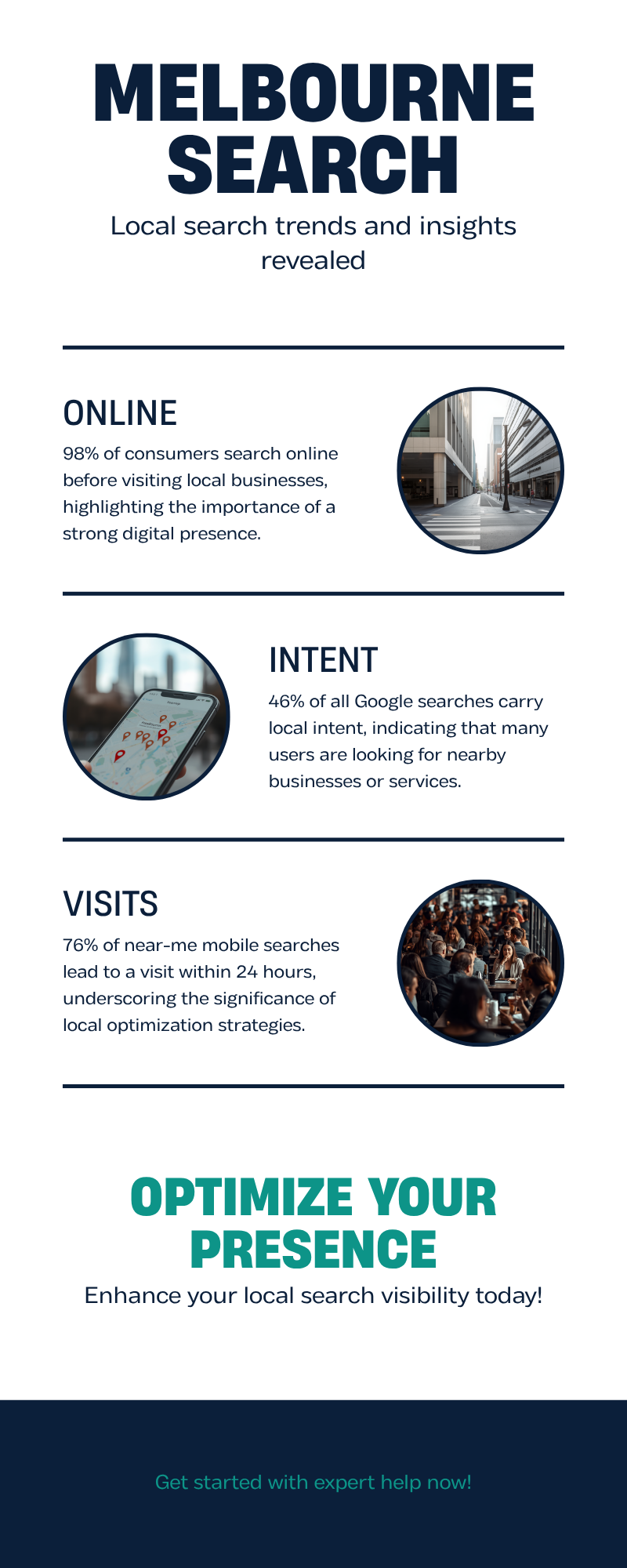
    A trades business in Brunswick competes for one suburb. A CBD business competes inside a two-kilometre radius packed with office towers, laneway retail and thousands of daily searches, many from people who are physically metres away. 98% of consumers now search online before visiting a local business, and 46% of all Google searches carry local intent. In the CBD that intent is sharper again: someone searching “accountant near me” from a Collins Street office is often ready to book within the hour, not browsing for next month.

    That density cuts both ways. It means more searches, but it also means more agencies, franchises and national chains bidding for the same terms. A generic “SEO agency” approach that works well in a quieter suburb often stalls in the CBD, because it doesn’t account for how many other businesses share the same building, the same postcode, and sometimes the same street number. A hair salon in Southbank isn’t just competing with other Southbank salons; it’s competing with every salon within a fifteen-minute walk that also has a Google Business Profile, plus every national chain with a CBD branch and a much bigger marketing team behind it.

    Not sure where your site stands right now? Our free 30-minute audit will tell you, even if you never become a client. Book a free consultation.

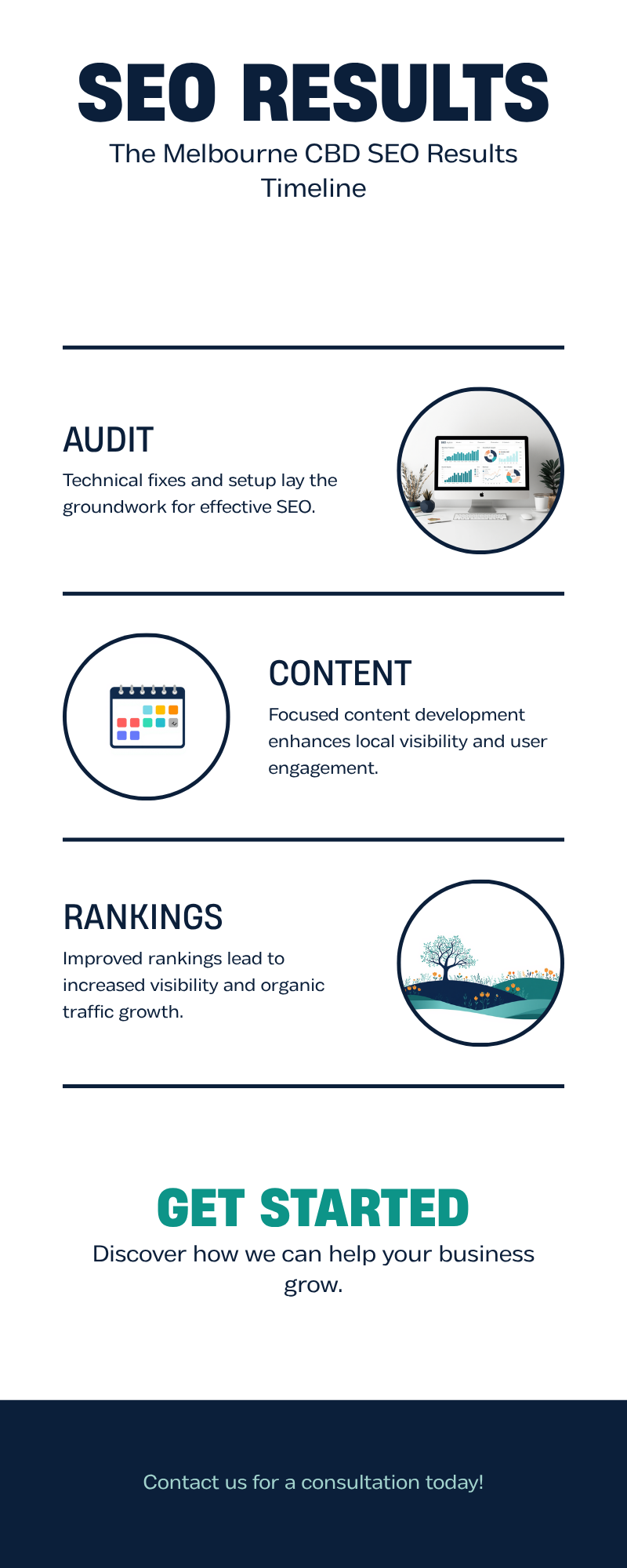
    Three-stage infographic showing the SEO process for Melbourne CBD businesses: audit and foundations, content and structure, and rankings climbing over time

    What actually moves the needle for a CBD listing

    Three things matter more in the CBD than anywhere else in Melbourne: precise Google Business Profile categorisation, review velocity, and page speed on mobile. Office workers search on their phones between meetings, so a slow site loses them before it finishes loading. Google’s own guidance on Business Profiles confirms that category accuracy and completeness are foundational to appearing in the Map Pack, which is where most CBD clicks happen before anyone scrolls down to the organic listings below it.

    Review velocity matters more in the CBD too, because competitor review counts climb faster in a dense market. A CBD dental practice with 40 reviews sitting next to one with 400 is not competing on equal terms, no matter how good the smaller practice’s dentistry actually is. Building a steady, honest flow of new reviews, rather than a one-off push before a launch, is one of the few genuinely compounding assets a CBD business can build, because review count and recency both feed directly into Map Pack ranking and rarely go backwards once earned.

    Local search behaviour (2026) What it means for a CBD business
    76% of near-me mobile searches lead to a visit within 24 hours Your Google Business Profile hours and address need to be exact, every single day
    28% of near-me searches lead to a purchase A slow or outdated website loses real, ready-to-buy customers at the last step
    46% of all Google searches carry local intent Suburb and landmark-specific content consistently outperforms generic service pages

    Source: Local Search Statistics 2026, BizIQ

    What SEO costs for a CBD business in 2026

    Most Melbourne CBD businesses spend somewhere between $1,500 and $4,000 a month on professional SEO, depending on how competitive their specific keywords are. A single-location cafe competes with dozens of nearby cafes for relatively low-value searches and typically sits at the lower end of that range. A CBD law firm, accounting practice or medical clinic competing for high-value commercial keywords sits at the higher end, because those keywords are worth more per click and the competition has bigger marketing budgets behind them.

    A realistic CBD engagement usually includes a technical audit and fix list, ongoing Google Business Profile management, two to four pieces of locally specific content a month, and manual, editorial link building rather than bulk-purchased links. Be wary of any quote that ignores the distinction between a suburban trades business and a CBD professional services firm entirely, since a flat-rate package rarely matches CBD-level competition either way. Our own case studies, including a Melbourne CBD law firm that grew organic traffic 412% in eight months and took monthly enquiries from 12 to 89, are on our results page if you want to see what a properly scoped campaign actually delivers over a realistic timeframe rather than a promised one.

    The maths usually works in the business’s favour once rankings stabilise. A CBD professional services firm paying $3,000 a month for SEO only needs one or two new clients from organic search to cover the cost many times over, and unlike paid ads, that traffic doesn’t disappear the moment the budget is paused.

    If your Google Business Profile still looks like it did the week you opened, fixing it is usually a two-week job and the fastest lever available to a CBD business. Talk to our Melbourne team if that sounds like your listing.

    How long it takes, and what goes wrong

    Most CBD clients start seeing ranking movement within 60 to 90 days, with meaningful enquiry growth by months four to six. The businesses that see faster results almost always fixed their Google Business Profile category and opening hours in week one, before any content work even started. The ones that stall usually made one of three mistakes.

    First, they targeted broad terms like “Melbourne accountant” instead of specific, winnable phrases such as “small business accountant Collins Street”, which convert better and rank faster. Second, they let a web developer’s redesign quietly break their page speed without anyone noticing for months, undoing a year of technical SEO work in a single afternoon. Third, they signed a 12-month contract with an agency that never explained what was actually being done month to month, which our own guide to choosing an SEO agency in Melbourne covers in more detail, including the six questions worth asking before you sign anything.

    Infographic showing 2026 Melbourne local search statistics: 98% of consumers search online before visiting a business, 46% of Google searches carry local intent, 76% of near-me mobile searches lead to a visit within 24 hours

    Building content that actually works for a CBD audience

    Generic blog posts rarely rank in a market this competitive. What works is specificity: naming the actual laneway, the actual building, the actual train line people search near. “A law firm near Flinders Street Station” will consistently out-rank “a Melbourne law firm”, because it matches how people actually search when they’re standing in the CBD with a specific, immediate need. This is worked into our SEO content strategy for every CBD client, alongside the technical fixes covered in our process page.

    It also pays to watch what other Melbourne CBD businesses are getting wrong before you copy their approach. Our recent piece on red flags to watch for when hiring an SEO agency covers the same contract and reporting traps that trip up CBD businesses specifically, since they are often the ones sold the most expensive, most generic packages simply because their postcode looks lucrative.

    Quick FAQ

    Do I need a physical CBD address to rank in the CBD? Yes, for Map Pack results a verified Google Business Profile address inside or very near the CBD is required. Service-area businesses without a public storefront can still rank organically without one, just not in the Map Pack itself.

    Is SEO worth it if I already run Google Ads in the CBD? Usually yes, since CBD ad clicks are among the most expensive in Melbourne for competitive terms. Organic rankings reduce your dependence on rising ad costs over time, even if you keep some paid spend running alongside it. See our FAQ for more on how the two work together in practice.

    How much does a technical SEO audit cost as a starting point? Our own audits are free and take about 30 minutes to review with you, covering site speed, mobile usability, Google Business Profile completeness and the biggest quick wins available before you commit to anything ongoing.

    The CBD rewards precision over raw budget. A smaller business with an accurate Google Business Profile, a fast site and specific, local content will consistently outrank a bigger competitor running a generic strategy across a dozen suburbs. Book your free consultation. No lock-in contracts, reply within 24 hours, Melbourne-based team. Get started. For more guides like this one, visit the blog.

  • Red Flags to Watch for When Hiring an SEO Agency in Melbourne (9 Warning Signs)

    A cafe owner in Brunswick signs a $1,800-a-month SEO contract after a cold call promises “guaranteed page one rankings within 30 days”. Four months later, nothing has moved except the invoice. Nearly one in five businesses that hire an SEO agency report a negative experience before finding a provider that actually delivers, according to Clutch.co’s 2026 business guide to SEO services. That is not because SEO does not work. It is because the industry has no licensing requirement and plenty of vocabulary that sounds impressive and means nothing. The warning signs are consistent and easy to spot once you know what to look for. Here are the nine that matter most, grouped into five areas worth checking before you sign anything.

    Promises no honest agency would make

    1. Someone guarantees you will rank number one

    If an agency promises a specific ranking position, especially “guaranteed page one” or “guaranteed number one”, treat it as the clearest warning sign there is. Google’s own guidance for anyone hiring an SEO puts it plainly: no one can guarantee a number one ranking on Google, and businesses should “beware of SEOs that claim to guarantee rankings, allege a special relationship with Google, or advertise a priority submit”. A ranking, meaning where your website appears in a list of search results for a given term, depends on hundreds of factors that shift constantly. When an agency guarantees a position anyway, ask exactly which search term they mean. It is often your own business name, or a term nobody searches for, a hollow win dressed up as proof of work.

    2. They claim a “special relationship” with Google or a paid shortcut

    No agency can pay for better organic placement, submit your site for “priority indexing”, or use a personal contact at Google to move you up the results. Google never accepts payment to include or rank a site in organic search results. A pitch built around insider access is, at best, a misunderstanding of how search works, and at worst, a way to justify a higher fee for nothing.

    5 areas to check before you sign 1 Promises & guarantees 2 Reporting & access 3 Backlinks & link building 4 Contracts & ownership 5 Price & speed Best SEO Agency Melbourne
    Five areas to check before you sign an SEO contract

    Not sure where your site stands? Our free 30-minute audit will tell you honestly, even if you never become a client. Book a free audit.

    Reporting that hides more than it shows

    3. Reports you cannot actually understand

    A trustworthy Melbourne agency sends a report you could explain to your accountant in two minutes. A red-flag agency sends a document full of jargon and metrics that always trend upward, no matter what happened to your enquiries. Watch for reports that lean on vanity numbers, such as “keywords tracked” or an unexplained “visibility score”, while leaving out enquiries, phone calls, and completed sales. We cover exactly what to check for in our plain-English guide to reading an SEO report. In short: if you cannot tell whether last month’s work moved the needle, the report has failed, no matter how polished it looks.

    4. They won’t give you access to your own accounts

    Google’s guidance for hiring an SEO recommends granting a prospective agency read-only access to Search Console (the free tool that shows how your site performs in Google’s results), not full control, until trust is established. Once you are a paying client, though, you should hold admin-level access to your own Google Business Profile, website and analytics. If an agency resists showing you their working dashboard, or refuses to add you as an owner on accounts set up in your business’s name, you no longer own your own marketing. They do.

    Red flag vs. what a trustworthy agency does
    Red flag What it usually means What a trustworthy agency does instead
    Guarantees a #1 ranking Overpromising to close the sale Gives a realistic range and timeframe after an audit
    Vague, jargon-heavy reports Nothing meaningful happened this month Reports on enquiries, calls and rankings you can verify yourself
    Won’t share login access Holding your data hostage if you leave Sets accounts up in your business’s name from day one
    Backlinks from random, unrelated sites Buying links or using a private blog network Earns links through content, PR and genuine outreach
    12-month lock-in with exit penalties Protecting the agency, not your budget Runs month-to-month and earns renewal every time
    No named point of contact Work is outsourced or junior-run Gives you a direct line to the person doing the work

    Backlinks built the wrong way

    5. Backlinks appear from random, low-quality sites

    Backlinks, meaning links from other websites that point to yours, still influence how Google ranks a site, which is why some agencies cut corners to manufacture them quickly. The most common shortcut is a private blog network: a cluster of low-quality, often unrelated websites built purely to sell links. Google treats this as a link scheme and can penalise your site for taking part, even if you did not know it was happening. Google’s spam policies list buying or selling links that pass ranking credit as a violation, and recovering from a manual penalty for unnatural links typically takes months, sometimes over a year if it overlaps with an algorithmic penalty too.

    6. They dodge a straight answer about how they build links

    Ask any prospective agency exactly how they plan to earn links, and expect a specific answer: content worth referencing, digital PR, partnerships, guest contributions to genuine industry publications. A vague answer, or a mention of “link packages” priced by volume, is your cue to walk away. We covered what genuine link building looks like in our guide to earning backlinks without buying them. Our own Authority Link Building service sticks to outreach-based methods for this reason. A cheap, fast pile of backlinks is a liability with a delayed invoice.

    Inherited a contract full of question marks, or found some backlinks that make you nervous? We will run a free, no-obligation review of your current SEO agency’s work so you know exactly what you are paying for. Ask for a free review.

    Contracts that protect the agency, not you

    7. A 12-month lock-in with no exit path

    Long contracts are not automatically a problem. Real SEO work takes time to show results, and a firm that commits to three or six months is protecting its own ability to deliver. The red flag looks different: a 12-month term with no performance checkpoints, steep exit penalties, and no clarity about what happens to your assets if you leave.

    8. Nobody can tell you who owns what

    Ask directly who retains ownership of your domain, website files, Google Business Profile, and any content written for you. A trustworthy agency builds these in your name from day one, so leaving never means starting again from zero. We run every engagement month-to-month for this reason, and set out what a normal engagement looks like on our process page. For the fuller buyer’s checklist, see our guide to choosing an SEO agency in Melbourne.

    What this actually costs, and why cheap is its own red flag

    9. The price is suspiciously low, or the timeline is suspiciously fast

    Legitimate SEO work is not cheap, because it is not automated. According to Clutch.co’s 2026 business guide to SEO services, basic local SEO for a small business typically runs USD $300 to $500 a month, agency-level SEO for a competitive local or national market sits between USD $1,000 and $10,000 a month depending on scope, and the industry’s standard minimum contract term is six months. Melbourne pricing follows the same tiering in Australian dollars: a business paying a few hundred dollars a month for “full SEO” is either being upsold later, or getting a template-based service with almost no hands-on work behind it.

    The flip side of a low price is a promise of speed. Nobody, including agencies with a decade of results behind them, can compress the time Google needs to trust a new page or a fixed technical issue. Expect early movement in the first few months and clearer gains over the following two to three quarters, not overnight. Over 500 Melbourne businesses have worked with our team since 2012, a track record worth asking any agency to demonstrate, not just claim. See some of the outcomes on our results page.

    Typical monthly SEO cost tiers (USD, Clutch.co 2026) $300-$500 Basic / local $1,000-$3,000 Agency / competitive local $3,000-$10,000 National / highly competitive Best SEO Agency Melbourne · Source: Clutch.co, 2026
    US benchmark SEO pricing by tier, illustrating why very cheap “full SEO” offers are worth questioning

    Frequently asked questions

    Is a 12-month SEO contract normal?

    Longer terms are common because SEO work compounds over months, not weeks. What is not normal is a lock-in with no exit path and no transparency about who owns your assets if you leave. See our FAQ for more on contracts and reporting.

    How much should SEO cost for a small Melbourne business?

    Based on Clutch.co’s 2026 benchmarks, expect a genuine monthly investment rather than a few hundred dollars, with pricing scaling alongside competition and scope.

    Can I leave a bad SEO agency partway through?

    It depends on the contract you signed, which is why reading the exit terms before you sign matters more than the sales pitch that got you there.

    The nine warning signs above share one thing in common: each trades your long-term visibility for someone else’s short-term sale. A guarantee, a locked-in contract, or a suspiciously cheap price should slow you down, not speed you up. Ask blunt questions before you sign, then check the answers against what shows up in Search Console. For more guides like this one, visit our blog.

    Ready to work with a Melbourne team that shows its work? Book your free consultation. No lock-in contracts, a reply within 24 hours, and a local team who will explain exactly what they are doing and why.

  • Google Search Console Explained for Business Owners: A Plain-English Guide

    Google Search Console (GSC) is a free tool from Google that shows you how Google sees your website. Think of it as a direct line to Google itself: it tells you which searches bring people to your site, whether Google can find and display all your pages, and whether anything technical is quietly stopping your website from performing in search results. Unlike Google Analytics, which tracks what visitors do once they land on your site, Search Console tracks what happens before that click — what people typed into Google, whether your page showed up, and whether they clicked on it.

    If you’ve already read how to read an SEO report in plain English, you’ll know that most of the numbers in a typical SEO report — rankings, visibility, traffic trends — ultimately come from data that Search Console collects behind the scenes. Learning to read the tool yourself means you don’t have to take anyone’s word for how your website is performing; you can check the source data directly, for free, at any time.

    Setting up Search Console properly takes about fifteen minutes and gives you visibility you cannot get anywhere else, including inside Google Analytics. If you’d rather have someone set it up correctly the first time and walk you through what it means for your specific business, you can book a free consultation and we’ll go through it with you.

    📊 The five Google Search Console reports every Melbourne business owner should check regularly.

    An infographic titled “Google Search Console at a Glance” showing a website icon in the centre connected to five reports: Performance, Page Indexing, Core Web Vitals, Mobile Usability and Sitemaps.

    Infographic file: best-seo-agency-melbourne-google-search-console-guide.png (attach when uploading to media library)

    What Google Search Console Actually Covers

    In short, Search Console is split into a handful of reports, each answering a different question about your site: which searches you’re appearing for, whether your pages are indexed, how fast your site feels to visitors, and whether Google has found your full sitemap. The rest of this guide walks through each of those reports in plain English, starting with getting the tool set up correctly in the first place.

    Setting Up and Verifying Your Website

    To get started, go to Google’s Search Console website and sign in using a Google account — ideally one tied to your business rather than a personal account that might leave the company one day. You’ll be asked to add a “property,” which is simply Google’s word for the website you want to monitor.

    You have two options here: a “Domain” property, covering every version of your address (www, non-www, http, https, and all subdomains) in one place, or a “URL prefix” property, covering just one exact web address. For most small and medium businesses, the Domain property is the better choice, since it gives the complete picture without adding multiple properties separately.

    Next comes verification — proving to Google that you genuinely own the website. The most common methods are a DNS record, added through your domain registrar (the company you bought your domain name from); an HTML file uploaded to your website’s files; or, if you already have Google Analytics or Tag Manager installed, instant verification through either of those. Full instructions are in Google’s Search Console verification help centre. If you’re not confident editing DNS records, loop in your web developer, since a wrong edit can occasionally take your email or website offline.

    The Performance Report: Understanding Queries, Clicks and Impressions

    Once your property is verified, the Performance report is where you’ll spend most of your time, and it’s genuinely the most useful part of the whole tool for a business owner. It shows four core numbers for every search term, known as a “query,” that people used to find your site. Impressions are how many times your website appeared somewhere in Google’s results, even if nobody clicked. Clicks are how many of those impressions turned into an actual visit. Average CTR, or click-through rate, is the percentage of impressions that became clicks. Average position is roughly where your page tends to rank for that particular search term.

    This report answers a practical business question: what are people typing into Google before they find me? You can filter by query, page, country and device, and track it over time. A Melbourne plumber might discover thousands of impressions for “emergency plumber melbourne” but very few clicks — a sign the page’s title and description aren’t convincing enough, or a competitor is simply outranking them.

    This gap between impressions and clicks matters more than it used to. A February 2026 study by Ahrefs, which analysed 300,000 search queries using aggregated Google Search Console click data, found that when an AI Overview appears above the normal results, the top-ranking organic page now loses 58% of the clicks it would otherwise have received, up sharply from the 34.5% drop the same researchers measured less than a year earlier (Source: Ahrefs, 2026). In practice, impressions alone are becoming a less reliable guide to expected traffic, which makes tracking actual clicks and conversions more important than ever.

    Page Indexing (Coverage): Is Google Actually Showing Your Pages?

    Before Google can show your page to anyone, it needs to be “indexed” — added to the enormous catalogue of pages Google is willing to display in search results. Google finds new pages by “crawling”: sending automated bots that follow links from page to page and read your content. Not every crawled page gets indexed. Google has a limited amount of attention for each site, sometimes called “crawl budget,” and it prioritises pages it judges useful and unique.

    The Page Indexing report, previously known as the Coverage report, lists every URL Google knows about and sorts them into indexed and not indexed, with a stated reason for each. Common reasons include duplicate content, where another page covers the same information; a canonical URL mismatch, where a canonical URL is the version of a page you’ve told Google is the “real” one when near-identical versions exist; or “crawled, currently not indexed,” a sign the content is too thin. For an online store, this report is essential, since a batch of “not indexed” product pages are effectively invisible in Google no matter how well they’re written. If you’re staring at a list of “not indexed” pages and aren’t sure which reason applies to you, book a free consultation and we’ll work through the report with you.

    Core Web Vitals and Page Experience: Is Your Site Fast Enough?

    Core Web Vitals measure how a real visitor experiences your site loading and responding, using three metrics: how quickly the main content appears on screen, known as Largest Contentful Paint; how quickly the page responds when someone taps or clicks something, known as Interaction to Next Paint; and how much the layout jumps around while everything finishes loading, known as Cumulative Layout Shift. Google gathers this data from real Chrome users visiting your site and folds it into the Core Web Vitals report, using it as one of many signals when deciding how to rank pages.

    Search Console used to house a separate Page Experience report bundling these speed signals with mobile-friendliness and security checks. Google has since retired that report, along with the older Mobile Usability report and Mobile-Friendly Test tool, folding mobile and speed signals into Core Web Vitals and free external tools such as Lighthouse instead (Source: Search Engine Land). The practical takeaway hasn’t changed: a slow, jumpy mobile site still frustrates visitors and works against you in search.

    📊 The three Core Web Vitals metrics Google measures on every website, and the scores that count as “good”.

    An infographic titled “Core Web Vitals Thresholds” showing three gauge graphics for Largest Contentful Paint (under 2.5 seconds), Interaction to Next Paint (under 200 milliseconds), and Cumulative Layout Shift (under 0.1).

    Infographic file: best-seo-agency-melbourne-core-web-vitals-thresholds.png (attach when uploading to media library)

    Sitemaps: Helping Google Find Everything You Publish

    A sitemap is simply a list of every page on your site that you want Google to know about — a signpost rather than a guarantee of indexing. Most platforms, including WordPress, Shopify and Wix, generate one automatically, usually at an address ending in sitemap.xml. Submitting it under the Sitemaps section of Search Console helps Google find new or updated pages faster, which matters most for larger catalogues or a recently restructured site.

    Quick Reference: What Each Report Shows and What to Do About It

    Report What It Shows Action to Take
    Performance Queries, clicks, impressions, CTR and average position Find pages with high impressions but low clicks and rewrite the title and meta description
    Page Indexing (Coverage) Which pages are indexed, excluded, or affected by errors Investigate “not indexed” pages after every new publish; fix duplicate or thin content
    Core Web Vitals Real-user loading speed, responsiveness and layout stability Prioritise fixing “Poor” URLs first, especially on mobile
    Sitemaps Whether your submitted sitemap has been read, and how many URLs were found versus indexed Resubmit after major site changes; investigate large gaps between submitted and indexed counts
    Links Which sites and pages link to yours, internally and externally Spot missing internal links to important category or service pages

    Turning Search Console Data into Business Decisions

    None of this data matters unless it changes what you do next. Check the Performance report monthly and look specifically for queries sitting in positions eleven to twenty, since a small content improvement can push these onto page one, where clicks jump sharply. Check Page Indexing after publishing anything new, and if you run an online store, cross-reference indexed product pages against your actual catalogue. Treat Core Web Vitals as ongoing maintenance rather than a one-off fix, since new plugins and page builder blocks can quietly slow a site back down within months.

    If any of these reports raise more questions than they answer, that’s completely normal. Search Console gives you the “what,” but working out the “why” and the right fix is where local SEO experience genuinely helps. You can browse our SEO services for Melbourne businesses, check our frequently asked questions for common Search Console and SEO queries, or simply book a free consultation and we’ll go through your own Search Console data with you, line by line.

  • How to Read an SEO Report Without a Marketing Degree: A Melbourne Business Owner’s Guide

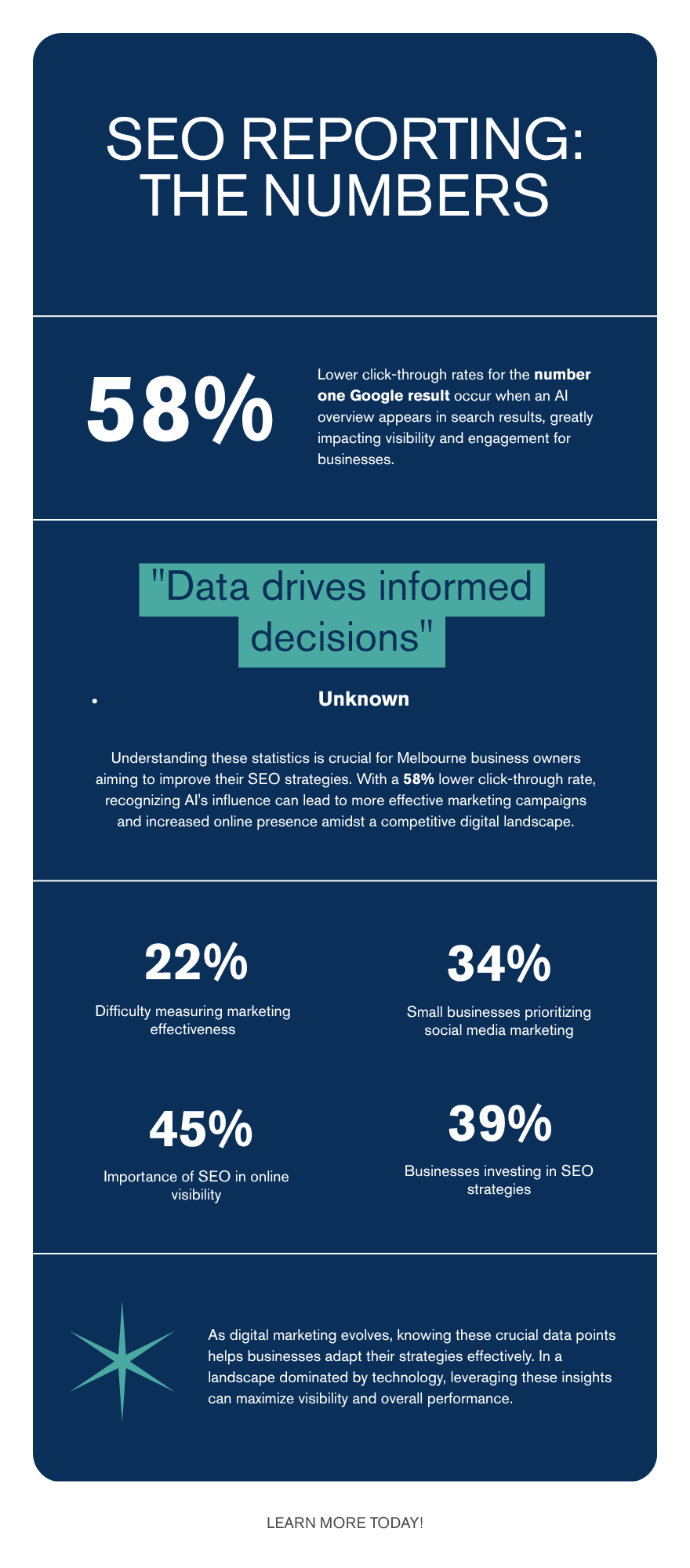
    Your SEO agency has just sent through this fortnight’s report. It runs to twelve pages, full of graphs and terms like organic sessions and keyword rankings, and you’ve got about four minutes before your next meeting. If you’ve ever nodded along on a reporting call without actually knowing whether the numbers were good or bad, you’re not alone. Nearly a quarter of Australian small business owners, 22%, say it’s difficult to tell what’s working in their marketing, according to a 2026 Constant Contact survey. This guide breaks an SEO report down into the four numbers that actually matter, shows you what a proper report should include, and flags the warning signs that separate a strategy that’s working from one that’s quietly going nowhere. None of it requires a marketing degree, just a clear idea of what each number is actually telling you.

    What should actually be in your SEO report

    A proper SEO report isn’t a folder of screenshots with a logo stuck on the cover. It should answer one plain question: is the money you’re spending on search engine optimisation turning into phone calls and enquiries? At a minimum, look for four things every time, whether your agency reports monthly or, like ours, fortnightly. If a report only ever shows the numbers that make last month look good, that’s a sign to start asking questions.

    What to check What it actually means Good sign Warning sign
    Organic traffic How many people found your site through an unpaid Google search Steady growth month on month, even if slow Traffic up but nothing else moves
    Keyword rankings Where your pages sit in Google for the searches your customers use Rankings improving for terms with buyer intent, such as “plumber Richmond” Rankings for random or branded terms only
    Conversions Enquiries, calls or form fills that came from organic search A visible link between traffic and enquiries No mention of enquiries at all
    Technical health Whether Google can actually crawl, read and load your site properly Issues flagged with a fix date given Same unresolved issues, report after report

    If your current report is missing any of these four, that’s not necessarily a red flag on its own, but it does mean you’re only getting part of the picture.

    Not sure if your current report stacks up? Book a free 30-minute consultation and site audit with our Melbourne team. There’s no obligation, and you’ll walk away knowing exactly where you stand, even if you don’t become a client.

    The four numbers that actually matter

    Once you know what should be in the report, the next skill is reading it in the right order. Here’s the sequence we walk clients through every fortnight.

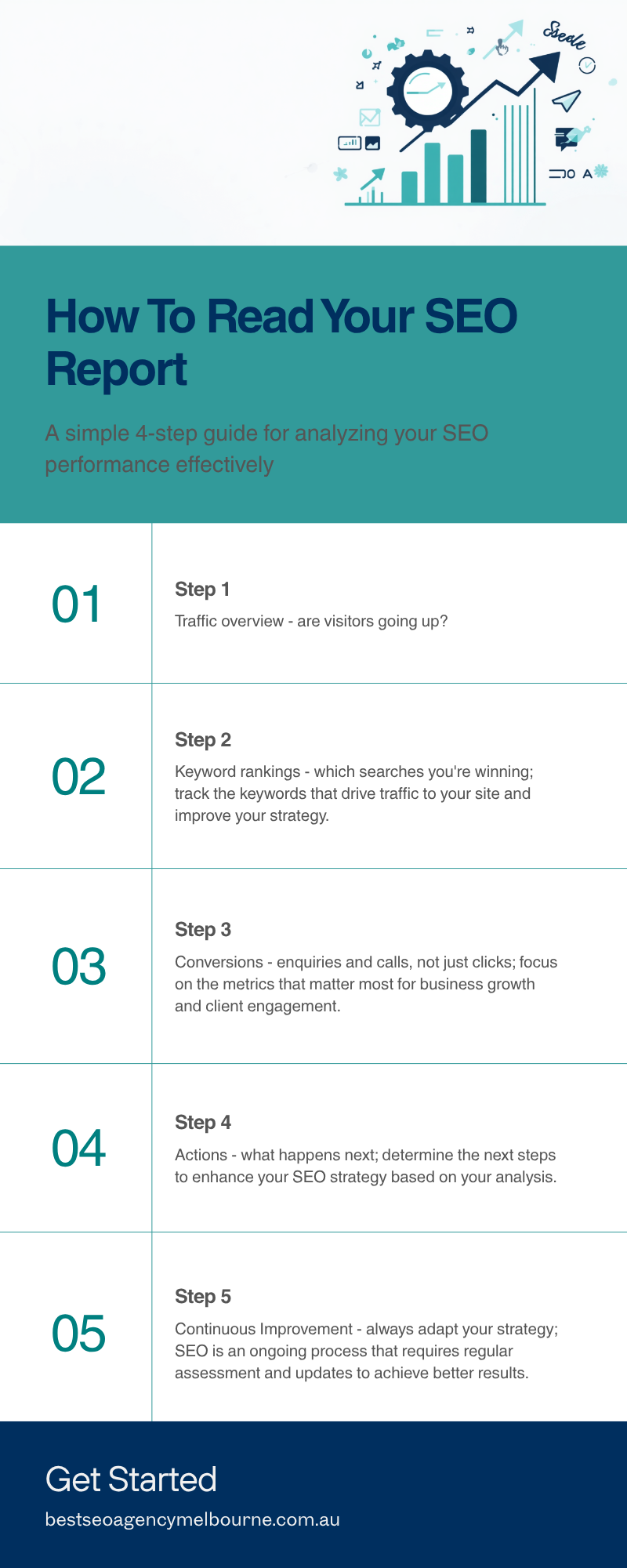
    Infographic showing the four steps to read an SEO report: traffic overview, keyword rankings, conversions and next actions, for Melbourne business owners

    1. Start with traffic direction, not the exact number

    Don’t get hung up on whether you had 812 or 840 visitors last month. What matters is the trend over three to six months. A Melbourne trades business we work with in Port Melbourne cared less about the raw number and more about the line trending up, quarter on quarter, once seasonal dips around Christmas and the mid-year slowdown were accounted for. A single month rarely tells you anything on its own.

    2. Check rankings for terms that actually pay the bills

    Ranking first for your own business name is not a win, you’d rank for that anyway. Look for movement on the searches a real customer would type before they’re ready to buy, things like “family lawyer Southbank” or “emergency electrician Brunswick”.

    3. Follow traffic through to conversions

    This is the step most reports skip, and it’s the one that matters most. Traffic without enquiries usually means the wrong pages are ranking, the content doesn’t answer the reader’s actual question, or there’s a trust issue further down the page. We’ve written before about why a blog can get traffic but no enquiries, and the fix is rarely more traffic, it’s usually a content or page-level problem.

    4. Read the actions, not just the outcomes

    A report without a “what happens next” section is really just a screenshot dump. Every fortnightly report should end with two or three specific actions, who’s doing them, and roughly when you’ll see the result.

    Why a number one ranking doesn’t mean what it used to

    Rankings alone used to be the whole story. In 2026, they’re not. Google now shows an AI-generated summary, called an AI Overview, above the traditional results for a large share of everyday searches. Ahrefs analysed 300,000 keywords using Google Search Console data and found that when an AI Overview appears, the click-through rate for the page ranking first drops by 58% compared with a normal search results page, in research published in February 2026. In plain terms, for every 100 clicks a page used to earn from sitting at position one, it now earns roughly 42.

    Infographic showing two 2026 statistics for reading an SEO report: a 58 percent drop in click-through rate when Google shows an AI Overview, and 22 percent of Australian small business owners who say it is hard to tell what is working

    That doesn’t mean SEO stopped working. It means a fortnightly report showing “still ranking number one” isn’t enough on its own. Ask your agency to show actual clicks and impressions from Google’s own Search Console Performance report alongside the ranking position, so you can see whether that top spot is still delivering visits.

    If your fortnightly report only shows rankings and doesn’t break down clicks, impressions or enquiries, it’s worth asking why. Request a free report review and our Melbourne team will walk you through what your current numbers are actually telling you, at no cost.

    Red flags: when a report is hiding a problem

    Most SEO reports aren’t dishonest, they’re just incomplete, and incomplete can hide a problem for months if you don’t know what to look for. Watch for these five patterns.

    • Vanity metrics only. Impressions, a “visibility score”, or social shares with no mention of enquiries.
    • No month-on-month comparison. A single snapshot tells you nothing about direction.
    • Jargon with no plain-English explanation. If you need a glossary to read your own report, ask for a rewrite.
    • Technical issues that never get fixed. The same broken pages flagged report after report, with no resolution date.
    • No named next action. Every report should end with what’s being done next, not just what happened last fortnight.

    This matters more than it might seem. The ACCC has flagged manipulative or misleading conduct in digital markets, including advertising and reporting claims, as an enforcement priority for 2026. A reputable agency has nothing to hide behind a chart, and should be happy to explain any number in your report in one sentence, without you having to ask twice.

    What this costs, how long it takes, and what goes wrong

    Cost. Melbourne SEO retainers commonly range from around $800 to $3,500 a month, depending on how competitive your industry is and how much content and technical work is involved. Be wary of anything priced far below that range, it usually means thin, templated work rather than a strategy built around your actual customers.

    Timeframe. Most Melbourne businesses see the first ranking movement within 60 to 90 days, with noticeable traffic and enquiry growth by months four to six. Anyone promising page-one rankings in two weeks is either exaggerating or planning something Google will eventually penalise.

    What goes wrong. The most common failure isn’t a bad strategy, it’s a bad contract. Locking into 12 months with an agency you can’t easily leave removes your ability to act on a report that isn’t delivering. A close second is an agency reporting on keywords nobody actually searches for, padding out the rankings table to look busy while the numbers that matter go quietly unmentioned. We’ve covered agency selection in more detail in how to choose an SEO agency in Melbourne without signing a 12-month mistake, including the six questions worth asking before you sign anything.

    Quick questions about SEO reporting

    How often should I actually receive a report?

    Fortnightly is a good middle ground for most small businesses, frequent enough to catch problems early, not so frequent that you’re paying for admin instead of results. Monthly is acceptable if the report is genuinely thorough.

    What if my traffic is up but enquiries aren’t moving?

    That’s usually a page or content problem rather than a traffic problem, see the section above on following traffic through to conversions.

    Can I ask my current agency to explain a report line by line?

    Yes, and you should. Any agency worth paying will walk you through their reporting without charging extra for the conversation. For more on what to expect, see our frequently asked questions.

    The takeaway

    A good SEO report should leave you more confident, not more confused. Ask for the four numbers, traffic, rankings, conversions and next actions, expect plain language over jargon, and treat a top ranking as one signal among several rather than the whole scorecard. If you’d like someone to sit down and walk through your own report line by line, free of charge and with no lock-in contract, get in touch for a free, obligation-free chat. For more plain-English guides written for Melbourne business owners rather than marketers, visit our blog and read the next one on your lunch break instead of scrolling.

  • How to Earn Genuine Backlinks Without Buying Them in 2026

    Most Melbourne businesses have been offered backlinks for sale at some point — a “guaranteed page one” package, a job-lot of 50 links for a few hundred dollars, or a guest post network promising instant authority. In 2026, taking that offer is one of the fastest ways to lose the rankings you already have. Google’s spam-detection system, SpamBrain, now flags manipulative link patterns in real time, and a manual action can cut your organic traffic by half or more. This guide sets out what genuinely works instead: the specific, unglamorous tactics that earn links from real Melbourne publications, partners and customers, without paying for them.

    Why buying backlinks backfires in 2026

    A paid link might show up in your backlink checker within a week, which is exactly why it is tempting when a competitor seems to be outranking you. The problem is what happens next. Google’s Search Central spam policies classify any paid link that passes ranking credit as a link scheme, whether it came from a “guest post network”, a private blog network, or a broker selling placements on real news sites. Enforcement has become faster and more automatic: buying links risks a traffic drop of 50–90% and a recovery period of six to twelve months, a cost most small Melbourne businesses cannot absorb while a competitor keeps ranking undisturbed.

    Paid links also tend to come from sites with nothing to do with your industry — a Melbourne plumber’s site linked from an unrelated fashion blog in another country, for instance. Even when Google does not catch the scheme outright, these links rarely carry the topical trust that actually moves rankings, so businesses often pay hundreds of dollars for links that do very little even before the penalty risk is considered. If you already have a backlink profile full of these, an audit is the sensible first step before you invest in earning new links.

    Not sure where your own backlink profile stands? Our free 30-minute audit will tell you exactly what you have and what is missing, even if you never become a client. Book a free consultation.

    What actually earns a genuine backlink

    A backlink is just another website choosing to link to yours. Real ones get earned the same way trust gets earned anywhere: by being the source someone actually wants to point to, whether that is a journalist looking for a quote, a supplier listing partners, or a customer writing about a good experience. For background on what a backlink is and why it still carries ranking weight in 2026, we covered the fundamentals in our recent explainer on backlinks and why they still matter. This article goes further into the practical side: what to actually do this month to start earning them, and roughly what it costs in time or budget.

    Comparison graphic showing the risks of buying backlinks against the durable benefits of earning genuine backlinks for a Melbourne business
    Comparison graphic showing the risks of buying backlinks against the durable benefits of earning genuine backlinks for a Melbourne business.
    Signal Paid link Earned link
    Speed Days Weeks to months
    Google Search Central compliant No Yes
    Typical cost $100–$500+ per link Staff or agency time
    Durability Often removed or devalued Stays live for years
    Topical relevance Usually unrelated Chosen by the publisher

    Five link-earning tactics that work for Melbourne businesses

    These are the methods our authority link building team uses with Melbourne clients, roughly in order of how quickly they tend to produce results.

    1. Digital PR around a genuine local story. Digital PR is now the most common link-earning method among SEO professionals, used by 67.3% of marketers surveyed in 2026. A Melbourne example: a South Melbourne clinic pitched a local health reporter with real, de-identified patient data on a seasonal trend, and picked up two links from Victorian news sites in the same month. The key is having something a journalist genuinely needs, not a press release about your business.
    2. Original data or a small local survey. Journalists and bloggers constantly need numbers to cite, and most small businesses sit on data they never publish — average job costs, seasonal demand, common customer questions. Survey 50–100 of your own customers or run a small industry snapshot, publish the results as a short report on your own site, and offer it directly to relevant Melbourne publications and industry bodies.
    3. Fixing broken links on sites that already reference your topic. Find pages that link to a dead or outdated resource on your subject — free tools can scan a competitor or industry page for broken outbound links — and suggest your own page as the replacement. It is a genuine favour to the site owner, which is why it still works when a cold pitch would be ignored.
    4. Supplier, partner and industry association listings. Chambers of commerce, supplier directories, trade associations and local business networks you are already a member of will often link to your site if you simply ask — an easy, low-risk starting point that costs nothing but an email.
    5. Case studies with named clients. When a client is happy to be named and quoted, ask if they will link to you from their own site alongside the story. It is a natural, mutually beneficial link that rarely feels like marketing to either side, and it usually strengthens the client relationship as well.

    If your current backlink profile looks more like the “buying” column in the table above than the “earning” one, talk to our Melbourne team — untangling risky links and replacing them usually takes two to four weeks.

    Before you start, a quick gut check: list your last five backlinks in Ahrefs, Semrush or Google Search Console. If most came from directories, comment sections or sites unrelated to your Melbourne industry, that is a sign your previous strategy leaned on volume rather than relevance, and a genuine link-earning approach will feel slower at first purely because it is aiming for quality instead.

    What this costs, how long it takes, and what goes wrong

    Earning links properly is not free, even without paying for the links themselves. Budget for the time it takes to research journalists, write a genuine pitch, or produce a small piece of original data — typically four to eight hours per successful placement if you are doing it yourself, or an ongoing monthly retainer if you outsource it to a specialist. Most Melbourne businesses see their first few earned links within four to six weeks of starting consistent outreach, with a steadier flow building over three to six months as relationships and reputation compound.

    The most common mistake is giving up after one or two pitches are ignored. Digital PR and outreach usually need six or more attempts before the first placement lands, and treating a single “no reply” as proof the strategy does not work wastes the groundwork already done. A second common mistake is chasing volume over relevance: ten low-quality directory links do less for rankings than one genuine link from a site Google already trusts in your industry. The data backs the patience required — pages with at least one earned backlink perform roughly ten times better in organic search than pages with none, and the #1 Google result carries on average 3.8 times more backlinks than positions two to ten.

    Bar chart of 2026 backlink statistics: pages with one backlink are 77% more likely to rank in the top 10, the number 1 result has 3.8 times more backlinks, 94% of pages have zero backlinks, and 67.3% of marketers rank digital PR as their top link-earning method
    Bar chart of 2026 backlink statistics: pages with one backlink are 77% more likely to rank in the top 10, the number 1 result has 3.8 times more backlinks, 94% of pages have zero backlinks, and 67.3% of marketers rank digital PR as their top link-earning method. Source: Ahrefs and Backlinko data, via DemandSage and Searchlab 2026 link building research.

    Our own results reflect the same pattern — see the case studies on our results page, including a Melbourne CBD legal firm that grew organic traffic 412% over eight months largely through genuine link acquisition rather than paid placements.

    Common questions

    Will one bad backlink get my whole site penalised? Rarely. Google’s algorithm generally devalues individual spammy links rather than penalising the whole site, unless there is a clear, large-scale pattern of manipulation. See our FAQ section for more on how we assess this risk during an audit.

    Can I remove backlinks I bought in the past? Yes — request removal from the linking site directly first, and use Google’s disavow tool as a last resort for any links you cannot get taken down yourself.

    Do internal links help as much as backlinks? They matter for a different reason: internal links help Google find and understand the pages on your own site. Backlinks are what other, independent websites vouch for, which is why they carry more ranking weight.

    Genuine backlinks take longer to build than a paid package, but they are the only kind that survive an algorithm update. Start with the suppliers and partners who already know you, add one piece of original local data this quarter, and be patient with outreach rather than chasing shortcuts. Ready to see where your backlink profile actually stands? Get started with a free, no-obligation consultation — no lock-in contracts, and we reply within 24 hours. For more on building topical authority the right way, see more guides on our blog.

  • What Is a Backlink and Why Does It Still Matter in 2026?

    A backlink is simply another website linking to yours. That is the whole definition, and if you have heard it described as anything more complicated, someone was probably trying to sell you something. What matters is not the definition, though — it is that backlinks remain one of the strongest signals Google uses to decide which Melbourne business deserves to rank above another, even after years of algorithm updates aimed at penalising the shortcuts businesses use to get them. Ahrefs’ 2026 analysis of ranking correlations found that the number of referring domains linking to a page has the strongest correlation with rankings of any factor studied, and that pages sitting in Google’s number one spot have on average 3.8 times more backlinks than pages ranked two through ten (Ahrefs, 2026). Here is what a backlink actually does, why the rules changed, and how a Melbourne business builds them properly in 2026.

    Not sure how your backlink profile compares to your competitors? Our free 30-minute audit will tell you, even if you never become a client. Book a free consultation

    What a backlink actually is, in plain English

    Think of a backlink as a vote of confidence from one website to another. When a Melbourne newspaper links to your law firm in an article about local business, or a supplier links to your online store from their partner page, that is a backlink. Google reads the web this way in part because it mirrors how trust works among people: if enough credible sources point to you, you are probably credible too. Not every link carries equal weight. A link from a well-known, relevant Australian publication counts for far more than dozens of links from low-quality directories, which is why chasing link quantity over link quality is the single most common mistake we see Melbourne businesses make.

    It helps to separate backlinks from internal links, since business owners often mix the two up. An internal link is one page on your own site linking to another page on your own site — useful for navigation and for spreading authority around, but not a vote of confidence from anyone else. A backlink has to come from a genuinely separate website. That distinction matters because some agencies pad reports with internal linking activity and call it link building, which is a bit like counting the times you compliment yourself as a character reference.

    Backlinks and Google rankings in 2026 Bar chart comparing the average number of backlinks for pages ranked number one versus pages ranked two through ten, showing number one pages have 3.8 times more backlinks. Backlinks vs Google Ranking Position (2026) #1 position — 3.8x more backlinks Positions 2–10 — baseline Referring domains have the strongest correlation with rankings of any factor studied Source: Ahrefs, 2026 SEO ranking correlation study
    Infographic: how backlink volume compares between the number one Google result and everything below it. Reference filename: backlinks-vs-google-ranking-melbourne-2026.svg

    Why backlinks still matter after years of algorithm crackdowns

    Google has spent the past two years specifically targeting manipulated links. Its spam policies now treat large-scale link buying, link exchange schemes and AI-generated guest-post farms as a domain-level risk rather than a one-off penalty, with any paid or exchanged link required to carry a rel="sponsored" or rel="nofollow" tag to stay compliant (Google Search Central, spam policies). None of that means backlinks stopped mattering. It means the easy, low-quality tactics that used to work — directory spam, link farms, bulk guest posts on irrelevant sites — now actively damage a site instead of helping it. Genuine, editorially earned links from relevant, trusted sources are worth more relative to spam than they have ever been, precisely because Google can now tell the difference at scale.

    Legitimate link building vs risky, penalty-prone tactics
    Approach Legitimate Risky or penalty-prone
    Guest posts Genuine article on a relevant, real-readership site Mass-produced AI content on link farms
    Paid placements Disclosed, tagged rel=”sponsored” Undisclosed paid links passed off as editorial
    Directories Reputable, industry-specific Australian directories Bulk submission to hundreds of low-quality directories
    Source of links Journalists, industry bodies, genuine partners and suppliers Private blog networks and link exchange groups

    If a previous agency built your backlinks through directories or exchanges you don’t recognise, talk to our Melbourne team — a link profile audit usually takes less than a week.

    How a genuine Melbourne link building campaign actually runs

    Real link building, the kind covered by our authority link building service, follows the same four-stage discovery-to-execution approach as the rest of our SEO process, starting with research rather than outreach. We map which Australian publications, industry bodies and complementary local businesses already link to competitors, then build something genuinely worth linking to — original data, a useful local guide, or a case study a journalist could actually cite. Outreach follows, pitched to a real person at a relevant site rather than blasted to a generic contact list, and every placement is tracked so we know which links are still live six months later, because links do get removed and a proper campaign checks for that rather than assuming a link earned once lasts forever.

    A legitimate link building campaign, step by step Four-stage process: research and target list, asset creation, outreach and pitching, and placement tracking with ongoing monitoring. 1. Research & targets 2. Build the asset 3. Outreach & pitch 4. Track & monitor
    Infographic: the four-stage process behind a legitimate Melbourne link building campaign. Reference filename: link-building-campaign-process-melbourne.svg

    A worked example makes the difference concrete. Two Melbourne accounting firms compete for the same clients. Firm A has 40 backlinks, all from the same three low-quality directories submitted years ago by an old agency. Firm B has 12 backlinks: one from a local business association it is a genuine member of, one from a client’s supplier page, one from a Herald Sun article a partner was quoted in, and the rest from industry-specific finance directories with real editorial standards. Firm B will consistently outrank Firm A, despite having a third of the links, because Google is not counting links — it is weighing trust, relevance and the likelihood that a real person put that link there on purpose.

    What this costs, how long it takes, and what goes wrong

    Genuine link building is slower and more expensive than the shortcuts it replaced, and any agency promising fifty links a month for a flat low fee is describing exactly the kind of link farm activity Google now penalises. Expect a proper campaign to run as an ongoing monthly retainer rather than a one-off purchase, with the first handful of quality placements landing within four to eight weeks and a measurably stronger backlink profile, tracked against the results our clients see, building over six to twelve months.

    The most common mistake is treating link building as a numbers game, buying volume from marketplaces that sell placements on low-quality, unrelated sites. The second is ignoring anchor text diversity, so every link uses the exact same keyword phrase, which itself is a pattern Google’s spam systems are tuned to notice. The third is never checking whether older links are still live — sites get redesigned, pages get deleted, and a backlink profile that looked strong two years ago can quietly lose a third of its value without anyone noticing. Building your own site’s worth linking to matters too: our guide to internal linking for large product catalogues covers the on-site half of link equity, and if the traffic those backlinks send isn’t converting once it arrives, our piece on why your blog gets traffic but no enquiries is worth reading alongside this one.

    Quick answers

    How many backlinks does a Melbourne business actually need? There is no fixed number. What matters is relevance and authority relative to your specific competitors — ten links from genuinely authoritative, relevant Australian sources will usually outperform a hundred from low-quality ones.

    Are nofollow links worthless? No. They don’t pass the same direct ranking signal as a followed link, but they still send referral traffic, build brand awareness, and are part of what a natural-looking link profile is supposed to contain. A profile made up entirely of followed links can itself look manipulated.

    Can I lose rankings from bad backlinks? Yes, if you built them yourself or a previous agency did. Google’s current spam systems assess a domain’s entire link profile, so a history of low-quality links can hold a site back even if recent work has been clean. See our FAQ for how we handle a link disavow if it’s ever genuinely needed.

    What is anchor text and why does it matter? Anchor text is the clickable words in a link, and it gives Google context about what the linked page is about. Natural anchor text varies — sometimes your brand name, sometimes a general phrase like “this Melbourne accountant”, sometimes just the URL — because that is how real people actually link. A profile where every single link uses the identical keyword phrase looks engineered, which is exactly the pattern Google’s spam detection is built to catch.

    Backlinks have not stopped mattering, they have simply stopped rewarding shortcuts. A handful of genuinely earned links from relevant Australian sources will do more for a Melbourne business in 2026 than a hundred bought placements ever will, and building that kind of profile is a well-defined, trackable process rather than a mystery. Book a free consultation and we will show you exactly where your current backlink profile stands, with no obligation either way. Get started. For more Melbourne SEO guides like this one, visit our blog.

  • How to Recover Rankings After a Shopify Replatform: A 2026 Guide for Melbourne Stores

    Your Melbourne store just moved to Shopify and the numbers are heading the wrong way. Search Console shows fewer impressions, the phone has gone quiet, and someone in the business is asking why the new site “broke” everything the old one used to rank for. This is one of the most common calls our team takes, and the good news is that a replatform does not have to mean a lasting ranking loss. Most of the damage comes from a small, fixable set of mistakes: missing redirects, rewritten product URLs, and metadata that never made the trip across. This guide covers why rankings drop after a Shopify migration, how long recovery genuinely takes, and the fixes that get a Melbourne store back to where it was, and often further ahead.

    Not sure whether your Shopify move is actually recoverable or something more serious? Our free 30-minute audit will tell you, even if you never become a client. Book a free consultation

    Why rankings drop after a Shopify replatform

    A replatform changes more than the shopfront. Product, collection and blog URLs are usually rebuilt around Shopify’s own structure, which means a page that ranked for three years at one address can suddenly live at another. If the old address returns a 404 instead of forwarding visitors and Google to the new one, every backlink and every scrap of ranking history pointing at it goes to waste.

    Metadata is the second casualty. Title tags, meta descriptions and structured data that were fine-tuned over months are easy to lose in a rebuild, especially when a theme swap or app installation overwrites them by default. Page speed can move in either direction too. Shopify’s hosting is generally fast, but a heavy theme, unoptimised images or a stack of speed-draining apps will undo that advantage quickly. Anyone weighing up a migration is really weighing up a technical SEO project, not just a platform swap, and it pays to treat it that way from the start.

    Internal linking is the quiet one. Old sites accumulate links between related products, categories and guides over years. Rebuild the site structure and those internal pathways often vanish, which makes it harder for Google, and shoppers, to find the pages that used to convert well.

    How much traffic loss is normal, and when it signals a real problem

    Some wobble is expected. A temporary dip of 10 to 15 percent in the first couple of weeks is considered normal while Google recrawls and re-indexes the new site, according to 2026 analysis from Search Engine Journal. A sustained drop beyond 30 percent, on the other hand, is treated as a sign of a genuine technical problem rather than a normal transition. Separate 2026 research from SEO.Domains puts it in sharper terms: 60 to 80 percent of all site migrations produce measurable traffic loss, and only around one in ten migrations ends with rankings actually improving.

    The scale of the drop tracks directly with execution quality. A 2026 AI-driven analysis reported by MarTech Cube links poorly executed migrations to a 20 to 40 percent loss in organic traffic, and separate figures show that badly handled moves can shed 20 to 60 percent of traffic within days when redirects are missing or broken. Nearly half of poorly executed migrations never fully recover their previous traffic levels. The table below summarises what a normal transition looks like next to a migration that has gone wrong.

    Signal Normal transition Migration gone wrong
    Traffic dip in week 1-2 10-15%, then recovering 30%+ and still falling
    Search Console coverage report Old URLs shown as redirected Old URLs shown as “not found (404)”
    Ranking movement by week 6 Back near pre-migration positions Still 10+ positions lower
    Backlink profile Redirected to new equivalent pages Pointing at dead or generic pages

    The recovery timeline you should expect

    With a complete, clean redirect map, Shopify’s own migration guidance puts ranking normalisation at four to six weeks, and Google’s Search Central documentation on site moves describes a similar four to twelve week window for a well-executed move, noting explicitly that “301 and other permanent redirects don’t cause a loss in PageRank.” Stores that plan the move properly typically see a dip of 10 percent or less and recover somewhere between one and six months, depending on how many pages and how much non-branded search traffic the store relies on.

    Infographic: the Shopify replatform SEO recovery timeline

    What Melbourne stores can expect after moving platforms, from redirect to full recovery.

    Weeks 1-2
    Crawling and indexing fluctuate as Google finds the new URLs
    Weeks 4-8
    Rankings stabilise where the 301 redirect map is complete
    Months 1-3
    Well-executed moves are usually fully recovered
    Months 6-12
    Poorly executed moves may still be clawing back lost rankings

    Source: Shopify SEO Migration Guide 2026; Google Search Central site move documentation 2026.

    If your Search Console graph looks like the “months 6-12” box above, talk to our Melbourne team — fixing a broken migration is usually a two to four week job, not a rebuild.

    The redirect and metadata checklist that actually protects rankings

    Partial redirect maps are the single biggest cause of migration traffic loss, according to Google’s Search Central guidance on site moves. Every URL that carried ranking value on the old site needs a permanent 301 redirect to its closest equivalent on Shopify, with no chains and no temporary redirects standing in for the real thing. If your store already has a solid product catalogue, our guide on internal linking strategy for large product catalogues is worth reading alongside this one, since a migration is the moment those internal pathways are most likely to break.

    Checklist item Why it matters
    Full 301 redirect map, old URL to new Passes ranking signals and link equity across, per Google’s own guidance
    Title tags and meta descriptions carried over Prevents Google re-evaluating pages from scratch
    Product and collection schema reinstated Keeps star ratings, price and stock showing in results
    Updated XML sitemap submitted in Search Console Speeds up discovery of the new URL structure
    Redirects kept live for at least 12 months Google needs repeated crawls, and old backlinks keep pointing at the old address

    Infographic: traffic impact by migration quality

    Organic traffic loss ranges reported for well-executed versus poorly executed Shopify migrations.

    Well-executed migration (clean 301s)2-10%
    Poorly executed migration (missed redirects)20-60%

    Source: SEO.Domains migration recovery analysis 2026; MarTech Cube SEO migration risk study 2026.

    What this costs, how long it takes, and what goes wrong

    A proper migration audit and redirect map for a mid-sized Melbourne store, somewhere in the range of 200 to 2,000 products, typically takes two to four weeks of dedicated work before launch, plus another four to eight weeks of monitoring afterwards. Stores that skip the audit and redirect their homepage only, hoping Shopify will “figure out” the rest, are the ones we see with the 20 to 60 percent traffic drops described above.

    The most common mistakes we see in Melbourne stores that have already replatformed: redirecting every old URL to the new homepage instead of its true equivalent, which Google treats as a soft 404; forgetting that collection page URLs changed structure entirely; and losing product schema because a new theme does not support it out of the box. Every one of these is fixable without another full rebuild, which is the part most business owners do not realise until someone tells them. It is also worth reviewing your Shopify SEO checklist for Melbourne online retailers, since several of the same fixes apply whether you are launching fresh on Shopify or repairing a migration that already happened.

    Our own case work backs this up. One Melbourne retailer we work with grew organic revenue from $310,000 to $2.1 million within 14 months, largely through the kind of category architecture and redirect discipline described here. You can see the detail on our results page, and the same principles apply just as much to fixing a migration as to growing from scratch. Our process for a recovery project starts with the same free audit as any new engagement, so you know exactly what broke before anyone touches your store.

    Common questions about Shopify migration SEO

    Will my rankings ever fully recover? In most cases, yes, provided the redirect map is complete and stays live. The exception is when competitors have moved into the ranking gap during the recovery window, which is why speed matters. See our full FAQ for more on typical SEO timelines.

    Should I redirect every old URL to my new homepage? No. A blanket homepage redirect is one of the most common causes of lasting ranking loss, because Google treats it as a sign the original page no longer exists in any real form.

    How do I know if my migration was done properly? Check Search Console’s Coverage report for your old URLs. If they show as redirected, that is a good sign. If they show as “not found,” you have gaps to fix.

    A Shopify replatform does not have to cost you the rankings you spent years building. Most of the damage traces back to a handful of fixable gaps: missing redirects, lost metadata and broken internal links, and every one of them has a known fix with a realistic timeline attached. If your store is still waiting on recovery, get a second set of eyes on it. Book your free consultation — no lock-in contracts, a reply within 24 hours, and a Melbourne-based team who has fixed this exact problem before. For more guides like this one, visit our blog.

  • How to Write Product Titles That Rank and Convert: A Melbourne Online Store’s Guide

    A Melbourne homewares store we looked at recently had a product called simply “Vase” on its category page. Type “ceramic vase Melbourne” into Google and that product was nowhere to be found, not because the vase was wrong for the search, but because the title never told Google, or the shopper, what made it worth clicking.

    A product title has to do two jobs at once: tell Google exactly what the product is so it matches the right searches, and tell a shopper enough in the first few words to make them click instead of scrolling past. Get both right and the same product starts showing up for searches it was invisible to before. This guide covers what actually goes into a title that does both.

    Most Melbourne stores never touch product titles after the initial site build, because the platform generates something reasonable by default and nobody thinks to revisit it. That default is rarely wrong, but it is rarely optimised either, and the gap between reasonable and optimised is exactly where the extra traffic sits.

    What Google actually needs from a product title

    There are two different “titles” worth knowing about. The page title (or SEO title) is what shows as the blue link in ordinary Google search results. The product title is a separate field used in Google Shopping and Merchant Center listings, and it has its own rules. Google’s own product data specification allows up to 150 characters, but only around the first 70 characters reliably show on a Shopping ad or free listing, so the most important words need to come first. Google also strictly disallows promotional language in the title itself, phrases like “sale” or “free shipping” belong in a different field, not the title, or the product risks disapproval.

    Google also asks for the distinguishing detail of each variant, colour, size, material, to sit inside the title itself rather than being left to the product description. Two t-shirts that differ only by colour need two different titles, not one generic title covering both, otherwise Google struggles to tell shoppers apart and may treat the listings as duplicates of each other.

    Infographic · product-title-formula-melbourne-ecommerce

    The anatomy of a title that ranks and converts

    Brand
    e.g. Nordic Home

    Product
    e.g. Ceramic Vase

    Attributes
    e.g. Handmade, Matte

    Size / Colour
    e.g. 30cm, Sand

    Alt text: Diagram showing the four-part product title formula for e-commerce SEO — brand, product, key attributes, and size or colour, in that order.

    Not sure whether your own product titles are working against you? Our free 30-minute consultation includes a live look at how your current titles are performing, even if you never become a client.

    What the best product titles actually do differently

    Store Growers analysed 151 product titles from 120 advertisers who were already ranking in the top 5–10 results for competitive search terms, giving a genuinely useful picture of what “good” looks like in practice rather than theory. The original research found the average title length among top performers was 70 characters, with the sweet spot sitting between 75 and 100. Just as tellingly, 81% of these advertisers used a different title in their product feed to the one shown on the actual product page, meaning the “set and forget” approach most Melbourne stores default to leaves real performance on the table.

    The research also found that titles longer than 70 characters, while less visible in full, still helped: Google reads the entire 150-character field even when a shopper only sees the front portion, so the extra words widen the range of searches a product can match without ever being seen directly. This is why a title built purely to “look nice” at 40 characters often underperforms one that runs longer but stays readable throughout.

    Title element How many top advertisers use it Why it matters
    Capitalise Each Word 97% Reads as a proper product name rather than a sentence fragment
    Digits instead of spelled-out numbers 97% Saves characters and matches how people actually search (“3 pack”, not “three pack”)
    Symbols to separate details (– / |) 70% Breaks the title into scannable chunks instead of one dense phrase
    Brand name included 44% Useful when shoppers search by brand, less useful for unbranded generic products
    Extra descriptive keywords beyond the core name 32% Widens the net of searches the product can match without misrepresenting it

    This is exactly the kind of detail our e-commerce SEO service works through product-by-product for Melbourne Shopify and WooCommerce stores, because a formula that works for one category rarely transfers cleanly to another.

    Infographic · product-title-changes-impressions-clicks-2026

    What happened when one store rewrote its top product titles

    Impressions
    +39%

    Clicks
    +38%

    Alt text: Bar chart showing a one-week before-and-after result from rewriting product titles — impressions up 39% and clicks up 38%, from Store Growers’ 2026 product title optimisation case study.

    Results like that will not carry over automatically. If your titles are already close to best practice, our client results show the bigger gains usually come from combining title fixes with the category and internal linking structure around them.

    What this costs, how long it takes, and what goes wrong

    Rewriting product titles is one of the lowest-cost SEO jobs available to a Melbourne online store, because it touches existing content rather than requiring new pages, images or design work. A store with under 100 products can usually have titles rewritten and tested within a week. Larger catalogues need a formula and a feed rule rather than manual edits product by product, which is a short technical setup rather than an ongoing cost, similar to the structure we cover in our Shopify SEO checklist for Melbourne retailers. If your catalogue runs into the thousands of products, talk to our team about setting up feed rules rather than trying to rewrite each one by hand.

    Movement in Google Shopping and organic search can appear within days of a title change, since product feeds refresh far more often than a page needs to be re-crawled, though a fuller picture of organic ranking movement usually takes three to six weeks, in line with what we walk through during our audit and strategy process.

    The most common mistake is stuffing every possible keyword into the title until it reads like a list rather than a product name; Google’s own guidance is to describe the product clearly, not maximise keyword count. The second is leaving every product in a range with an identical title except for a colour swapped at the very end, buried past the 70-character cut-off where nobody sees it. The third is copying the on-page product title straight into the Shopping feed without checking whether it still fits the 150-character limit once modifiers are added, which causes the listing to be truncated mid-word. A fourth, less obvious mistake is changing titles constantly to chase small ranking shifts; Google needs time to re-evaluate a listing after a change, so testing one meaningful version for a few weeks beats rewriting a title every few days.

    Common questions

    Should my Shopify product title and my Google Shopping title be identical?
    Not necessarily. Store Growers found 81% of top advertisers use a different title in their Shopping feed than on the product page itself, usually because the feed title is built for search matching first.

    How long should a product title actually be?
    Aim for 75–100 characters as a sweet spot; the front 70 characters are what most shoppers actually see, so the most important words need to sit there.

    Will better titles alone fix poor product page rankings?
    They help significantly, but titles work best alongside solid internal linking between related products and clean category structure; see our FAQ for the full picture on e-commerce SEO scope and pricing.

    Do I need special software to manage product titles at scale?
    Not for a small catalogue; Merchant Center’s built-in attribute rules handle most formula-based changes. Larger stores with thousands of SKUs often benefit from a dedicated feed management tool once manual edits become impractical.

    Getting product titles working harder

    A product title is one of the few pieces of SEO copy a Melbourne store owner can rewrite this afternoon and plausibly see movement within days. Lead with the brand and product name, add the attributes a shopper actually filters by, keep the important words inside the first 70 characters, and resist the urge to stuff in every keyword a product could theoretically match.

    Book a free, no-obligation consultation with a Melbourne SEO expert. We will review your product titles alongside the rest of your store and give you an honest picture of what is worth fixing first. Get a free consultation, or browse more guides on the Best SEO Agency Melbourne blog.