Blog

  • Best SEO Agencies in Melbourne for Insurance Brokers: What to Look for in 2026

    Most Melbourne insurance brokers still win new clients through insurer panel introductions, accountant referrals and word of mouth built up over years. That pipeline works, but it has a ceiling, and it says nothing about the person searching “business insurance broker Melbourne” or “public liability insurance Richmond” at 9pm because their current policy just let them down. That searcher lands on a comparison site or a national insurer almost every time, not on a local broker’s website, because most local brokerages have never properly invested in search visibility. This article covers what a genuine SEO specialist checks before proposing anything, what the work actually costs, the content that earns trust before the first phone call, and the questions worth asking before you sign with anyone.

    Why insurance broking needs a different SEO approach to generic marketing

    Generic keywords like “insurance” or “insurance broker” are dominated by comparison sites, aggregators and the big national insurers, none of which a suburban Melbourne brokerage can realistically outrank. A specialist agency does not chase those terms. Instead, the work centres on specific policy-and-location combinations, such as “landlord insurance Brunswick”, “tradie public liability Dandenong” or “professional indemnity broker Melbourne CBD”, where competition is thinner and buyer intent is much higher. That is also where local SEO does most of the heavy lifting: Google Business Profile optimisation, suburb-level service pages and review generation, rather than a single generic homepage trying to rank for everything.

    A brokerage is also a regulated business. Every page needs to be accurate about the Australian Financial Services Licence (AFSL) the brokerage operates under, and every claim about coverage or cost needs to be defensible. An agency that has never worked with a regulated financial services client will often write content that a compliance-conscious principal cannot publish as is, which wastes weeks of back and forth.

    The content that earns trust from Melbourne business owners also looks different to a generic marketing blog. Case studies naming a real industry, a Fitzroy import business, a Dandenong logistics operator, outperform generic claims about coverage. Explainers on the exact excess and exclusion questions clients ask in the first meeting, such as what a landlord policy actually covers if a tenant stops paying rent, or what a tradie’s public liability does and does not cover on a building site, rank well because almost nobody in the Melbourne market is writing them in plain English.

    Not sure where your brokerage’s website currently stands against comparison sites and the big insurers? Our free 30-minute audit will tell you exactly where the gaps are, even if you never become a client. Book a free consultation.

    What a genuine specialist checks before proposing anything

    A generalist marketing agency will often open with a proposal built around generic keywords and a content calendar. A specialist starts by auditing three things: what the brokerage already ranks for, what its actual AFSL-permitted service area covers, and where the current website fails basic technical checks that stop Google from indexing pages properly in the first place. The table below sets out what to compare when you are assessing proposals from different Melbourne agencies.

    What to check Why it matters Red flag
    Policy-and-suburb keyword mapping Shows the agency understands your actual client base, not generic insurance search volume A keyword list identical to a generic “financial services” template
    AFSL and compliance awareness Content and claims need to hold up to regulatory scrutiny No questions asked about your licence, authorised representatives or PDS wording
    Google Business Profile strategy Map Pack visibility drives a large share of “near me” insurance searches GBP treated as an afterthought or not mentioned at all
    Technical SEO audit before strategy A broker site with indexing or speed problems will not rank regardless of content quality Straight to a content calendar with no technical audit
    Contract terms Month-to-month terms signal confidence in results 12-month lock-in with no exit clause
    The insurance broker SEO roadmap: the first 90 days A three-phase timeline showing audit and foundations in weeks 1-2, content and Google Business Profile build-out in weeks 3-8, and measurement and refinement in weeks 9-12, for a Melbourne insurance broker SEO campaign. The Insurance Broker SEO Roadmap: First 90 Days Weeks 1-2 Audit & Foundations Weeks 3-8 Content & GBP Build-Out Weeks 9-12 Measure & Refine Technical audit, keyword mapping Suburb pages, GBP, reviews Rank tracking, content expansion bestseoagencymelbourne.au
    The insurance broker SEO roadmap: audit and foundations in weeks 1-2, content and Google Business Profile build-out in weeks 3-8, measurement and refinement in weeks 9-12.

    The keywords that actually bring in enquiries

    Branded and generic insurance terms are close to worthless for a suburban brokerage. What converts is specific: policy type plus suburb, policy type plus industry, and “broker near me” style queries once your Google Business Profile is properly built out. A tradie searching “public liability insurance for electricians Melbourne” is close to ready to call. A landlord searching “landlord insurance Brunswick vs Coburg” is comparing options right now. These are the searches a specialist agency targets, and they are also exactly the kind of buyer-intent phrasing our own guide for Melbourne mortgage brokers covers for a closely related regulated-services audience.

    Renewal season is worth planning content around too. A wave of searches for “switching insurance broker Melbourne” and “business insurance renewal” appears every year around policy renewal periods, and a brokerage with the right page already published and indexed months ahead captures that traffic before a competitor even starts writing. Seasonal risk content works the same way: storm and flood cover searches spike before Melbourne’s storm season, and trade-specific public liability searches spike around EOFY when many sole traders review their setup.

    The market opportunity is real. There were 2,741,087 actively trading small businesses in Australia as at 30 June 2026, an increase of 3.2% on the year before, and every one of them is a potential commercial insurance client for a broker who can be found when they search (ASBFEO, 2026).

    If your Google Business Profile looks thin compared with the brokers appearing in the Map Pack above you, talk to our Melbourne team โ€” fixing it is usually a two-week job, not a two-month one.

    What this costs, how long it takes, and what goes wrong

    Expect a genuine Melbourne SEO program for an insurance brokerage to sit in a similar band to other regulated professional services: a set-up phase covering the technical audit and suburb page build-out, followed by an ongoing monthly retainer for content, links and reporting. Ask for a fixed monthly figure rather than a percentage of ad spend, since SEO is not a paid media channel and should not be priced like one. Most brokerages see the first movement in rankings within 60 to 90 days, with meaningful enquiry volume by month four to six, similar to the timelines reported across other Melbourne service-business campaigns.

    What goes wrong most often is scope creep in the wrong direction: an agency that starts strong on suburb pages and then drifts into generic “insurance tips” content that no potential client is actually searching for. The second common failure is under-investment in reviews. A brokerage with 12 Google reviews will consistently lose Map Pack position to a competitor with 80, regardless of how good the website content is.

    Underinsurance is a genuine and growing problem for the exact clients a good broker serves. Almost one in 10 Australian small businesses report inadequate insurance cover, 75% take only an “ad hoc” approach to risk management, and 47% reported a revenue downturn in the past 12 months, according to the 2026 Vero SME Insurance Index (Insurance Business Australia, 2026). Content built around that gap, in plain language rather than policy jargon, consistently performs well because it answers a real and current worry.

    Australian SME underinsurance, 2026 Bar chart: 10 percent of Australian small businesses report inadequate insurance cover, 75 percent take an ad hoc approach to risk management, 47 percent reported a revenue downturn in the past 12 months. Source: 2026 Vero SME Insurance Index. Australian SME Insurance Risk, 2026 10% Underinsured 75% Ad hoc risk management 47% Revenue downturn (12mo) Source: 2026 Vero SME Insurance Index ยท bestseoagencymelbourne.au
    Almost 1 in 10 Australian small businesses report inadequate insurance cover, 75% manage risk on an ad hoc basis, and 47% reported a revenue downturn in the past 12 months. Source: 2026 Vero SME Insurance Index, via Insurance Business Australia.

    Content that builds trust before the first phone call

    Insurance is a high-trust purchase, and most buyers research for days before they ever pick up the phone. The content that moves them from browsing to booking is rarely a sales page. It is a plain-language breakdown of what a specific policy actually covers, written by someone who clearly understands the client’s industry rather than insurance in general. A landlord comparing cover for a Brunswick terrace wants to know what happens if a tenant stops paying rent, not a generic list of policy features. A tradie wants a realistic figure for what public liability costs at their trade and claims history, not a vague “contact us for a quote”.

    This is also where the earlier keyword research pays off twice. The same suburb-and-policy phrases that bring a visitor in from Google also make natural headings for the content itself, so the page answers the exact question the visitor typed, in the first two sentences, before it earns the phone call further down the page.

    Questions worth asking before you sign

    Do you have experience with regulated financial services clients? A brokerage cannot afford an agency learning AFSL basics on the job.

    Learn more about how a properly built content and local SEO program fits together on our services page, and see real numbers from other Melbourne service businesses on our results page.

    What does reporting actually look like? Ask to see a sample report before you sign anything, not after.

    Will you manage our Google Business Profile as well as the website? The two need to be handled together, since Map Pack rankings and website rankings influence each other, and a broker paying for both separately from two different providers often ends up with a disconnected strategy.

    Is content reviewed for compliance before it goes live? If the answer is no, keep looking. For more questions like these, see our general FAQ, and browse other guides on our SEO blog, including our recent look at technical SEO for Melbourne financial planners, a closely related regulated-services audience.

    The bottom line

    An insurance brokerage does not need more traffic. It needs the right searches, from people in the right suburbs, looking for the exact policy the brokerage actually writes, arriving on a page that answers their question in plain English rather than policy jargon. That takes an agency that understands both search and the regulatory reality of financial services, not a generalist running the same playbook used for a cafe or a plumber.

    Book your free consultation. No lock-in contracts, reply within 24 hours, Melbourne-based team. Get started.
  • Technical SEO Agencies in Melbourne for Financial Planners: The 5 Checks That Matter in 2026

    A financial planner in Camberwell can have the best advice in Melbourne and still lose a prospective client to a competitor three suburbs over, simply because their website took six seconds to load on a phone. Financial services is one of the few industries where Google has confirmed that page experience genuinely moves rankings, not just user comfort. Yet most financial planning websites in Melbourne were built by generalist web developers who have never heard of Core Web Vitals, let alone fixed one. This article breaks down the checks a genuine technical SEO specialist runs on a financial planner’s website before touching a single word of content, what each fix actually costs, and how long the improvement takes to show up in Google Search Console.

    Why financial planner websites fail technical SEO more often than most

    Financial planning sites tend to be built on heavily templated platforms, loaded with compliance widgets, risk profiler plugins, and stock photography that nobody has ever compressed. Add a chat widget, a mortgage calculator, and three tracking scripts from three different marketing tools, and you have a page that is slow before a single client testimonial has loaded. On top of that, financial services pages carry a heavier trust burden than most industries. A tradie’s website can get away with a rough edge or two. A page asking someone to hand over their retirement savings cannot.

    We see the same five problems on almost every Melbourne financial planning site we audit for technical SEO, and they are close cousins of the issues we mapped out recently for Melbourne builders shopping for a technical SEO agency: bloated homepage scripts, unoptimised headshots and hero images, missing schema markup, thin mobile menus that push the phone number below the fold, and no clear signal to Google about who is actually giving the advice. Below is what we check first, in the order it actually matters.

    Check 1: Core Web Vitals, the speed and stability scores Google can measure

    Core Web Vitals are the three metrics Google uses to measure real-world page experience: Largest Contentful Paint (how long the main content takes to appear), Interaction to Next Paint (how quickly the page responds when someone taps something), and Cumulative Layout Shift (whether the page jumps around while loading). Google’s own developer documentation sets clear targets for each one, and it explicitly ties good scores to how the page experience aligns with what its core ranking systems reward.

    Metric What it measures Google’s “good” threshold Common fix on a financial planner site
    Largest Contentful Paint (LCP) Loading speed of the main content Under 2.5 seconds Compress the adviser’s hero photo, remove render-blocking scripts
    Interaction to Next Paint (INP) Responsiveness when tapping or clicking Under 200 milliseconds Defer the chat widget and risk profiler plugin until after load
    Cumulative Layout Shift (CLS) Visual stability while the page loads Under 0.1 Set fixed dimensions on images and embedded calculators

    Most Melbourne financial planning sites we test fail at least one of these three, usually Largest Contentful Paint, because the hero image of the adviser’s team is a five-megabyte JPEG straight out of a photographer’s folder. Fixing it is not a redesign. It is usually a one-week job: compress and resize the images, load the booking widget after the main content, and set width and height on every image so the page stops jumping while it loads.

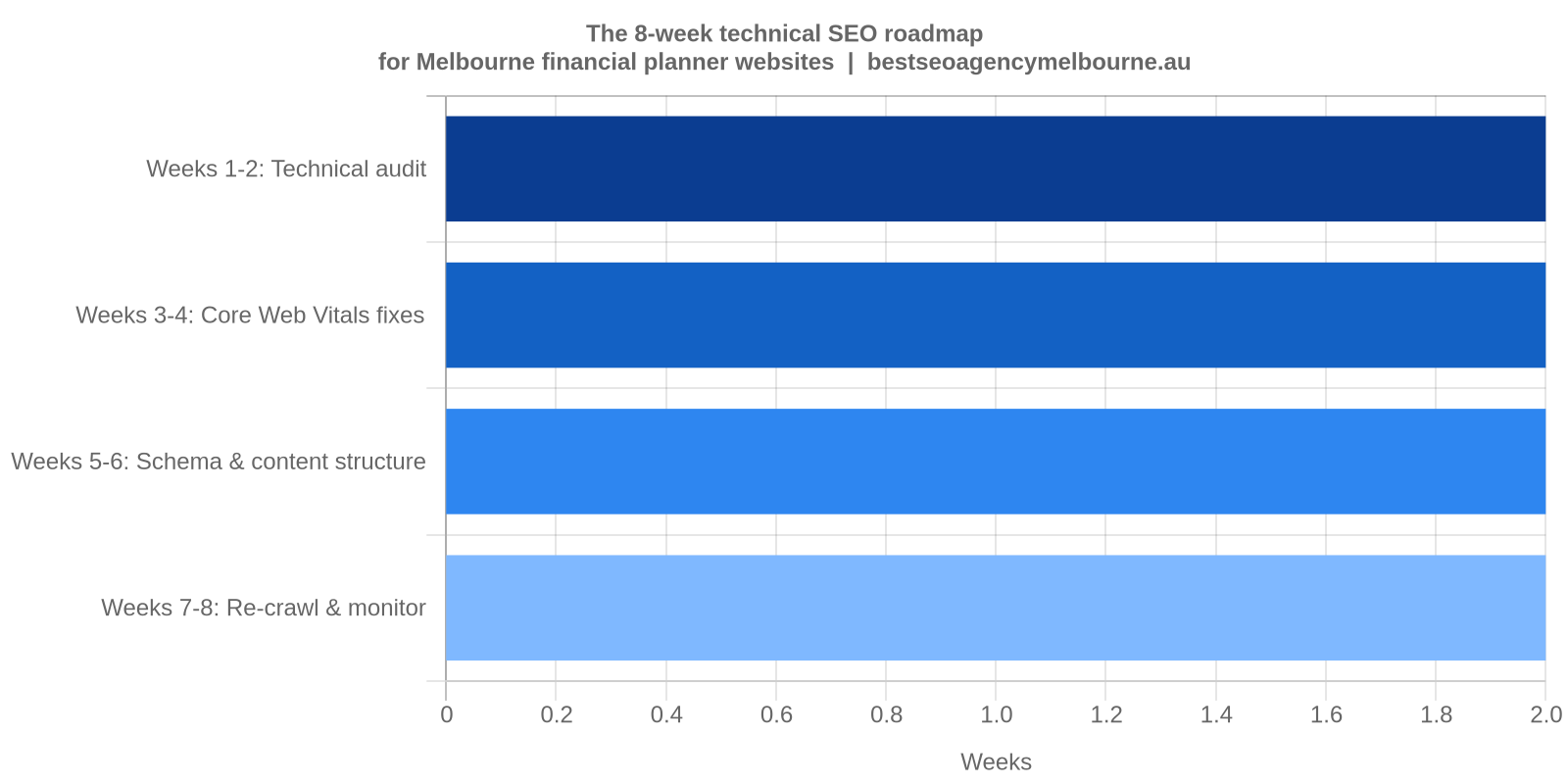
    Timeline showing the eight-week technical SEO roadmap Melbourne financial planners can follow, from a technical audit through to Core Web Vitals fixes and ongoing monitoring.

    Not sure where your own site stands on these three scores? Our free 30-minute strategy call includes a live check of all three, even if you never become a client. Book a free strategy call.

    Check 2: Mobile experience and the fine-print problem

    Financial planners in Australia carry disclosure obligations that most other local businesses do not: an Australian Financial Services Licence number, a Financial Services Guide link, and disclaimers about general versus personal advice. On desktop these fit neatly in a footer. On mobile, they are often the reason a page fails Google’s mobile usability checks, because the disclaimer text is set at 10 pixels and the licence number sits inside an image instead of real, readable text.

    A specialist checks three things here: whether tap targets (the phone number, the “book a call” button, the licence number link) are large enough to hit accurately on a phone screen, whether the Financial Services Guide is a real linked PDF rather than a scanned image Google cannot read, and whether the site’s mobile menu buries the phone number two taps deep. None of this is glamorous work. All of it affects whether Google, and the prospective client scrolling on a tram, can actually use the page.

    If your site’s mobile menu looks like the “before” example above, our Melbourne team can usually restructure it inside a two-week sprint. Talk to our team about what that would involve for your specific site.

    Check 3: Schema markup that tells Google who is actually giving the advice

    Schema markup is a small block of structured code added to a page that explains, in a format search engines can read directly, what a business is and who works there. Without it, Google has to guess whether a page belongs to a financial planning practice, an individual adviser, or a blog about money. With FinancialService and Person schema correctly set up, Google can connect the practice’s AFSL number, physical Melbourne address, and the individual adviser’s name and credentials, which matters for how the practice appears in local results and, increasingly, in AI-generated search summaries.

    This is one of the more overlooked areas. In a recent scan of financial planning sites across Melbourne’s inner suburbs, the majority had no FinancialService schema at all, and several had generic “Organization” schema that gave Google no way to distinguish the practice from a shopfront selling insurance policies. Adding this correctly is usually a half-day task for someone who understands both the schema specification and the compliance wording a licensed adviser is required to use.

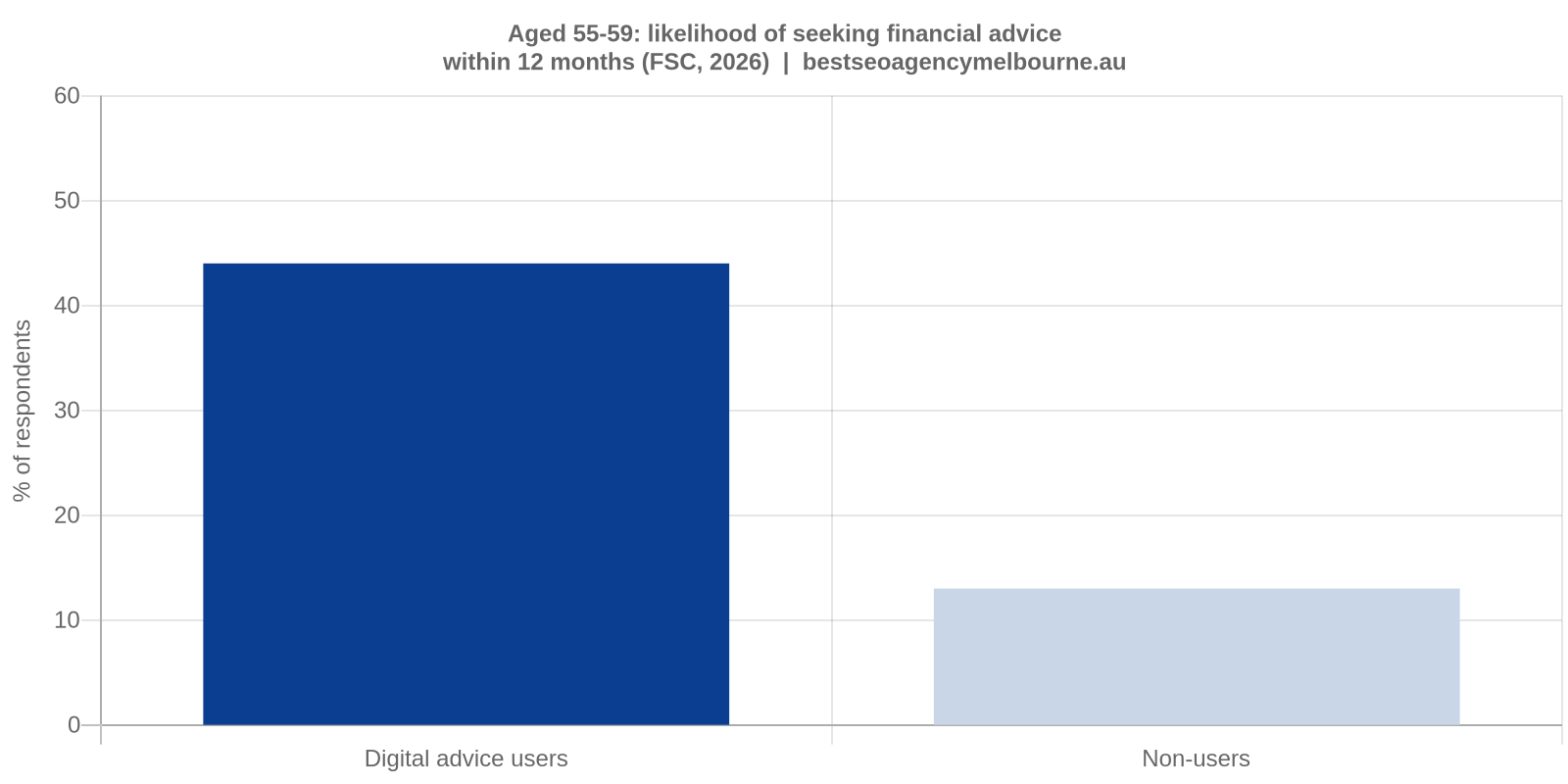
    Bar chart showing that 44 percent of digital advice users aged 55 to 59 plan to seek professional financial advice within 12 months, compared with 13 percent of non-users, based on 2026 Financial Services Council research.

    What this costs, how long it takes, and what goes wrong

    A full technical SEO fix for a Melbourne financial planning site, covering Core Web Vitals, mobile usability and schema markup, typically runs as an eight-week program rather than a single invoice, not unlike the staged approach we set out in our guide to local SEO for Melbourne mortgage brokers. Weeks one and two are the audit. Weeks three and four fix the speed and stability issues. Weeks five and six add schema and tidy the content structure around it. The final two weeks are spent re-crawling the site and watching Google Search Console to confirm the fixes actually landed, since Google does not update its Core Web Vitals report instantly.

    What goes wrong is almost always the same thing: a practice pays for a redesign, gets a beautiful new site, and the Largest Contentful Paint score gets worse because nobody compressed the new hero images or tested the new booking widget’s effect on responsiveness. A redesign and a technical SEO fix are not the same project, and treating them as one is the most common way Melbourne financial planning websites end up looking better and ranking worse.

    This kind of technical groundwork matters more than most advisers realise, particularly as more Australians start their advice journey online before ever picking up the phone. Financial Services Council research published in 2026 found that, among Australians aged 55 to 59, those who had engaged with digital advice tools were more than three times as likely to seek professional financial advice within the next 12 months as those who had not (44 per cent compared with 13 per cent). A financial planner’s website is often that first digital touchpoint, and a slow, broken one loses that early interest before a phone call ever happens.

    There is also a genuine business case for getting this right now rather than later. Australian Bureau of Statistics data released in August 2026 shows Financial and Insurance Services was one of the fastest-growing industry categories in the country over 2025 to 2026, up 4.3 per cent to 139,417 actively trading businesses nationally. More competitors are entering the market every quarter, and the ones with a technically sound website are the ones capturing the search traffic the others are leaving behind, the kind of gains we track in detail in our client results.

    Frequently asked questions

    Do I need to redesign my whole website to fix these issues?
    Usually not. Most of the fixes above happen on the existing site: compressing images, deferring scripts, and adding schema. A redesign is only necessary if the underlying platform cannot support these changes at all.

    How do I know if my site already has these problems?
    Google Search Console’s Core Web Vitals report will show you, for free, right now. Our FAQ page covers the other common questions Melbourne financial planners ask before starting.

    The bottom line

    Financial planners compete on trust, and a slow, broken website undermines that trust before a prospective client reads a single word of advice. The fix is rarely a full rebuild. It is a focused, eight-week technical program: Core Web Vitals, mobile usability, and schema markup, done properly and checked against Search Console rather than assumed. Book a free 30-minute consultation and we’ll tell you exactly where your site stands, no lock-in contracts, and a reply within 24 hours. Get started, or read more technical SEO guides on our blog.

  • Local SEO for Melbourne Mortgage Brokers: What It Actually Takes to Rank in 2026

    Mortgage brokers now settle 81.6 per cent of all new home loans in Australia, the highest share on record, according to MFAA data for the June 2026 quarter. That growth is good news for the industry and bad news for your search rankings: every one of those brokers is now competing for the same “mortgage broker near me” click in Melbourne. Getting found by Google is no longer optional, it is the difference between a full pipeline and an empty one. Here is what local SEO actually takes for a Melbourne mortgage broker in 2026, what it costs, and where most brokers waste their budget.

    Why local SEO works differently for a mortgage broker

    A cafe or a beauty salon can run a Tuesday special and see a booking that afternoon. A home loan decision takes weeks, sometimes months, and the borrower will compare several brokers before they pick up the phone. That means your website has to do a longer selling job than a typical local trade site. It needs to answer the practical questions, whether you deal with self-employed applicants, which lenders sit on your panel, whether you charge a fee, before the enquiry form is ever touched.

    Content also has to survive a compliance read, not just a keyword check. Your Australian Credit Licence number, lender panel disclosures and comparison rate warnings all need to appear correctly. An agency that has only worked with tradies and cafes will often skip this detail entirely, or bury it in fine print that does nothing for trust or rankings. Borrowers researching a broker want to see runs on the board: settlement numbers, panel size, and real answers for situations like theirs, not generic “servicing all of Melbourne” copy.

    Not sure whether your website is bringing in enquiries or quietly losing them to a competitor? Our free 30-minute strategy call will tell you, even if you never become a client. Book a free strategy call →

    The Google Business Profile fixes that actually bring in enquiries

    Reviews decide more of this than most brokers expect. Across BrightLocal’s 2026 Local Consumer Review Survey, 97 per cent of consumers said they read reviews before choosing a local business, and 31 per cent said they would only use a business rated 4.5 stars or higher. If your Google Business Profile has six reviews from 2020, a competitor with fifty recent ones is winning the click before your website has even loaded.

    Area Generic local SEO setup Mortgage broker specific setup
    Business category Listed simply as “Finance” Categorised specifically as mortgage broker, with loan types listed in the services section
    Reviews A handful of old reviews, no response strategy Steady monthly reviews, each one answered, negative reviews handled calmly
    Photos and posts Stock imagery, rarely updated Team photos, office photos, and monthly updates on rate changes or lending news
    Q&A section Left empty Pre-filled with the questions borrowers actually ask, such as fees and self-employed lending
    Four step Google Business Profile checklist for Melbourne mortgage brokers Checklist infographic showing four steps: correct category and services, a steady flow of recent reviews, updated photos and monthly posts, and a filled-in Q&A section. 1 Correct category 2 Steady reviews 3 Photos & monthly posts 4 Filled-in Q&A local-seo-checklist-melbourne-mortgage-brokers Best SEO Agency Melbourne
    Infographic: the four-step Google Business Profile checklist we run for every Melbourne mortgage broker client.

    Google’s own Business Profile help centre confirms the same fundamentals: complete, accurate profiles with regular activity outperform bare-bones listings. Our local SEO service exists mostly to close this exact gap. It is rarely glamorous work, updating photos, prompting reviews, filling in the Q&A section, but it is the difference between a profile that Google trusts and one it quietly buries below three competitors.

    Suburb pages and content that actually rank

    The other half of the job is content. A single “areas we serve” page with a list of forty suburbs does nothing for rankings, because Google can tell when a page has no real substance behind it. What works is a smaller number of genuinely different pages, built around real situations: a first home buyer page for Brunswick, a self-employed lending page for the CBD, a refinancing page for South Yarra. Each one should read like it was written for one borrower type, not for everyone at once, the same discipline behind the questions we recommend asking any agency you are comparing.

    This is also where cannibalisation creeps in. Two near-identical suburb pages targeting the same phrase will compete with each other and rank worse than one well-built page would alone. If you are unsure whether that is happening on your own site, our case studies show what a properly structured content set looks like once it is fixed.

    If your Google Business Profile is still sitting under a generic “Finance” category with no reviews from the last twelve months, talk to our Melbourne team. Fixing it properly is usually a two-week job. Talk to our team →

    Consumer review reading habits, 2026 Bar chart showing 97 per cent of consumers read reviews before choosing a local business, and 31 per cent will only use a business rated 4.5 stars or higher, based on BrightLocal’s 2026 Local Consumer Review Survey. 97% Read reviews before choosing a business 31% Require 4.5 stars or higher review-statistics-melbourne-mortgage-brokers-2026
    Infographic: how much reviews influence a borrower’s choice of mortgage broker, BrightLocal 2026 data.

    What this costs, how long it takes, and what goes wrong

    Expect a genuine Melbourne SEO program for a mortgage broker to start somewhere between $1,500 and $4,000 a month, depending on how competitive your target suburbs are. Most brokers see their Google Business Profile and easier suburb terms move within 60 to 90 days. The harder, high-value terms that every CBD broker wants usually take four to eight months of consistent work.

    The most common mistake is an agency reusing a template built for tradies: one generic service area page and a keyword list built for “plumber near me” style searches, with no attention to the compliance detail a finance client needs. The second is chasing backlinks from loan comparison directories and finance forums that Google treats as a spam risk rather than a trust signal. Slow and specific beats fast and generic in this niche, every time.

    Tracking whether it is actually working

    Local SEO for a mortgage broker is not something you set up once and forget. The Google Business Profile fixes above need checking every month, not because Google enforces a schedule, but because a bad review left unanswered for three weeks will still be sitting there when the next borrower reads it. We recommend tracking three numbers specifically: phone calls attributed to your Google Business Profile, form submissions from your suburb-specific pages, and how many of your target keywords sit in the top three map pack positions rather than page two.

    Google Search Console and GA4 will show you the second and third numbers for free, once they are set up correctly, which is worth doing even if you never hire an agency. What most DIY setups get wrong is treating a ranking improvement as the goal rather than the enquiry it should produce. A keyword can climb from position nine to position four and still generate zero extra phone calls if the page it points to does not answer the borrower’s actual question. Before spending another dollar on content or links, check whether your existing top pages are converting visits into enquiries, because fixing that is usually cheaper than chasing more traffic to a page that already leaks the traffic it has.

    Common questions

    How is local SEO for a mortgage broker different from a trade business? The keywords are more situation-specific, the content has to satisfy compliance requirements, and trust signals like settlement numbers and panel size matter as much as star ratings. Our FAQ section covers timelines and pricing in more detail.

    How long before a Melbourne broker sees more enquiries from Google? Most clients notice a genuine lift in phone and form enquiries between month three and month six, once Google Business Profile improvements and the first batch of suburb and situation-specific content have had time to be indexed and trusted.

    Do I need to rank for every home loan keyword in Melbourne? No. A smaller number of well-chosen, situation-specific terms, such as “self-employed home loan broker Melbourne” or “refinance broker South Yarra”, will usually bring better-qualified enquiries than a broad term that attracts comparison-site traffic and window shoppers.

    The brokers winning Melbourne’s search results right now are not the ones spending the most on ads. They are the ones whose website answers a real borrower’s question, backed by a Google Business Profile that looks active and trusted. Book your free consultation and we will show you exactly where your site stands against the brokers already outranking you. No lock-in contracts, and we reply within 24 hours. Get started → For more guides like this one, visit our SEO blog.

  • Best SEO Agencies in Melbourne for Mortgage Brokers: What to Look for in 2026

    Mortgage brokers now settle 81 per cent of all new home loans in Australia, the highest share ever recorded, according to Cotality data commissioned by the Mortgage and Finance Association of Australia. That is a lot of borrowers choosing a broker over a bank branch, and most of them start that choice with a Google search rather than a referral from a mate. The trouble for a Melbourne broker is that the search results are just as crowded as the home loan market itself. Comparison sites, aggregators and every other broker in your postcode are chasing the same “mortgage broker near me” click. This guide covers what a genuine SEO specialist checks first, what it costs, how long it takes, and the questions worth asking before you sign with anyone.

    What makes SEO for mortgage brokers different

    Most Melbourne SEO agencies built their process on trades and hospitality clients: plumbers, cafes, beauty salons. A mortgage broker is a different animal. Your content has to survive a compliance read, not just a keyword check. Lender panel size, comparison rate disclosures and your Australian Credit Licence number all need to appear correctly, and a rushed agency will either skip them or bury them in fine print that Google cannot read as a trust signal anyway.

    Borrowers researching a broker are also making a bigger decision than choosing a cafe for lunch. They want to see runs on the board: how many loans you have settled, which lenders you deal with, and what happens if their income is irregular or their deposit is thin, the kind of detail we showcase in our own client case studies. Generic SEO copy that works fine for a plumber in Brunswick reads as thin and unconvincing on a finance site, and Google’s own systems increasingly reward pages that show real experience over recycled advice.

    There is also a timing problem specific to finance. A cafe or a beauty salon can post an offer and see a booking the same afternoon. A home loan decision takes weeks, sometimes months, and the borrower will look at several brokers before they call anyone. That means your website is doing a longer selling job than a typical trade site. It has to answer the boring but decisive questions, such as whether you deal with self-employed applicants, whether you charge a fee, and which lenders sit on your panel, before the enquiry form is ever touched. An agency that only knows how to write “servicing all of Melbourne’s eastern suburbs” style copy will not get you there.

    Not sure whether your current site is winning or losing you enquiries? Our free 30-minute strategy call will tell you, even if you never become a client. Book a free strategy call →

    What a genuine specialist checks first

    Ask any agency how they would approach your site and you will quickly find out whether they have worked with a finance client before. A generalist will start talking about blog frequency and social sharing. A specialist will ask about your lender panel, your loan types, and whether your current site even has a compliant privacy policy and credit representative disclosure, because Google’s trust signals for finance content depend on getting that boring detail right first. The table below is a rough guide to the difference in approach.

    Area Generalist local SEO agency Mortgage broker specialist
    Keyword targeting Broad terms like “mortgage broker Melbourne” Buyer-intent and situation-specific terms, such as “self-employed home loan Melbourne” or “first home buyer broker Richmond”
    Content compliance Ignores credit licence and disclosure requirements Builds licence numbers, lender panel disclosures and comparison rate warnings into the page correctly
    Local pages One “areas we serve” page with a suburb list Individual suburb pages with genuinely different content, not the same paragraph with the suburb name swapped
    Trust signals A generic testimonials carousel Settlement numbers, lender panel size and case studies broken down by loan type
    The 90 day Melbourne mortgage broker SEO timeline A timeline graphic showing three stages of mortgage broker SEO in Melbourne: weeks one and two audit and compliance check, weeks three to six content and Google Business Profile build, and weeks seven to twelve first ranking movement. Weeks 1–2 Audit & compliance check Weeks 3–6 Content & GBP build Weeks 7–12 First ranking movement seo-results-timeline-melbourne Best SEO Agency Melbourne
    Infographic: the 90 day timeline a genuine Melbourne SEO specialist follows for a mortgage broker client, from audit through to first ranking movement.

    Local SEO fundamentals that actually move the needle for brokers

    Ranking for finance keywords in Melbourne is hard, but the fundamentals are not exotic. A properly categorised Google Business Profile, genuine suburb pages and a steady flow of reviews still do most of the work. That last point matters more than most brokers realise: 97 per cent of consumers now read reviews before choosing a local business, according to BrightLocal’s 2026 Local Consumer Review Survey. If your Google Business Profile has three reviews from 2019, a competitor with forty recent ones is winning the click before your website even loads. Our local SEO service exists largely to fix exactly this gap.

    Mortgage broker share of new home loans, 2018 versus 2026 A bar chart showing Australian mortgage broker market share of new home loans rising from 55.3 per cent in March 2018 to 81 per cent in March 2026, based on MFAA and Cotality data. 55.3% March 2018 81% March 2026 broker-market-share-growth-melbourne
    Infographic: broker market share of new Australian home loans climbed from 55.3 per cent in March 2018 to 81 per cent in March 2026 (MFAA / Cotality data).

    That growth is exactly why the search results have become more competitive, not less. Every one of those brokers now knows that Google is where borrowers start looking, which is the same reason our specialist-versus-generalist test we use when vetting agencies for builders applies just as directly here, and it is the same logic behind the Google Business Profile fixes we recommend for beauty salons chasing bookings. The specific checklist changes by industry. The underlying test, whether the agency understands your actual client and not just your suburb, does not.

    If your Google Business Profile still lists you under a generic “finance” category with no recent reviews attached, talk to our Melbourne team. Fixing it properly is usually a two-week job, not a two-month one. Talk to our team →

    What this costs, how long it takes, and what goes wrong

    Expect a genuine Melbourne SEO program for a mortgage broker to start somewhere between $1,500 and $4,000 a month, depending on how competitive your target suburbs are and how much content and outreach work is needed. Most brokers see their Google Business Profile and easier suburb terms move within 60 to 90 days. The harder, high-value terms, the ones every broker in the CBD wants, usually take four to eight months of consistent work.

    The most common mistake is an agency reusing a template built for tradies: one generic service area page, a keyword list built for “plumber near me” style searches, and no attention to the compliance text a finance client actually needs. The second most common mistake is chasing backlinks from finance forums and loan comparison directories that Google treats as a spam risk rather than a trust signal. Slow and specific beats fast and generic every time in this niche.

    The third mistake, and the one that costs brokers the most enquiries, is treating the website as a brochure instead of a sales tool. A page that lists services without answering “can you help someone in my situation” will lose the borrower to whichever competitor answers that question first. Every page on a broker’s site should read like it was written for one specific borrower type, a first home buyer, a self-employed contractor, someone refinancing after a rate rise, rather than for everyone at once.

    Common questions

    How is SEO for a mortgage broker different from SEO for a plumber or a cafe? The keywords are more situation-specific, the content has to satisfy compliance requirements, and trust signals like settlement numbers and lender panels matter more than star ratings alone. See our full FAQ section for more detail on timelines and pricing.

    How long before a Melbourne mortgage broker sees more enquiries from Google? Most clients notice a genuine lift in phone and form enquiries between month three and month six, once Google Business Profile improvements and the first batch of suburb and situation-specific content have had time to be indexed and trusted.

    Do I need to be on the front page for every home loan keyword? No. A handful of well-chosen, situation-specific terms with genuine buyer intent, such as “refinance broker South Yarra” or “self-employed home loan broker Melbourne”, will usually bring in better-qualified enquiries than ranking for a broad term like “home loans” that attracts window shoppers and comparison-site traffic.

    The brokers winning Melbourne’s search results right now are not the ones with the biggest ad budget. They are the ones whose website actually answers a self-employed borrower’s real question, backed by a Google Business Profile that looks active and trusted. Book your free consultation and we will show you exactly where your site stands against the brokers already outranking you. No lock-in contracts, and we reply within two hours. Get started → For more guides like this one, visit our SEO blog.

  • Best Technical SEO Agencies in Melbourne for Builders

    A builder’s website rarely loses enquiries because the copy is wrong. It loses them because the site is slow on a job-site 4G connection, the schema markup doesn’t tell Google what suburbs you actually service, or half the service-area pages aren’t indexed at all. That’s the gap between choosing an SEO agency on price and choosing one that actually checks the technical foundations first.

    This guide covers what a genuine technical SEO specialist looks at on a Melbourne builder’s site, the checks that matter most in 2026, and what it should cost to get right.

    What “technical SEO” actually means for a builder

    Technical SEO is simply making sure Google (and your customers) can find, load and use your site without friction. For a builder, that means: the site loads fast on a tradie’s phone at a job site, Google can crawl and index every suburb page you service, the structured data (schema) tells Google you’re a builder in Melbourne rather than leaving it to guess, and nothing is broken on mobile. None of it is about clever tricks — it’s about removing the friction that costs you enquiries before a homeowner even reads your copy.

    The 5 checks a genuine technical SEO specialist runs first

    • Core Web Vitals and page speed. How fast does your site load, and does it stay stable while loading (no jumping buttons or images)? This is measured on real user data, not just a lab test.
    • Mobile usability. Tap targets, readable text without zooming, and forms that actually work on a phone screen with one thumb.
    • Crawlability and indexation. Are your suburb and service pages (“builder in Brunswick”, “renovation Hawthorn”) actually in Google’s index, or quietly excluded?
    • Schema markup. Structured data (LocalBusiness, service area, reviews) that spells out who you are and where you work, so Google can match you to local searches with confidence.
    • Site architecture. A clear, shallow structure so Google (and homeowners) can get from your homepage to any service-area page in two or three clicks.

    Book a free 30-minute strategy call with a senior consultant and we’ll run these five checks on your site live, at no cost.

    Core Web Vitals: why Google’s 2026 threshold change matters for builders

    Core Web Vitals are the three measurements Google uses to judge whether a page is genuinely fast and stable for real visitors: Largest Contentful Paint (how long the main content takes to appear), Interaction to Next Paint (how quickly the page responds when tapped), and Cumulative Layout Shift (whether things jump around while loading). Google’s own guidance confirms a “good” score needs all three passing for at least 75% of visits — and the bar for what counts as “good” has tightened in 2026, not loosened.

    Core Web Vitals pass rate by Google ranking position, 2026: 91% at position 1 · 78% at positions 2–3 · 61% at positions 4–10 · 47% for page 2 results.
    Source: web.dev, Google, 2026.

    In plain terms: the closer a page sits to a passing Core Web Vitals score, the more often it shows up near the top. For a builder competing against three or four other trades businesses for the same handful of suburb searches, that gap is often the difference between page one and page two.

    Common technical problems on Melbourne builder sites

    Issue What it looks like Typical fix Priority
    Slow Largest Contentful Paint Hero image or gallery takes 4+ seconds to appear on mobile Compress and lazy-load images, use a faster host or CDN High
    Missing or thin schema markup No LocalBusiness or service-area schema in the page code Add structured data for business type, suburbs served and reviews High
    Suburb pages not indexed Service-area pages don’t appear when you search site:yourdomain.com.au Fix internal linking, submit an updated sitemap, remove noindex tags High
    Layout shift on load Enquiry form or phone number jumps as the page finishes loading Reserve space for images and ads before they load Medium
    Duplicate or thin suburb content Ten suburb pages with near-identical wording Write genuinely distinct, locally specific content for each area Medium

    How homeowners actually search for a builder

    Most of the research happens on a phone, in short bursts, often while a homeowner is scrolling reviews or comparing three builders side by side. If your site is slow to load or awkward to tap through on mobile, you’re often ruled out before your quote is even requested.

    How homeowners search for a builder online, 2026: around 75% of enquiry-stage browsing happens on mobile, and mobile drives roughly 58% of construction-industry site traffic — but only about 35% of conversions, because slow or clunky mobile experiences push enquiries back to desktop or lose them altogether.
    Sources: BrightLocal and Web Tonic construction industry data, 2026.

    Notice the gap between traffic share and conversion share: mobile brings in the browsing, but a clunky mobile experience still pushes the actual enquiry back to desktop, or loses it altogether. That gap is exactly what technical SEO closes.

    Want the technical side handled properly? See our Technical SEO service for the full scope of what we check and fix.

    What it costs and how long it takes

    A proper technical SEO audit for a builder’s site typically takes one to two weeks and should cover every item in the checklist above, not just a speed score. Ongoing technical maintenance (fixing new issues as the site changes, re-testing after each Google update) is usually billed monthly alongside broader SEO work. The trap to avoid is a one-off “speed fix” that ignores schema and indexation — it treats the symptom, not the actual reason enquiries are being lost.

    Questions to ask before you hire

    • Can you show me the Core Web Vitals report for my site right now, not just a generic promise?
    • Will you check indexation on every suburb and service page, not just the homepage?
    • What schema markup will you add, and how does it apply specifically to a builder?
    • Do you have experience with construction or trade clients, or is this generic SEO?

    If you’ve already read our guide on local SEO for Melbourne construction companies, technical SEO is the foundation that makes those local rankings possible in the first place — without it, even the best Google Business Profile struggles to convert.

    Getting the technical foundations right is not a one-off job, it’s the base everything else is built on. Book your free 30-minute strategy call with a senior Melbourne SEO consultant and we’ll show you exactly where your site is losing enquiries.

  • Local SEO for Melbourne Construction Companies: What It Actually Takes to Rank in 2026

    A concreter in Dandenong and a builder in Brunswick can do equally good work, yet only one of them shows up when a homeowner in either suburb searches “concreter near me” tonight. That gap rarely comes down to the quality of the work. It comes down to whether Google can find, trust and recommend the business at the exact moment someone is ready to hire a contractor. Construction is one of Australia’s largest industries by business count, with 462,939 construction businesses trading nationally as of June 2025, according to the Australian Bureau of Statistics. In a market that crowded, local search visibility is often the difference between a full pipeline and a quiet phone. Here is what local SEO actually involves for a Melbourne construction company, in plain terms, and roughly how long each part takes.

    What local SEO actually means for a construction business

    Local SEO is the work that decides whether your business appears in the three-listing “map pack” and the local results Google shows when someone searches for a builder, plasterer, electrician or landscaper near them. It is different to general SEO, which focuses on ranking a website nationally for broad terms. For a construction company that only services Melbourne and its surrounding suburbs, the map pack matters more than a page one ranking for a generic keyword nobody in Ferntree Gully is actually typing into Google.

    Three things drive it. The first is your Google Business Profile, the free listing that appears with your reviews, photos and opening hours whenever someone searches your business name or your trade plus a suburb. The second is the consistency of your business details across the web, directories, supplier listings, industry associations and old profiles you may have forgotten about. The third is the signal your own website sends about exactly which suburbs and services you cover, which most construction sites get wrong by writing one generic page for the whole of Melbourne instead of pages built around the areas they actually service.

    Not sure where your business currently stands on any of this? Our free 30-minute audit will tell you, even if you never become a client. Book a free consultation and we will walk through your current Google Business Profile and website together.

    The five things that actually move the needle

    Most construction companies waste money on generic SEO packages before the basics are even in place. These are the five areas worth fixing first, in the order we typically tackle them for local SEO clients in the trades and construction space, and the same fundamentals sit behind the case studies on our results page.

    Local ranking factor Why it matters for a construction company Where to fix it
    Google Business Profile completeness Incomplete profiles rank behind competitors who have filled in services, hours, service areas and licence details Google Business Profile dashboard
    Reviews and response rate Review volume and recency are one of the clearest trust signals Google and homeowners both use Post-job follow-up process
    NAP consistency (name, address, phone) Mismatched details across directories confuse Google about which listing is genuine Directories, supplier listings, old profiles
    Project photos and service-area pages Real project photos and suburb-specific pages tell Google which jobs you actually do, and where Website and Google Business Profile
    Site speed and technical health A slow, broken site loses the ranking benefit that good local signals have earned it Hosting and website build

    Google Business Profile deserves the most attention because it is free, it is usually the first thing a homeowner sees, and most construction businesses only fill in half of it. Add every service you actually offer rather than a single generic category, list your licence or registration number if your trade requires one, and upload real photos from finished jobs rather than stock images. A profile like this, kept current, does more for a builder’s phone than most paid advertising.

    Citations matter too, even though they are the least glamorous part of the list. Directories like hipages, Houzz, True Local and the Yellow Pages still carry weight, and industry bodies such as the Housing Industry Association or Master Builders Victoria are worth claiming a listing on if your business is a member. The goal is simple: your business name, address and phone number should read identically everywhere they appear online. A single old address from a previous office, sitting quietly on a directory from years ago, can confuse Google about which listing to trust.

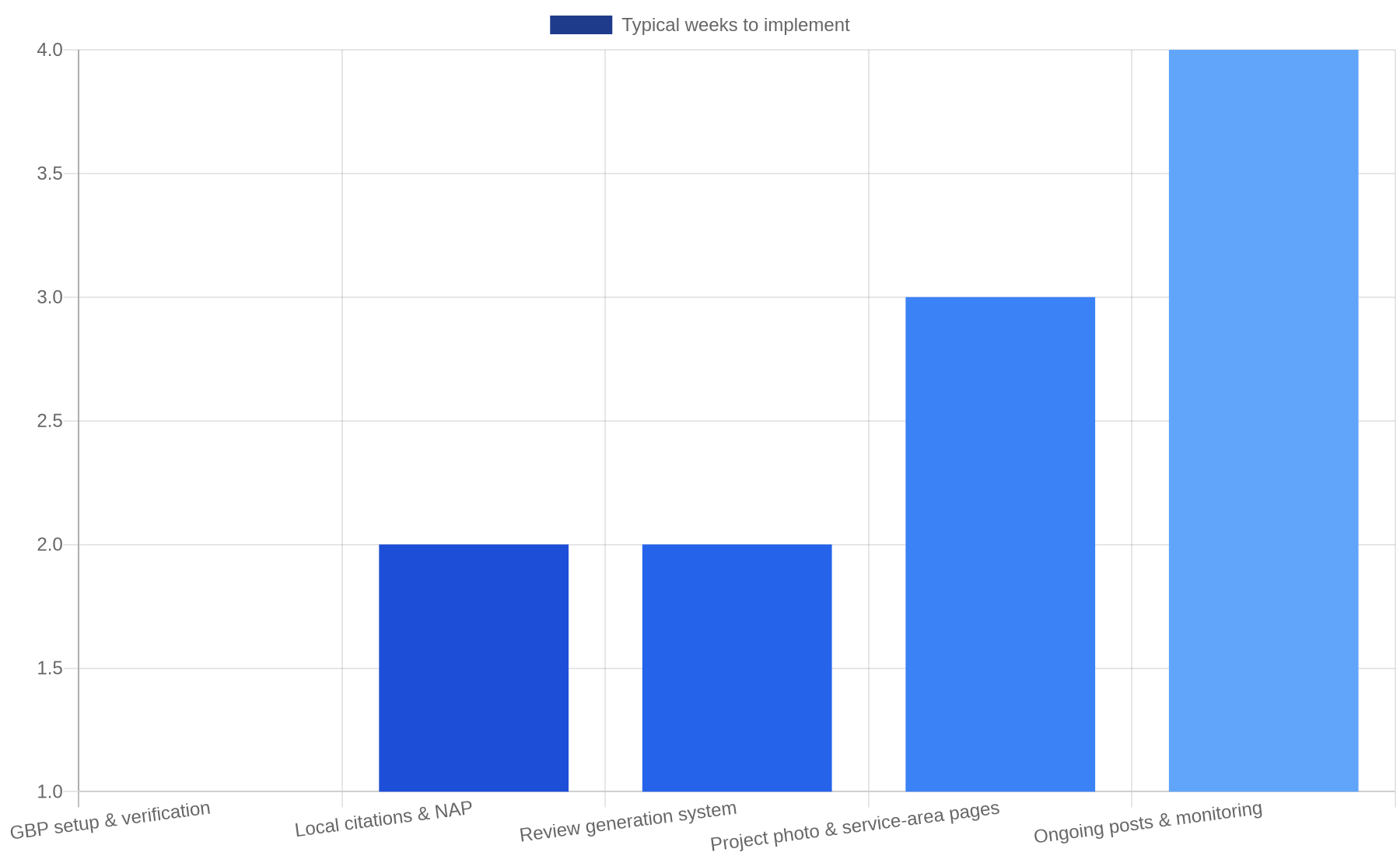
    Five-step local SEO checklist and typical implementation timeline for Melbourne construction companies

    A typical rollout order for a Melbourne construction company starting from scratch. Businesses with an existing Google Business Profile can usually skip straight to reviews and service-area pages.

    Why this matters more than most business owners think

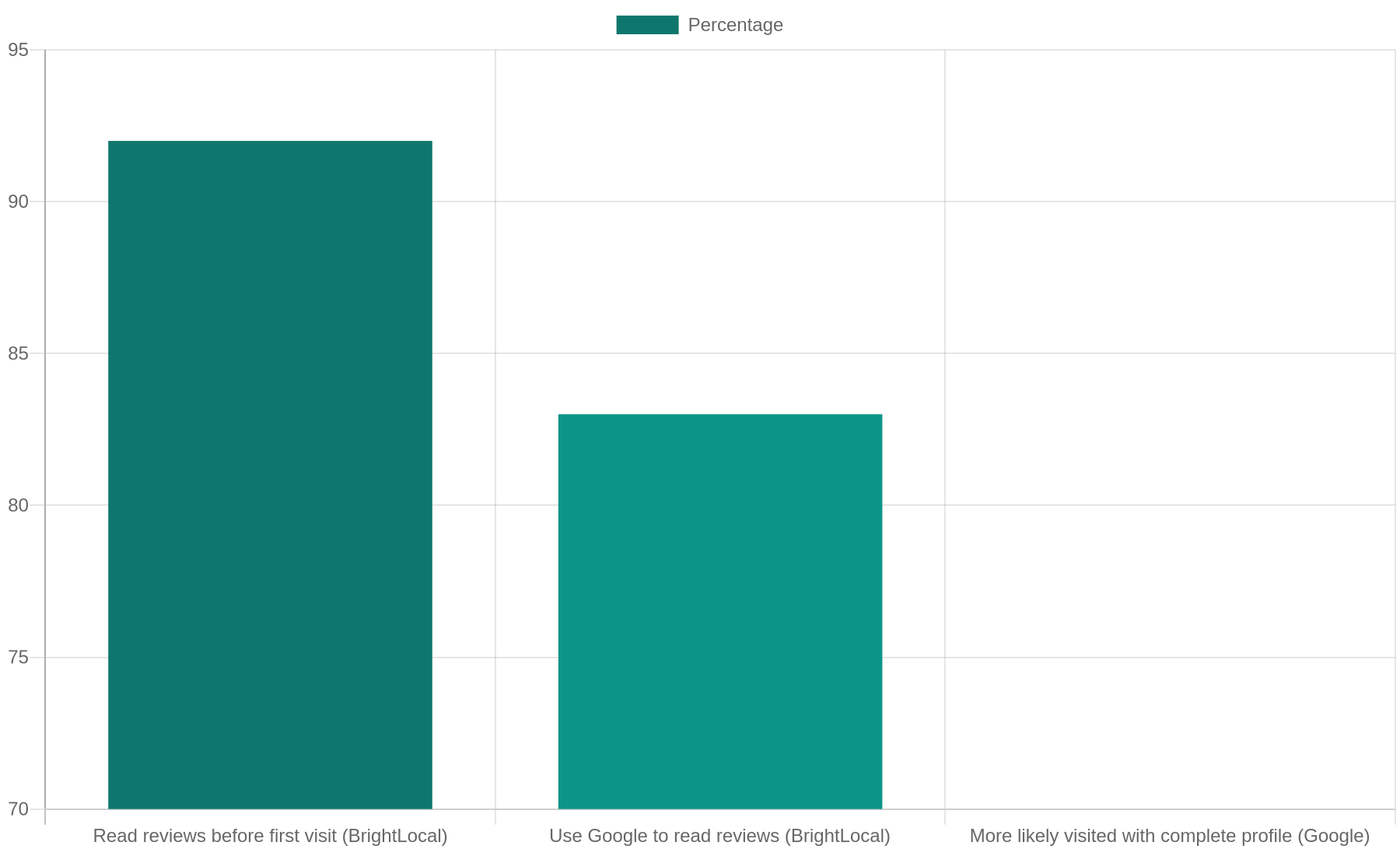
    The research backs this up clearly. In its 2024 Local Consumer Review Survey, BrightLocal found that 92% of consumers read reviews of a local business before their first visit or enquiry, and 83% of them do that reading on Google specifically. Google’s own guidance for businesses states that a complete, verified Business Profile makes a business roughly 70% more likely to attract a visit than an incomplete one. For a construction company, a “visit” is a phone call, a quote request or a message asking whether you cover a particular suburb. If your profile is thin and your reviews are three years old, you are handing that enquiry to whichever competitor turned up first.

    Bar chart showing the percentage of consumers who read reviews before their first visit and the impact of a complete Google Business Profile

    If your Google Business Profile still looks like the “before” example above, three-year-old reviews and a handful of blurry photos, talk to our Melbourne team. Fixing it properly is usually a two to three week job, not a months-long project, and it is often the single highest-return piece of marketing a small construction business can do.

    What this costs, how long it takes, and what goes wrong

    A single-location Melbourne construction or trade business can expect to pay somewhere between $800 and $2,500 a month for an ongoing local SEO program, depending on how many suburbs and services are being targeted and how competitive they are. A landscaper working across six or seven eastern suburbs sits comfortably in that range. Builders and larger renovation companies competing across multiple council areas, or fighting for visibility in the inner city, usually sit at the higher end because there are simply more competitors to outrank. Most businesses see the first movement in map pack visibility within 6 to 10 weeks, with meaningful enquiry growth by month four or five. Highly competitive categories, like general builders in the inner suburbs, can take longer, and anyone promising page one rankings inside a fortnight is not being straight with you.

    The most common mistakes we see are not exotic. Businesses create a second Google Business Profile after moving office and end up with two competing, half-updated listings, both diluting the other’s reviews and rankings. Owners ask happy clients for reviews inconsistently, so the profile goes quiet for months at a time and then gets a sudden cluster, which looks unnatural to both Google and prospective customers. Website content gets written once, for “Melbourne”, instead of for the dozen suburbs a business actually services, which means the site never appears for any of them specifically. And plenty of construction companies hire a generalist digital marketing agency that has never dealt with builder’s licence numbers, trade certifications or the way homeowners actually search for renovation work, which shows up as generic copy that could belong to any industry from hairdressing to plumbing.

    Common questions

    How long before a construction company sees results from local SEO? Most Melbourne clients see initial map pack movement within 6 to 10 weeks and a clear increase in phone enquiries by month four. See our FAQ for more on typical timelines across services.

    Do separate job sites count as separate locations for Google? No. Google Business Profile is built around your registered business address or a defined service area, not individual project sites, so a construction company should run one profile per genuine office location, not one per job.

    Is local SEO worth it for a two or three person building crew? Often, yes, because smaller crews rely more heavily on a steady stream of local enquiries than large builders with existing referral networks, and the fixes above cost far less than most owners assume once the basics are in place.

    For a broader look at hiring the right specialist rather than doing this in-house, our guide to choosing an SEO agency as a builder covers the questions worth asking before you sign anything. The same local SEO fundamentals covered here also apply, suburb by suburb, in our local SEO checklist for Melbourne beauty salons, if you want to see how the same system plays out in a different trade.

    The takeaway

    Local SEO for a construction company is not complicated, but it does need to be done properly and kept current. Get your Google Business Profile complete, keep your business details consistent everywhere they appear, ask every satisfied client for a review, and build pages for the actual suburbs you service. Book your free consultation today. No lock-in contracts, a reply within 24 hours, and a Melbourne-based team who understands the trades. Get started, or read more on our SEO blog.

  • Best SEO Agencies in Melbourne for Builders: What to Look for in 2026

    A homeowner in Brunswick who wants a rear extension does not open the phone book. They search “builders near me” or “home renovation builder Melbourne,” glance at the Map Pack, skim a handful of reviews, and call one of the first three names they see. If your building company is not one of them, you are not losing that job to a better builder, you are losing it before your name is even in the running. This guide sets out what a genuine SEO agency actually does for a Melbourne building company, what it should cost, how long results take, and the specific things worth checking before you sign anything.

    Why the first page of Google decides who gets the enquiry

    Builders have always won work on reputation and referral, and that has not disappeared. What has changed is where the referral conversation now happens before it happens with you. Ninety-seven percent of local searches start with a search engine, and 97% of consumers read reviews before choosing a local business, a figure that has climbed as buyers grow warier of a handful of old five-star ratings and want to see recent, specific feedback (BrightLocal, Local Consumer Review Survey 2026). For a building company, that means your Google Business Profile, your project photos, your reviews and the suburb pages on your website are doing the job a signboard and a word-of-mouth referral used to do on their own.

    The stakes are higher again in 2026. After a wave of well-publicised builder collapses across Australia, homeowners researching a build or renovation are now far more focused on risk: a builder’s financial stability, a clear fixed-price contract, and a track record they can actually verify online before they hand over a deposit (State of the Australian Renovation Market, 2026). A thin, outdated website with no recent reviews does not just cost you a click, it raises exactly the doubts a nervous homeowner is trying to screen out.

    Not sure how your business currently shows up against nearby builders? Our free 30-minute audit will show you exactly where you stand, even if you never become a client. Book a free consultation.

    What a genuine Melbourne SEO agency actually does for a builder

    “SEO” gets used loosely by everyone from a $200-a-month directory reseller to a specialist consultancy, so it is worth being specific about what real work looks like for a building company. It generally means: actively managing your Google Business Profile, including project categories, service areas and fresh photos of completed jobs; building genuine suburb-level pages for the areas you actually build in, rather than one thin page with a list of suburb names stuffed at the bottom; a system for collecting and responding to reviews after every handover, not an occasional reminder email; fixing technical issues such as a slow-loading gallery page that pushes mobile visitors back to the search results, the kind of work covered by our technical SEO service; and earning links from legitimate local sources such as supplier partners, industry associations and local publications, which is what our authority link building work is built around. The table below shows how that compares with the two approaches most builders try first.

    Approach What you actually get Typical monthly cost
    DIY (you or office manager) Basic Google Business Profile, no suburb pages, reviews requested inconsistently $0 cash, 3–5 hours/week of your time
    General digital marketing freelancer Some on-page tweaks, occasional social posts, limited local search or construction-industry expertise $500–$1,200
    Specialist Melbourne local SEO agency Full Google Business Profile management, suburb pages, review system, technical fixes, fortnightly reporting $1,300–$3,800
    How to evaluate an SEO agency for your building company A four-stage timeline: stage one audit and suburb strategy, stage two Google Business Profile and reviews, stage three content and case studies, stage four reporting and no lock-in contract. How to evaluate an SEO agency for your building company 1 Audit & suburb strategy 2 Google Business Profile & reviews 3 Content & case studies 4 Reporting & no lock-in contract bestseoagencymelbourne.au
    Infographic: the four-stage process for evaluating an SEO agency for a Melbourne building company, from initial audit through to reporting and contract terms.

    What to look for when comparing agencies

    Once you have shortlisted a few names, the real differences show up in specifics, not sales pitches. Ask to see an actual suburb page they have built for another trade or construction client, not just a homepage screenshot. Ask how they handle reviews: do they have a system for requesting them after every job, or is it left to chance? Ask what their reporting shows, rankings alone, or actual calls, form submissions and enquiry volume tied back to your revenue. And ask directly whether there is a lock-in contract, because a specialist confident in their results should not need one to keep you.

    This is also where it is worth being honest about what separates a genuine specialist from a generalist wearing an SEO hat. Our team has been doing this work for Melbourne businesses since 2012, entirely in-house with no offshore outsourcing, across more than 500 local campaigns. We report in plain language every fortnight rather than burying results in a jargon-heavy PDF, and our case studies show real, traceable revenue outcomes rather than vanity ranking screenshots. None of that is unique to us in theory, but in practice it is rarer than it should be, which is exactly why it is worth checking for before you sign.

    A proper strategy for a builder also leans on content and SEO strategy work that is specific to construction: pages that answer the questions a homeowner actually types in, such as council permit timelines in your service area, typical build costs for your region, or what a fixed-price contract should include, rather than generic “why choose us” copy that could sit on any builder’s site in the country. If a proposed strategy would read exactly the same on a competitor’s website, it has not been built for your business yet. Get a custom proposal and we will show you what that looks like for your suburbs and your typical project size.

    What it costs, how long it takes, and what goes wrong

    Expect to pay somewhere between $1,300 and $3,800 a month for genuine local SEO management on a building company, depending on how many suburbs you service and how competitive they are. Most Melbourne builders see initial ranking movement within 60 to 90 days, with a real lift in calls and enquiries by month four to six. Anyone promising page-one rankings within two weeks is either exaggerating or planning to use tactics that risk your listing being suspended.

    The construction sector itself gives some sense of why local visibility matters more, not less, right now. Nationally, 121,140 detached houses were approved for construction in the 2025/26 financial year, up 7.0% on the year before, while Victoria’s own approvals grew 2.8% in July 2026, though the state is still building at closer to 35,000 detached starts a year against nearer 40,000 during the 2010s (Housing Industry Association, July 2026; HIA Victoria Regional Update, 2026). More approvals nationally means more builders competing for the same searches, and a Victorian market that still lags the recovery means every enquiry matters more here than in faster-growing states.

    Why Melbourne builders can’t rely on referrals alone Three statistics: 97 percent of local searches start with a search engine, 97 percent of consumers read reviews before choosing a local business, and detached house approvals rose 7 percent nationally in 2025/26. Why Melbourne builders can’t rely on referrals alone 97% of local searches start with a search engine 97% read reviews before choosing a local business +7% more homes approved for construction in 2025/26 Source: BrightLocal 2026 · HIA 2026 · bestseoagencymelbourne.au
    Infographic: the search, review and construction-approval data behind why Melbourne builders need strong local search visibility in 2026.

    The most common mistake we see builders make is signing a 12-month lock-in with an agency that will not show its working, followed closely by treating reviews as optional. With homeowners now actively screening builders for financial stability and track record after a string of industry collapses, a profile sitting on a handful of reviews from 2023 does more damage than an outdated logo ever could.

    Frequently asked questions

    Do I need a separate page for every suburb I build in?
    No, just the ones with enough genuine search volume to justify a page that is actually useful, with real project photos and specifics for that area. A handful of strong suburb pages will consistently outperform twenty thin, near-identical ones.

    Will SEO help if most of my work comes from referrals and past clients?
    Yes, because even a referred homeowner checks you out online before calling, comparing your reviews, photos and site against whoever else they found searching. Referral work and search visibility reinforce each other rather than compete.

    How is this different to running Google Ads for my building company?
    Google Ads puts you in front of buyers immediately but stops the moment you stop paying. Local SEO takes longer to build but keeps generating enquiries without an ongoing per-click cost once you are ranking, which is why most established Melbourne builders eventually run both. You can find more detail on our approach in the FAQ section of our main site.

    If homeowners searching for a builder in your service area cannot find you before they find someone else, that is a fixable problem, not a fact of the industry. Book your free, no-obligation consultation today: a Melbourne-based team, no lock-in contracts, and a reply within 24 hours. We have covered the same buying decision for other trades too, including our guides to choosing an SEO agency as a Melbourne electrician and what Melbourne plumbers should look for in local SEO, both worth a read if you work alongside those trades on site. For more guides like this one, visit our SEO blog.

  • On-Page SEO for Melbourne Vet Clinics: The Practical Guide to Title Tags, Content, Speed and Schema

    A pet owner searching “vet near me” at 9pm with a limping dog does not read your homepage top to bottom. They scan a title in Google, glance at your site for three seconds, and either call or bounce to the next listing. On-page SEO is the unglamorous, entirely controllable part of getting that moment right: the title tags, the actual words on your pages, how fast they load, and whether Google understands what your clinic does. Get it wrong and even a well-run, well-loved practice stays invisible. Here is exactly what to fix, in order.

    Why on-page SEO decides whether pet owners even call you

    According to a 2026 survey of 2,000 pet owners across Australia and the UK, 83% consider a clinic’s website important when choosing where to take their pet, and almost a third, 29%, have decided against a specific clinic purely because of its website. For pet owners under 35, a poor website is a deal-breaker for 47% of them. None of that is about clinical quality. It is about whether your site looks credible, loads properly, and answers the question in front of them fast enough.

    ๐Ÿ“Š Infographic: Why your website is costing you pet owners (83% say it matters, 29% have said no because of it)

    (Branded data graphic โ€” pending upload to media library)

    Fix your title tags and meta descriptions first

    Your title tag is the blue link people see in Google, and it is one of the strongest signals both Google and the pet owner use to judge relevance in the first two seconds. Google’s own guidance on writing effective title links is blunt: make every title unique, descriptive, and specific to that page, not a boilerplate template repeated across your site. “Home” or “Services” as a title tag wastes the most valuable real estate you have.

    For a Melbourne vet clinic, a weak title reads “Veterinary Services | Clinic Name”. A working one reads “Vet in Richmond, Melbourne | Same-Day Appointments | Clinic Name”. Same logic applies to your meta description: it is not a ranking factor directly, but it is your pitch on the search results page, so it should mention your suburb, your point of difference (same-day appointments, after-hours care, a specific species focus), and be under 155 characters so it does not get cut off.

    Not sure where your site stands? Our free 30-minute audit will tell you, even if you never become a client. Book a free strategy call.

    Write page content a pet owner actually needs

    Most vet clinic websites describe services in the same generic language: “comprehensive care”, “compassionate team”, “state-of-the-art facility”. None of it is wrong, and none of it helps you rank, because it would be equally true on any clinic’s site in the country. What actually works is specific, local, useful detail: which suburbs you serve, whether you take walk-in emergencies, what a first consultation costs, which animals you specialise in, and real photos of your actual clinic and team rather than stock imagery.

    Each core service, vaccinations, desexing, dental care, emergency care, deserves its own page rather than being buried in a single “Services” paragraph. A dedicated page can target the specific phrase a worried pet owner types, like “dog dental cleaning cost Melbourne”, in a way a combined page never will.

    Reviews belong on these pages too, not just on your Google Business Profile. The same 2026 survey found that 31% of pet owners cite reviews as a key reason for choosing a vet, and among pet owners under 35 that figure climbs to 88% who “always” or “often” check reviews before booking. Embedding two or three genuine, recent reviews on your homepage and service pages, alongside a link to your full review profile, does double duty: it reassures a nervous pet owner and gives Google more real, unique text to index.

    On-page element Common mistake What to do instead
    Title tag Generic, repeated across pages Unique per page, includes suburb and service
    Service pages One page covering everything Separate page per core service
    Images Stock photos, no alt text Real clinic photos with descriptive alt text
    Page speed Untested, unoptimised images Tested regularly, compressed images and caching
    Schema markup None, or generic business schema only VeterinaryCare and LocalBusiness structured data

    ๐Ÿ“Š Infographic: The on-page SEO checklist for Melbourne vet clinics

    (Branded checklist graphic โ€” pending upload to media library)

    If your service pages read like the “common mistake” column above, talk to our Melbourne team โ€” rewriting them properly is usually a two to three week job.

    Page speed is not optional for a clinic people search for in an emergency

    Pet owners searching for a vet are frequently doing so from a car park or a waiting room on patchy mobile reception, not relaxed at a desktop. A slow-loading page in that moment loses the booking to whichever clinic loads first. Run your own site through Google’s PageSpeed Insights and look specifically at the mobile score, not just desktop, since that is the version Google actually indexes and ranks. Large uncompressed images are the most common cause of a slow vet clinic site, followed by booking widgets and chat plugins loaded on every page instead of only where needed.

    Add schema markup so Google understands what you are

    Structured data, small pieces of code added to your pages, tells Google explicitly that you are a veterinary clinic, where you are located, what your hours are, and what services you offer. Without it, Google has to guess from your page text alone. With VeterinaryCare and LocalBusiness schema correctly implemented, your listing becomes eligible for richer search results: star ratings, opening hours, and a phone number directly in the results, all of which increase the chance a pet owner calls without even visiting your site first.

    This is the part most clinics skip entirely, usually because it sounds technical rather than because it is genuinely hard. A developer or a specialist can add it correctly in an afternoon for a typical single-location clinic. Multi-location practices need a separate LocalBusiness entry per site, each with its own address, phone number and hours, so Google does not blend two clinics into one confusing listing.

    What this costs and how long it takes

    A full on-page SEO clean-up for a single-location vet clinic, title tags, meta descriptions, service page rewrites, image optimisation and schema, typically takes three to five weeks of focused work, depending on how many service pages exist. Title tag and meta description fixes alone can be done in days and often show movement in click-through rate within a few weeks, well before rankings themselves shift. Full content rewrites take longer because they need real input from your clinic, pricing, specialties, actual case examples, not generic copy. We always recommend fixing title tags and page speed first, since both are fast, cheap, and measurable, before investing in a full content rebuild.

    Multi-location practices should expect the timeline to stretch, since every additional site needs its own titles, service pages and schema rather than a single template copied across locations. Budget for this properly rather than rushing it: a rewritten page that still reads like a template gains you very little, while a handful of genuinely specific, well-structured pages consistently outperform a large volume of thin ones.

    Frequently asked questions

    Do I need new content on every page, or just the ones that matter most?
    Start with your highest-intent pages: your homepage, your emergency or urgent care page, and your two or three most-searched services. See our FAQ for more on how we prioritise.

    Will fixing on-page SEO actually bring in more bookings, not just traffic?
    Yes, when it is paired with a clear call to action and an easy way to book. Our results page includes a South Melbourne medical clinic that tripled new patient enquiries within six months of exactly this kind of clean-up.

    Should I hire someone for this, or can my practice manager do it?
    Title tags and image alt text are manageable in-house with a clear checklist. Schema markup and page speed fixes usually need technical help, which is where our content SEO team steps in.

    Before you brief anyone on this work, it is worth reading what we look for when Melbourne clinics compare agencies. Our guide on best SEO agencies in Melbourne for veterinary clinics covers the same ground from the buyer’s side, and our piece on on-page SEO for Melbourne beauty salons walks through the same checklist applied to a different local service business, useful if you run more than one type of practice.

    None of this requires a marketing degree, and none of it requires guessing. Fix your title tags, write real page content, test your speed, and add schema, in that order, and most of the improvement shows up before you have spent a dollar on anything else. Book your free strategy call. No lock-in contracts, senior consultant, response within two hours. Book my call. For more practical guides, visit our blog.

  • Best SEO Agencies in Melbourne for Veterinary Clinics: What to Look for in 2026

    Nearly three in four Australian households now own a pet, and an estimated 31.6 million pets live across 7.7 million homes nationally, yet most Melbourne vet clinics still rely on word of mouth and a Google Business Profile nobody has touched since it was set up. Pet owners now shop for a vet the same way they shop for anything else: they search on their phone, they read the reviews, and they book with whoever answers first. Here’s what a genuine SEO specialist for veterinary clinics actually does differently, what it costs, and the questions worth asking before you sign with anyone.

    Why local search matters more for vets than most other trades

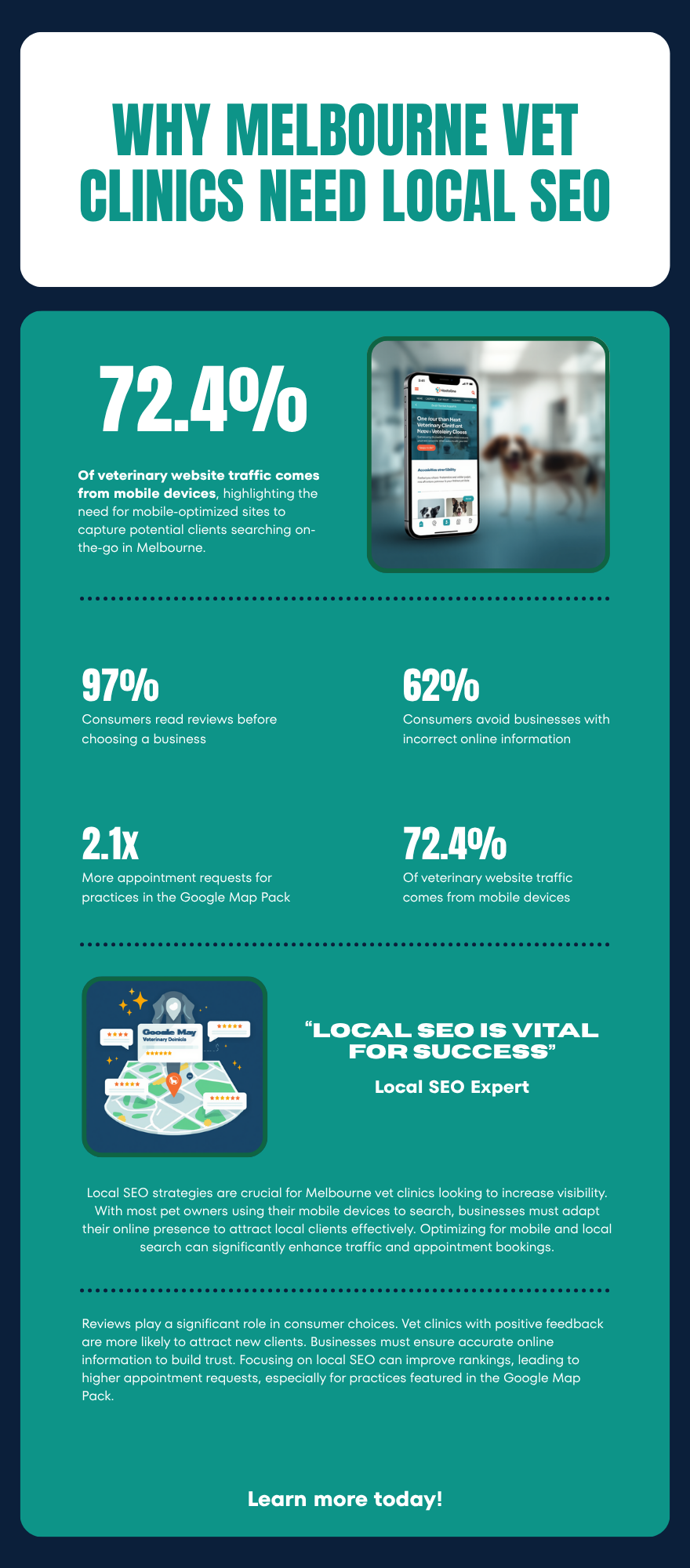
    Veterinary visits are rarely planned weeks in advance. A limping dog or a cat that has stopped eating sends an owner straight to Google, usually from their phone, usually within the same suburb. 72.4% of veterinary website traffic now comes from mobile devices, and pet owners who find a clinic this way rarely shop around for long once they’ve made a decision. That makes local SEO, not brand advertising, the channel that actually fills a Melbourne vet clinic’s appointment book. Radio ads and letterbox flyers might build long-term brand recognition, but they rarely reach someone standing in their kitchen at 7pm searching “emergency vet near me” with a distressed animal in their arms.

    Pet spending has grown alongside ownership. Australia’s pet owners now spend an estimated $21.3 billion a year on their pets, with veterinary services accounting for a significant share of that figure. More spending and more competition among clinics means the practices that show up first, and look most trustworthy once found, capture a disproportionate share of that growth.

    Not sure where your clinic’s listing actually stands? Our free 30-minute audit will tell you, even if you never become a client. Book a free consultation.

    Comparison infographic showing why the Google Map Pack outperforms organic-only listings for Melbourne veterinary clinics

    What a genuine vet SEO specialist checks first

    A specialist starts with the Google Business Profile category, because “Veterinarian” and “Animal hospital” are treated differently by Google and picking the wrong one quietly caps how often a clinic appears in the Map Pack. From there, they check whether the clinic is listed consistently across directories, whether opening hours match reality including after-hours emergency availability, and whether the review response rate looks like a real, attentive practice rather than an abandoned profile.

    97% of consumers read online reviews before choosing a local business, and for a decision as trust-sensitive as who treats your pet, that figure is likely conservative. A clinic with 30 reviews sitting below a competitor with 300 starts every search at a disadvantage, regardless of how good the actual veterinary care is on offer.

    A specialist will also check whether the clinic’s website actually names its services in plain language. “Companion animal wellness” means little to someone searching “cat vaccination cost Melbourne”, while a page that plainly lists vaccinations, desexing, dental care and emergency services, each with its own short section, matches far more of what pet owners are actually typing into Google. This sounds like a small thing, but it’s routinely the difference between a page that ranks for a handful of terms and one that ranks for dozens.

    Veterinary local search data (2026) What it means for your clinic
    72.4% of vet website traffic is from mobile Your site and booking form need to work perfectly on a phone, not just a desktop
    97% of consumers read reviews before choosing Review volume and recency directly affect who gets the call
    62% avoid a business with incorrect online details Wrong hours or a disconnected phone number actively costs you bookings

    Source: Veterinary Marketing Statistics, Stethon Digital Marketing, 2026

    Map Pack visibility versus organic rankings

    For a Melbourne vet clinic, the Google Map Pack, the three listings shown with a map at the top of local results, matters more than ranking well in the organic results underneath it. Practices that appear in the Map Pack receive noticeably more enquiries than those relying on organic listings alone, simply because the Map Pack shows the address, phone number, hours and rating without the searcher needing to click through to a website first. A genuine specialist optimises for the Map Pack first and treats the website as the second layer of conversion, not the other way around.

    This doesn’t mean the website stops mattering. Once a pet owner clicks through from the Map Pack, a slow-loading page or a booking form that fails on mobile undoes all the work that got them there in the first place. The two layers work together: the Map Pack earns the click, and the website earns the booking.

    Infographic showing 2026 veterinary local SEO statistics for Melbourne clinics: 72.4% of traffic is mobile, 97% of consumers read reviews, 62% avoid businesses with incorrect listings, and Map Pack practices get 2.1x more appointment requests

    If your clinic’s Google Business Profile still shows old opening hours or is missing photos of the practice, fixing it is usually a two-week job and the fastest lever available. Talk to our Melbourne team if that sounds familiar.

    What it costs, and what a fair scope looks like

    Local SEO for a single-location Melbourne vet clinic typically runs from $1,200 to $2,500 a month, depending on how competitive the surrounding suburbs are and whether the clinic offers specialty services worth targeting separately, such as exotic animal care or after-hours emergency treatment. Multi-location practices, including the larger networks that have consolidated across Victoria in recent years, generally need a bespoke scope rather than a flat monthly package, since each location competes in its own local market.

    A fair scope includes Google Business Profile management across every location, a review generation process that doesn’t feel forced to clients, locally specific content such as suburb landing pages, and basic technical fixes to booking forms and mobile speed. Our local SEO service is built around exactly this scope for Melbourne healthcare and veterinary clients specifically.

    The return is usually straightforward to justify. A single new client with an ongoing pet, who returns for vaccinations, check-ups and eventual dental or surgical work over several years, is worth many times a clinic’s monthly SEO spend on its own. Unlike a one-off referral, that value compounds every time the clinic’s listing keeps outranking a competitor’s for the next search.

    What goes wrong, and how long results take

    Most vet clinics start seeing Map Pack movement within 60 to 90 days of fixing the basics, with a measurable lift in appointment enquiries by months three to four. The clinics that stall usually made one of two mistakes: they paid for a generic “local SEO package” that never accounted for veterinary-specific search behaviour, such as emergency and after-hours searches spiking on evenings and weekends, or they focused entirely on their website while ignoring their Google Business Profile, which is where most pet owners actually make their decision.

    A third, quieter mistake is treating every location the same way in a multi-clinic practice. A Fitzroy clinic and a Frankston clinic under the same brand are competing in completely different local markets, with different competitor sets and different search volumes, and a strategy built for one rarely transfers cleanly to the other. Each location needs its own Google Business Profile, its own local landing page, and ideally its own review generation focus, even when the branding above them stays consistent.

    It’s worth comparing notes with how other Melbourne service businesses approach this. Our guide to best SEO agencies in Melbourne for electricians covers many of the same vetting questions worth asking any specialist, and our piece on best SEO agencies for Melbourne beauty salons covers the review-and-booking dynamics that apply just as directly to a vet practice.

    Quick FAQ

    Should a vet clinic bother with SEO if most clients come from referrals? Yes. Referrals bring in clients who already trust you, but new-to-area pet owners and emergency searches almost always start on Google, and that’s the audience local SEO captures. See our FAQ for more.

    Does a multi-vet practice need separate listings for each vet? Individual practitioner profiles can help for specialists with their own following, but the clinic’s own Google Business Profile should always remain the primary listing driving bookings.

    How is SEO for a vet clinic different from SEO for a regular retail business? The intent is more urgent and more emotional. Pet owners searching while worried about an animal convert faster than a typical retail shopper, but they also abandon a slow website or an unanswered enquiry faster too, so speed and responsiveness matter more than they would for a business selling a lower-stakes product.

    Melbourne pet owners are searching for a vet right now, on their phones, ready to book. A clinic with an accurate, well-reviewed Google Business Profile and a fast, mobile-friendly site will consistently out-book a bigger practice with a neglected listing. Book your free consultation. No lock-in contracts, senior consultant, response within 2 hours. Book my call. For more guides like this one, visit the blog.

  • Technical SEO Agencies for Melbourne Beauty Salons

    Your beauty salon’s booking page might look perfect on a laptop and still be losing appointments every day. A polished homepage, a full treatment menu and a wall of five-star Google reviews don’t count for much if the page takes eight seconds to load on a phone outside a tram stop on Chapel Street, or if Google can’t work out which of your ten near-identical “hair salon [suburb]” pages should actually rank. That’s technical SEO: the unglamorous engineering underneath a website that decides whether all your other marketing effort ever gets seen. This guide covers exactly what a genuine technical SEO specialist checks on a Melbourne beauty salon site, what a proper engagement costs, and the mistakes that quietly cap your rankings even after everything else looks right.

    Why technical SEO decides whether your booking system ever gets used

    Beauty is one of the most image-heavy categories on the web. A single salon site might carry forty or more portfolio photos, an embedded booking widget, an Instagram feed and a handful of tracking scripts, and every one of those elements adds to how long a phone takes to render the page. Google measures this directly through Core Web Vitals: three real-world metrics that grade how fast a page appears (Largest Contentful Paint, or LCP), how quickly it responds to a tap (Interaction to Next Paint, or INP), and how much the layout jumps around while loading (Cumulative Layout Shift, or CLS). Google recommends LCP within 2.5 seconds, INP under 200 milliseconds and CLS below 0.1, and these scores feed directly into how its ranking systems evaluate a page (Google Search Central, Core Web Vitals).

    The stakes are only getting higher. In the 2024โ€“25 financial year, 91% of Australian businesses said the internet met most or all of their operational needs, up from 88% two years earlier, and this reliance keeps climbing as more transactions, bookings and enquiries move online (Australian Bureau of Statistics, Characteristics of Australian Business 2024โ€“25). For a salon whose entire website exists to get one thing done, a booked appointment, a slow or confusing technical setup is not a minor inconvenience. It is lost revenue that never shows up as an obvious problem, because a client who gives up on a slow gallery simply books somewhere else without telling you why.

    Not sure whether your salon’s site is fast enough to hold onto mobile visitors? A free audit will tell you exactly where it stands, even if you never become a client. Book a free strategy call with our Melbourne team.

    The five technical checks a genuine specialist runs before anything else

    Plenty of Melbourne agencies will offer a “technical audit” as a line item on a proposal. What separates a genuine technical SEO specialist from a generalist is which five things they check first, before touching a single word of copy.

    Check What it means in plain English Why it matters for a beauty salon
    Mobile speed & Core Web Vitals How fast your gallery, booking widget and treatment pages load on a phone Most bookings happen on mobile between appointments; a slow gallery costs bookings before a client sees your work
    Image handling Whether before/after photos are compressed, correctly sized and lazy-loaded Portfolio photos are usually the single biggest drag on load time for a salon site
    Schema markup Structured data that tells Google what your business, treatments and reviews actually are Missing schema is often why a competitor’s star rating shows in search results and yours doesn’t
    Duplicate suburb or treatment pages Whether near-identical pages for different suburbs or treatments compete with each other Confuses Google about which page to rank, splitting your visibility instead of concentrating it
    Crawlability of the booking system Whether Google can actually reach and read pages behind a booking plugin or third-party widget A booking system that blocks crawling can make your best pages invisible to search without any obvious symptom
    The 5 technical checks, in order 1 Mobile speed & Core Web Vitals

    2 Image handling & compression

    3 Schema markup for treatments

    4 Duplicate suburb/treatment page cleanup

    5 Booking system crawlability

    Best SEO Agency Melbourne
    The five technical checks we run on a Melbourne beauty salon site, in order.

    If your salon offers several treatments, hair, nails, lashes, skin, each usually needs its own page rather than one page trying to rank for everything, and that only works if the technical foundation supports it: clean URLs, no orphaned pages, and a sitemap that reflects your current service menu. We cover the content and on-page side of this in our companion guide to on-page SEO for Melbourne beauty salons; this piece focuses on what happens underneath that content. Our Technical SEO service runs all five of these checks as standard on every new Melbourne client, using the same methodology we apply across industries, including our recent breakdown of technical SEO agencies for Melbourne plumbers.

    Considering a technical SEO agency for your salon but not sure your current site actually needs one? Ask to see the exact Core Web Vitals numbers for your homepage and your busiest treatment page before you sign anything, not just a generic score out of 100. Talk to our Melbourne team about what a proper audit would cover for your site.

    Schema markup: making Google and AI tools understand your salon

    Schema markup is a small block of code added to your site that spells out, in a format search engines can read, what your business is, what treatments you offer and what customers say about you. Without it, Google is left guessing, and a guess is far more likely to under-represent you than a competitor with clean markup. Google’s structured data guidelines confirm that business and review markup feed directly into the rich results, star ratings, opening hours and similar details, that appear in search, and Google has said publicly that its generative AI features also rely on structured data to understand and cite businesses, not just traditional search listings (Google Search Central, structured data guidelines).

    For a beauty salon specifically, three layers of schema are worth getting right: a LocalBusiness (or more specific HairSalon or BeautySalon) block for your core details, Service markup for each treatment, and Review markup pulled from genuine client feedback. A generalist agency will often apply one generic LocalBusiness block and stop there. A specialist builds markup out for each treatment page separately, because Google treats a lash technician page and a colour specialist page as different search intents, not variations of the same page.

    What this costs, how long it takes, and what goes wrong

    A proper technical SEO engagement for a single-location Melbourne beauty salon typically starts with a one-off audit priced from around $800 to $1,800, depending on how large and complex the site is, followed by ongoing technical maintenance bundled into a monthly retainer, commonly $500 to $1,500 a month when paired with content and local SEO work. Straightforward fixes, image compression, basic schema, cleaning up redirects, are usually live within two to three weeks. Deeper issues, such as migrating away from a booking plugin that blocks crawling or rebuilding a duplicate-riddled URL structure, can take six to ten weeks and need to be planned around your live booking calendar so you don’t lose appointments mid-fix.

    The most common mistake we see is a salon owner changing website platforms, moving from a website builder to WordPress, or switching booking software, without mapping old URLs to new ones. Every old link, including the ones Google has already indexed and ranked, breaks at once, and rankings that took a year to build can disappear within a fortnight. The second common mistake is treating a one-off audit as a permanent fix. Core Web Vitals scores drift as you add new photos, new plugins and new tracking scripts, so a site that passed in January can quietly fail by June without anyone noticing until bookings drop.

    The numbers behind the case for technical SEO

    None of this is guesswork. The thresholds and figures below are the exact ones we check against on every Melbourne beauty salon audit.

    Why the technical numbers matter

    2.5s Google’s recommended Largest Contentful Paint (LCP)

    200ms Google’s recommended Interaction to Next Paint (INP)

    91% of Australian businesses say the internet meets most/all of their needs

    Sources: Google Search Central (2025); ABS Characteristics of Australian Business, 2024โ€“25 ยท Best SEO Agency Melbourne

    The Core Web Vitals thresholds Google recommends, and why Australian businesses can’t treat their website as optional.

    Common questions

    Do I need technical SEO if my salon site already looks fast on my desktop? Desktop speed rarely reflects the mobile experience your clients actually get. Most bookings happen on a phone, and mobile Core Web Vitals are assessed separately from desktop. See our FAQ section for more on how we test both.

    Can I fix these issues myself on a website builder like Wix or Squarespace? Some things, image compression and basic schema through a plugin, are within reach for a salon owner. Deeper issues like crawlability behind a booking widget or platform-level duplicate pages usually need a developer or specialist agency to resolve properly.

    How is this different from the on-page SEO guide you’ve already published? On-page SEO covers the words, titles and structure you control directly. Technical SEO is the engineering underneath that content, the part a specialist checks before a single headline is rewritten.

    The Melbourne beauty salons winning in search in 2026 are the ones treating their website’s technical health as seriously as their treatment quality: fast on mobile, properly marked up, and free of the duplicate pages and crawl traps that quietly cap rankings. Start with the five checks above, and revisit them every few months as your site changes. Ready to see exactly where your salon’s site stands? Book your free, no-obligation strategy call today, there’s no lock-in contract and our Melbourne team responds within 2 hours. For more Melbourne-specific guides, visit our blog.