Blog

  • SEO Agencies in Melbourne for Plumbers: What to Look for in 2026

    SEO Agencies in Melbourne for Plumbers: What to Look for in 2026

    When a pipe bursts at 10pm, nobody scrolls to page two of Google. They tap the first plumber in the Map Pack, read the star rating in about four seconds, and call. If your plumbing business is not one of those three listings, or your website loads slowly on a phone in a dark hallway, that job goes to a competitor. This guide explains what SEO actually needs to look like for a Melbourne plumbing business, what it costs, how long it takes, and how to tell a genuine local SEO agency from one reselling a generic package built for a completely different type of business.

    Why plumbing SEO is not the same as SEO for a law firm or a shop

    Most searches for a plumber carry two things at once: urgency and location. Someone typing “emergency plumber Richmond” or “blocked drain near me” wants an answer within minutes, not a brand to research over a week. That changes what actually matters. A beautifully written blog post will not save a burst pipe job if your Google Business Profile has the wrong service area, your phone number is hard to find on mobile, or a competitor three suburbs over has 40 more reviews than you.

    An SEO agency that treats a plumbing business the same way it treats an accounting firm or a fashion retailer is missing the point. The work should centre on the Map Pack, your Google Business Profile, suburb-level service pages, and a steady flow of reviews, not just blog content and backlinks.

    There is also a job-type layer to this that many generic campaigns skip entirely. A plumber searching for “hot water system repair Brunswick” and a plumber searching for “gas fitting Camberwell” are two completely different customers, and a single generic “plumbing services” page cannot rank strongly for both. The businesses that consistently show up across a wide area of Melbourne, from Footscray to Box Hill and Brighton to Preston, are the ones with dedicated pages for each major service crossed with each suburb they cover, not just one page trying to do everything at once.

    Not sure whether your current listing is even competitive? Our free 30-minute strategy call will tell you exactly where you stand in the Melbourne plumber Map Pack, even if you never become a client. Book a free strategy call.

    What a proper Melbourne plumbing SEO campaign actually includes

    Strip away the jargon and a genuine local SEO campaign for a trade business comes down to five things: a fully optimised Google Business Profile, individual pages for each suburb or service area you cover, fast mobile load times, a system for collecting reviews after every job, and technical basics like correct schema markup so Google understands what you do and where. None of this is exotic. Most of it is neglected because it is unglamorous, ongoing work rather than a one-off fix.

    The path a customer takes from typing a search to booking your team is short, and every step is a place your business can lose them. The graphic below shows that path end to end.
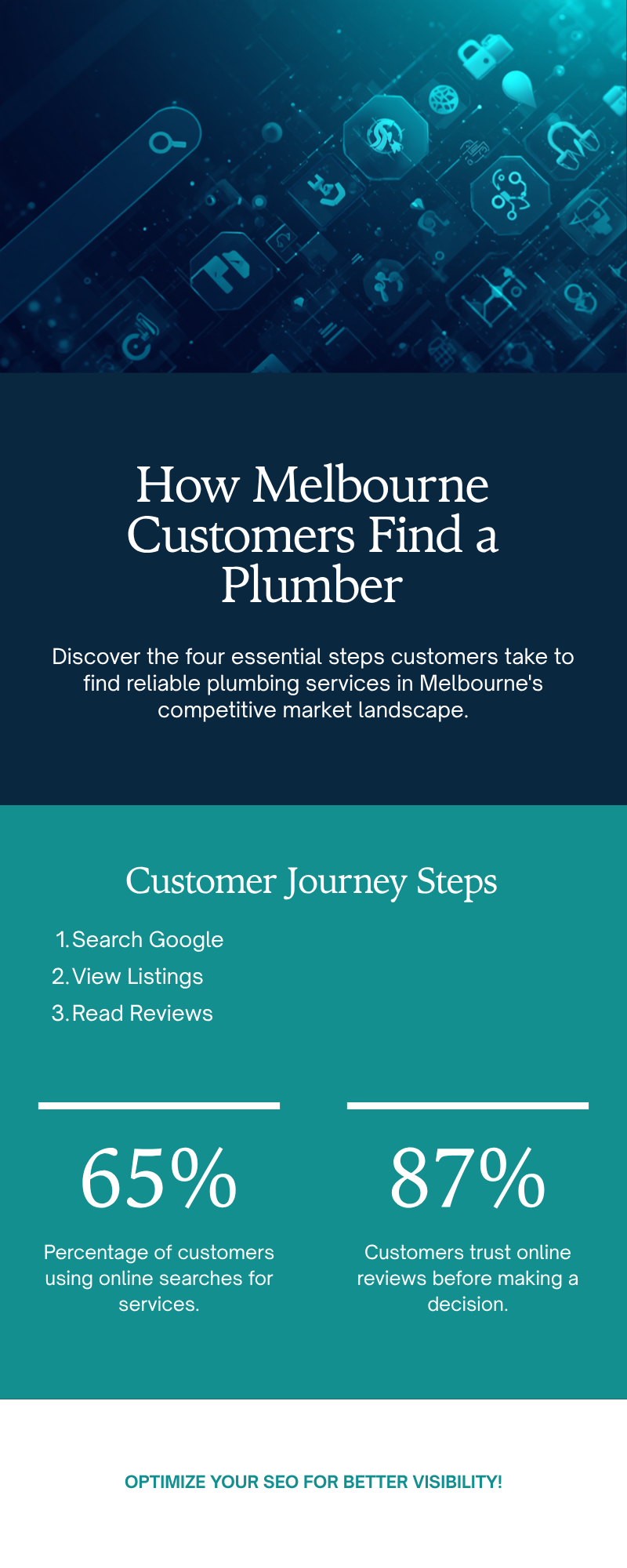
    Infographic showing how a Melbourne customer finds and books a plumber: searching Google for emergency plumber near me, viewing the Map Pack, reading reviews, then calling to book.

    Our own local SEO service is built around exactly that path: profile optimisation, suburb pages, and review systems, rather than a generic content package repurposed from a different industry.

    What’s included Why it matters for a plumber Typical timeframe
    Google Business Profile optimisation Directly drives Map Pack visibility for “near me” and emergency searches 2 to 4 weeks
    Suburb-level service pages Ranks you for each area you actually service, not just your head office suburb 4 to 8 weeks
    Review generation system Reviews are now one of the strongest local ranking and trust signals Ongoing
    Mobile speed and technical fixes Most emergency searches happen on a phone; a slow site loses the call 2 to 6 weeks
    Schema and citations Confirms your service area and trade licence details to Google 2 to 4 weeks

    Reviews are the single biggest factor customers control

    Of everything on that list, reviews deserve the most attention because the data on this is unusually clear. According to BrightLocal’s Local Consumer Review Survey 2026, 97% of consumers now read reviews before choosing a local business, and 31% will not use a business rated below 4.5 stars. For a trade where trust and safety matter as much as price, that is not a marginal factor. It is close to a gatekeeper.

    Bar chart infographic showing that 97 percent of consumers read reviews before choosing a local business and 31 percent require a rating of 4.5 stars or higher, sourced from BrightLocal 2026.

    Google’s own guidance on improving local ranking lists relevance, distance and prominence as the three ranking factors, and prominence is built largely from reviews, mentions, and links. A plumber with 120 reviews at 4.8 stars will consistently outrank a technically better website with 12 reviews. Most businesses lose here not because customers are unhappy, but because nobody asks for the review at the right moment, which is within an hour of the job being finished, while the relief of a fixed problem is still fresh.

    If your Google Business Profile still shows the “before” numbers above, rather than the “after”, talk to our Melbourne team. Fixing a review and profile gap is usually a two-week job, not a six-month rebuild.

    What this costs, how long it takes, and what goes wrong

    For a single-location Melbourne plumbing business, a realistic monthly local SEO investment sits between $800 and $2,500, depending on how many suburbs you service and how competitive your area is. Expect the first genuine Map Pack movement within 6 to 10 weeks, with compounding results over 4 to 6 months as reviews and citations build up. Anyone promising a page-one ranking inside 30 days is either describing paid ads, not organic SEO, or setting you up for a rankings crash once Google notices the shortcuts.

    The three mistakes we see most often in Melbourne trade businesses: duplicate or inconsistent Google Business Profile listings across old addresses, a website that is not genuinely fast on a phone with patchy 4G, and generic “About Us” style content that never mentions the actual suburbs and services a customer is searching for. Each of these is fixable, but each also quietly caps how high you can rank no matter how much content gets published elsewhere.

    Transparency matters here too, more than in most other services a trade business buys. Ask any agency you are considering exactly what a fortnightly report will show you. If the answer is vague, that is a warning sign. Our own clients get a plain-language fortnightly report and a live view of ranking movement, which is part of why we maintain a 98% client retention rate across the 500-plus Melbourne businesses we have worked with. You can see examples of the kind of outcomes trade and service businesses achieve on our results page.

    Common questions

    Do I need a website for every suburb I service? Not a whole website, but a dedicated page per major suburb or service area performs far better than one generic “service areas” page, because it lets each page target the specific local search terms customers use.

    Is Google Ads faster than SEO for a plumber? Ads can generate calls the same day, but the cost per lead is ongoing and rises with competition. SEO takes longer to build but keeps producing enquiries without paying for every click. Most established plumbing businesses in Melbourne run both, with ads covering the gap while SEO builds. See our frequently asked questions for more detail on how the two work together.

    How is this different from SEO for other local trades? The mechanics are similar to what works for other vertical businesses. Our guide on choosing a local SEO agency for a Melbourne law firm and our piece on on-page SEO for Melbourne real estate agents both cover the same core skills, applied to a different urgency profile and customer journey.

    Can I do this myself instead of hiring an agency? Some of it, yes. Claiming and fully completing your Google Business Profile, asking every happy customer for a review, and making sure your phone number is clickable on mobile cost nothing but time. Where most owner-operators run out of road is the technical side, page speed, schema markup, and building out suburb pages correctly without accidentally creating duplicate content that confuses Google rather than helping it.

    Choosing the right agency comes down to one test: can they explain exactly how a “near me” search turns into a booked job for your specific trade, or are they reciting a generic SEO pitch? Book your free consultation with our Melbourne team. No lock-in contracts, a reply within 24 hours, and a plan built around the Map Pack rather than blog traffic that never converts. Get started, or read more guides like this one on our SEO blog.
  • Enterprise SEO Agencies in Melbourne for Real Estate Agents

    A single-office agency can get away with one well-optimised page and a handful of local listings. A real estate network with eight offices across Melbourne cannot. Every suburb page, every agent profile and every listing feed has to be built the same way, or Google starts treating the network as eight small, competing sites instead of one strong one. That is the problem enterprise SEO is meant to solve, and it is a different job to standard on-page SEO.

    This guide covers what an enterprise SEO agency actually does for a Melbourne real estate network, how the rollout is structured, what it costs, and the mistakes that stall projects before they show any results at all.

    What makes real estate SEO an enterprise problem

    A single office in Brunswick needs one strong local page, a Google Business Profile and a handful of suburb-specific listings. A network with offices in Brunswick, Glen Waverley, Brighton and five other suburbs needs all of that repeated correctly eight times, without the pages looking duplicated to Google or confusing about which office serves which suburb.

    The real work is structural. Franchise and multi-office real estate sites commonly lose rankings because listing pages get indexed and then removed as properties sell, agent profile URLs change when staff move between offices, and near-identical suburb pages get filtered out of search results as duplicate content. None of this shows up in a normal on-page audit of a single page. It only shows up when someone looks at the network as a whole, which is exactly what our guide to choosing an on-page SEO agency for realtors does not cover, because on-page work and enterprise structure are two different jobs. A franchise head office often only discovers the scale of the problem when a new office opens and its pages never gain traction, even though the copy reads perfectly well on its own.

    Not sure whether your network has this problem or a simpler one? Our free 30-minute audit will tell you, even if you never become a client. Book a free consultation.

    The technical groundwork: schema, crawl budget and duplicate pages

    Every office needs its own LocalBusiness schema markup, correctly nested under the parent organisation, with its own address, phone number and trading hours. Get this wrong and Google can attribute reviews, ratings or opening hours to the wrong office, which is a common cause of a franchise office simply not appearing in the local map pack for its own suburb.

    Crawl budget matters more at network scale too. A site with thousands of listing pages that come and go as properties sell can waste Google’s attention on stale, sold, or duplicate URLs unless the sitemap and internal linking are actively managed. This is the same technical layer covered in our technical SEO service, just applied across every office at once rather than one site. Internal linking needs the same treatment: each office page should link sideways to nearby offices and up to relevant suburb guides, so authority flows around the network instead of pooling on whichever office happened to launch first.

    Requirement Single office Enterprise network (6+ offices)
    Local schema markup One LocalBusiness block One block per office, nested under a parent organisation
    Listing pages to manage Dozens Hundreds to thousands, constantly changing
    Agent profile pages A handful 50 or more, with staff moving between offices
    Typical monthly SEO investment A$1,500 to A$2,500 A$6,000 to A$10,000 or more

    CRM feeds and syndicated listings

    Most Melbourne real estate networks pipe listings out to realestate.com.au and Domain straight from their CRM, and the same feed usually populates the network’s own website. That is efficient, but it creates a specific SEO problem: the exact same property description now lives on three or four different domains at once. Google has to decide which version is the original, and it does not always pick the network’s own site.

    A properly built enterprise site solves this with canonical tags pointing back to the network’s own listing page, unique agent commentary layered on top of the syndicated description, and a sitemap that drops listing URLs the moment a property is marked sold rather than leaving them to rot as soft 404s. Skipping this step is one of the fastest ways to see a listing page rank on a portal instead of on the agency’s own site, even when the agency wrote the description first. It is also one of the cheapest problems to fix, since it is a configuration issue rather than a content one, which makes it a sensible first project for a network testing a new agency before committing to a full rollout.

    Agent profile and listing pages at scale

    The biggest content job in an enterprise rollout is building agent profile pages and suburb landing pages that are genuinely different from each other, not the same template with the suburb name swapped. Google can tell the difference, and so can a buyer comparing two offices side by side.

    A realistic rollout runs in four stages, usually over four to six months: a technical audit of the whole network in the first fortnight, multi-location schema and site structure work over the following month, agent and listing pages built out suburb by suburb from around week seven, then portfolio-wide ranking gains that compound from month four onward as the older pages mature. Agencies that skip the structural stage and jump straight to writing content usually see rankings for one or two offices improve while the rest of the network stays flat.

    If your Google Business Profiles across offices look inconsistent or out of date, talk to our Melbourne team. Fixing a multi-location profile setup is usually a two to three week job. Talk to our Melbourne team.

    Who a real estate network is actually competing with online

    It helps to be honest about the scoreboard. realestate.com.au set a record with 13.05 million Australians visiting the site in October 2025, more than 60% of the country’s adult online population, according to REA Group’s own reporting. Google itself handles roughly 94% of search queries in Australia. A real estate network is not just competing with other agencies for rankings, it is competing with the portals its own listings appear on, and with the map pack for every suburb it operates in.

    That means an enterprise SEO strategy has to win in three places at once: the organic results below the map pack, the map pack itself for every suburb the network covers, and the small amount of space left on page one once the portals have taken their share. Trying to win only one of these and ignoring the others is a common reason enterprise SEO budgets get spent without enquiries following.

    This is why our results page tracks organic enquiries separately from portal leads. A network that only measures portal performance has no visibility into whether its own website is doing any work at all.

    What this costs, how long it takes, and what goes wrong

    Entry-level real estate SEO in Australia typically runs from A$500 to A$2,500 a month for a single suburb and a single office. Enterprise work for a network of six or more offices in a competitive metro like Melbourne typically clusters between A$6,000 and A$10,000 or more a month, reflecting the extra schema, content and technical management involved.

    Most projects that stall do so for one of three reasons. First, no one owns the sitemap, so it silently fills with sold listings and 404s, and Google slowly stops trusting it. Second, agent profile pages are built once and never updated when staff move offices, leaving broken internal links scattered across the network that a normal site audit misses because each individual page still loads fine. Third, the agency treats every office page as a copy-paste template with the suburb name swapped, which triggers duplicate content filtering and flatlines rankings for every office at once rather than just one. A fourth, quieter cause is ownership: when no single person on the network’s side is accountable for reviewing monthly reports, technical issues can sit unresolved for months even when the agency has flagged them.

    Frequently asked questions

    How long before an enterprise real estate SEO rollout shows results? Expect early technical wins in the first two months, with meaningful ranking and enquiry growth from month four as new agent and suburb pages mature. See our full FAQ for more on timelines.

    Can a network run enterprise SEO in-house? Some larger networks do, but most need outside help to manage schema consistency and content velocity across many offices at once, particularly during rapid expansion or when several offices open in the same year.

    Does every office need its own separate SEO budget? No. Enterprise SEO is priced and run as one project across the whole network, because the technical foundations, schema, sitemap and internal linking, are shared infrastructure, not something that can be split office by office.

    Real estate networks that get enterprise SEO right treat every office as part of one connected structure, not eight separate websites competing for the same search terms. Book your free consultation. No lock-in contracts, reply within 24 hours, Melbourne-based team. Get started.

    For more guides like this one, visit our SEO blog.

    Sources: REA Group monthly visitor data as reported by SahmCapital, November 2025; Google structured data guidance via Google Search Central; industry pricing context via the Real Estate Institute of Victoria.

  • On-page SEO agencies in Melbourne for realtors: what to look for in 2026

    On-page SEO agencies in Melbourne for realtors: what to look for in 2026

    If you run a real estate agency in Melbourne, most buyers and sellers now start their search on Google, not with a phone call to your office. The trouble is that most agency websites are built to look good, not to be found. Listing pages, suburb guides and agent profiles often sit with little thought given to what Google needs to rank them. That gap is what on-page SEO fixes, and it is also where real estate businesses waste money on agencies that do not understand the property market. This guide covers what on-page SEO means in plain terms, what a genuinely useful Melbourne SEO partner looks like, what it costs, how long it takes, and where most realtors go wrong.

    What on-page SEO actually means for a real estate agency

    On-page SEO is everything you control directly on your own website that helps Google understand and rank your pages. It is different from off-page work like building links from other sites, and different from paid ads, which stop working the moment you stop paying. For a real estate agency, on-page SEO covers things like:

    • Title tags: the blue clickable headline in Google search results. Each listing, suburb page and service page needs its own (for example, “3 Bedroom Family Homes in Brunswick | Your Agency Name”).
    • Meta descriptions: the short summary under the title in search results. It does not directly affect rankings, but a clear, specific description earns more clicks, which sends a positive signal to Google.
    • Headers (H1, H2, H3): the heading structure of a page. One clear H1, with H2s breaking up sections, helps readers and search engines follow the content.
    • Image alt text: a written description of every photo, originally built for vision-impaired visitors using screen readers, and also read by Google to understand what an image shows. Property photos with proper alt text (“Renovated kitchen with island bench, Hawthorn townhouse”) can appear in Google Image search too.
    • Internal linking: linking your suburb, service and blog pages to each other with descriptive text.
    • Schema markup: a small block of code that labels content for Google in a structured way, for example marking a page as a property listing with a price and suburb, rather than Google guessing from plain text.
    • Page speed: how quickly a page loads on mobile, which matters because most buyers browse listings on their phone between inspections.

    Google’s own SEO starter guide covers these fundamentals in more depth, though it is written for a general audience rather than real estate specifically.

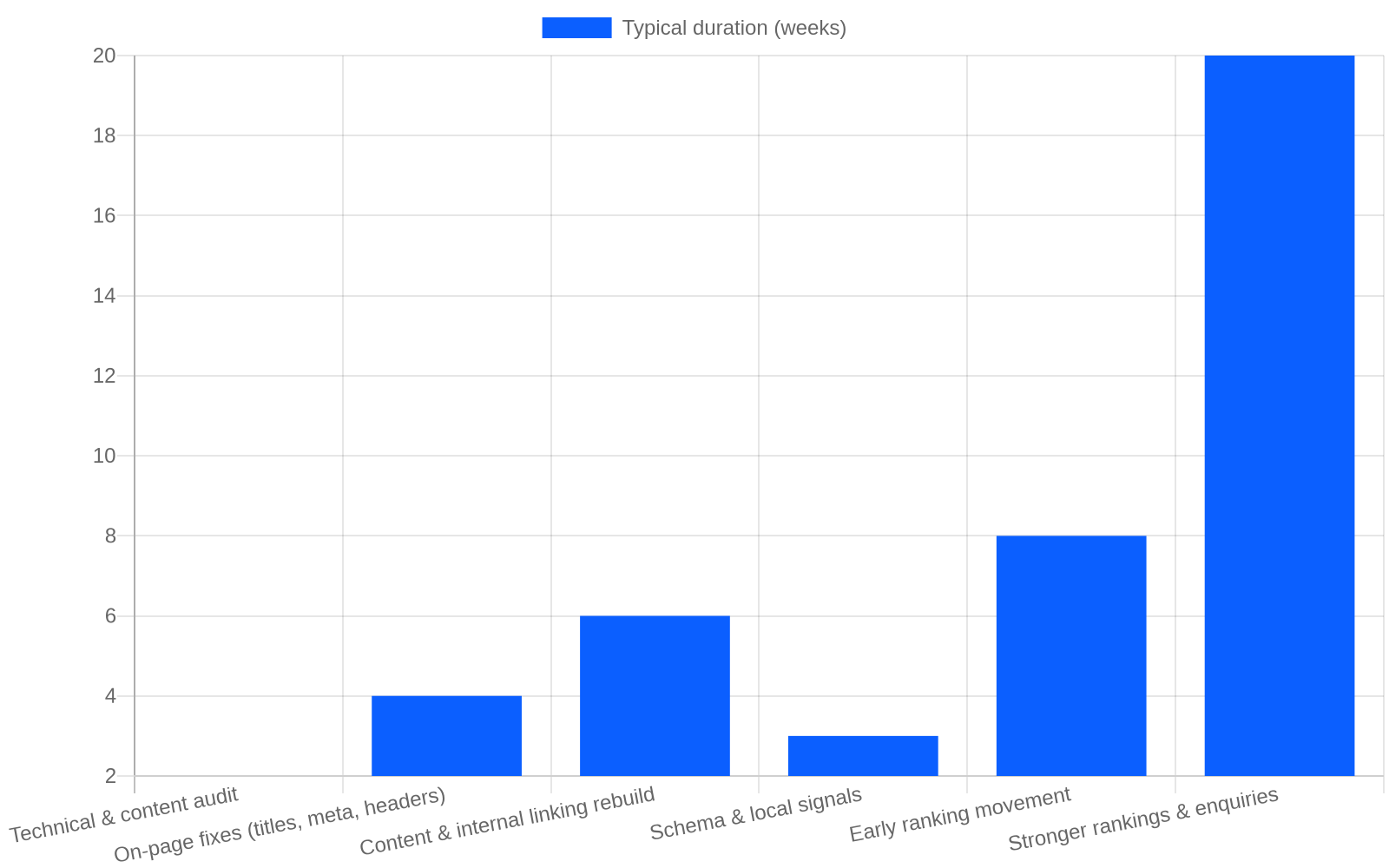
    Timeline chart showing how long on-page SEO takes to work for a Melbourne real estate agency, from technical audit through to stronger rankings and enquiries.

    Infographic: a realistic on-page SEO timeline for a Melbourne real estate agency, from the first audit through to measurable ranking gains.

    Not sure where your agency’s website currently stands? A free 30-minute audit will show you exactly which pages are costing you enquiries. Book your free strategy call here.

    What to look for in an on-page SEO agency or partner

    Plenty of agencies claim to “do SEO.” Far fewer understand how a real estate business actually generates leads, through suburb-specific searches, listing visibility and local trust signals. Before signing anything, compare your options against what actually matters.

    What to check DIY / in-house Generalist marketing agency Specialist SEO agency
    Understands suburb-level property search behaviour Sometimes, but time-poor Rarely Should be core expertise
    Writes content for individual listings and suburb pages Ad hoc Generic templates Structured, ongoing
    Reporting you can actually read N/A Often vague Plain-language and regular
    Contract terms N/A Often 6 to 12 month lock-in Best providers offer month-to-month
    Typical monthly investment Staff time only $800 to $2,000 $1,500 to $5,000+
    Time to see ranking movement Slow, inconsistent 3 to 6 months, variable Usually 2 to 4 months for early signals

    Ask any agency to show real, current suburb or listing pages they have written for a property business, not just ranking screenshots. A partner who understands real estate should explain how they’d structure your site across your service suburbs in the first meeting, not a follow-up proposal.

    Red flags to walk away from

    Some warning signs are consistent across every industry, and real estate is no exception:

    • Guaranteed page one rankings. No one, including Google, can guarantee a ranking position. Anyone promising a specific rank by a specific date is either inexperienced or being dishonest.
    • No audit before a quote. A genuine SEO partner needs to see your current site before pricing any work. A flat quote with no audit usually means a generic package, not a plan built for your agency.
    • Long lock-in contracts. Results should speak for themselves within a reasonable window. Agencies that need a 12-month contract to keep you are often protecting themselves from churn, not protecting your results.
    • Backlinks from unrelated, low-quality sites. Links from gambling or overseas directory sites pointing at your domain are a shortcut that can get your site penalised.
    • No mention of your Google Business Profile. For an agency with a physical office, your Google Business Profile and on-page local signals need to work together. An agency that only talks about your website is missing half the picture.

    What this costs, how long it takes, and what usually goes wrong

    For a small to mid-sized Melbourne agency, ongoing on-page and content SEO typically runs $1,500 to $5,000 a month, depending on how many suburbs and services you cover. Larger multi-office agencies sit at the higher end, or above it.

    Expect the first few weeks to go into a technical and content audit, followed by fixes to titles, meta descriptions, headers and page speed. Content rebuilding for priority pages usually takes another month or two, with early ranking movement on suburb-specific searches showing within 8 to 12 weeks. Broader terms like “real estate agent Melbourne” are far more competitive and can take six months or longer, which is why suburb and property-type specific pages matter so much for a smaller agency.

    The most common failure is chasing broad, generic keywords instead of specific phrases buyers actually type, like “townhouse for sale Coburg” rather than just “real estate agent.” A close second is thin, duplicated content across suburb pages, where only the suburb name changes, a pattern Google rarely ranks well. The third is treating on-page SEO as a one-off project rather than an ongoing discipline.

    Once you know what good work costs and how long it takes, it’s easier to spot a proposal that overpromises. If you’d like a second opinion on a quote you’ve received, book a free 30-minute strategy call, no obligation either way.

    Why this matters more than ever for Melbourne real estate

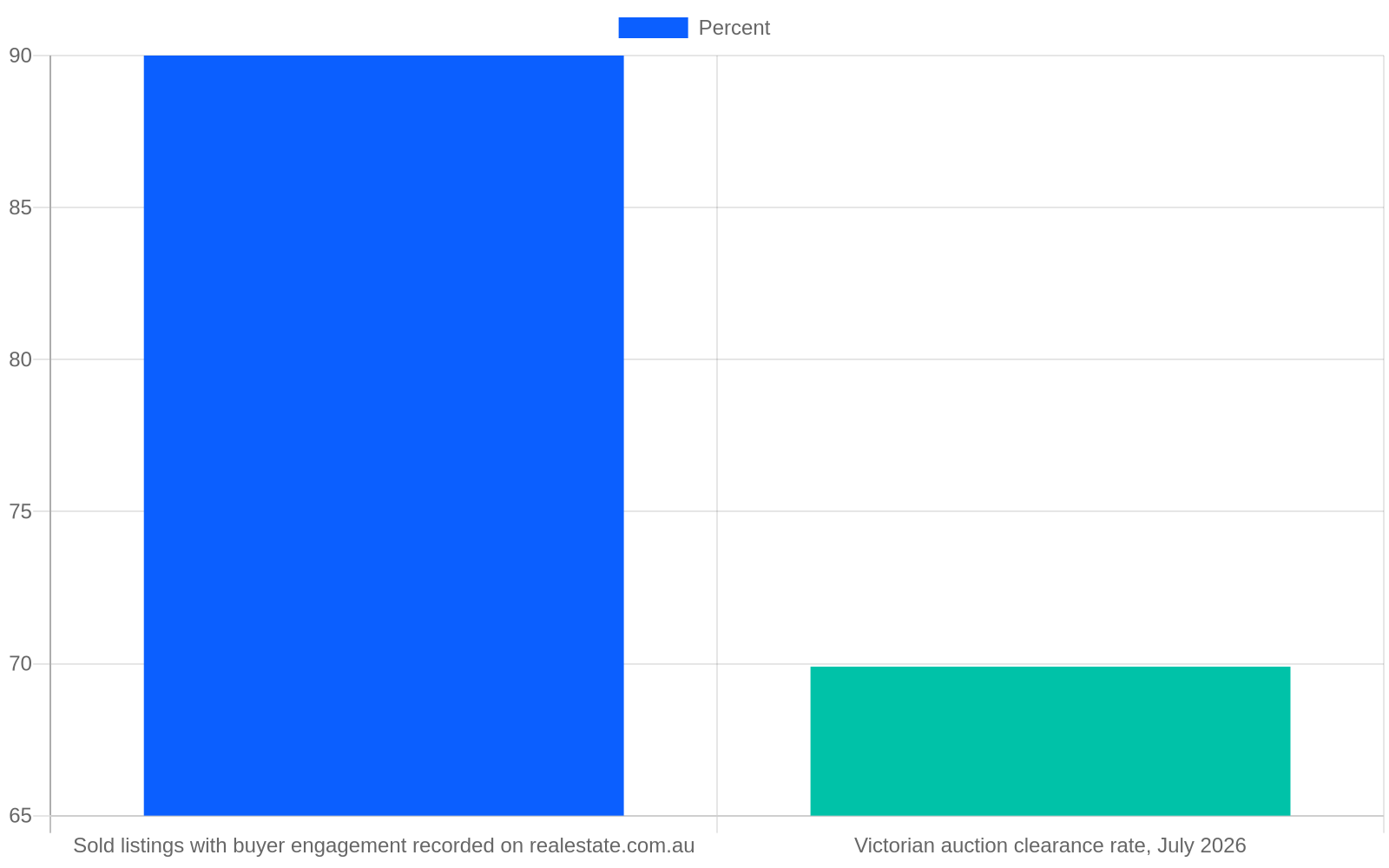
    Attention in the Melbourne property market is harder to earn than it used to be, and the data backs that up. According to the REIV Research Bulletin, Victoria’s auction clearance rate sat at 69.9 per cent in July 2026, with the median Victorian property taking 45 days to sell privately in the same month. That is a competitive, fast-moving market where visibility windows are short.

    Separately, PropTrack’s 2026 Buyer Impact Model, built by REA Group and independently validated by Deloitte, found that buyer engagement is recorded on 9 in 10 properties that go on to sell, and eventual buyers view roughly 28 times more property images than people who do not end up buying. That’s a strong argument for proper on-page work: well-written headings, accurate alt text on every photo, and fast-loading pages keep a genuinely interested buyer engaged with your listing rather than bouncing back to search results.

    Bar chart of 2026 Melbourne property market statistics relevant to on-page SEO for realtors, showing buyer engagement and auction clearance rates.

    Infographic: key 2026 Melbourne property market figures that show why on-page visibility and content quality matter for real estate agencies.

    We’ve applied the same approach across other Melbourne service industries, including a CBD law firm that saw a 412 per cent increase in organic traffic. See how that played out in our case studies, with the real estate version following the same principles, applied to listings and suburbs.

    Common questions from Melbourne real estate agencies

    Is on-page SEO different from Google Ads? Yes. Ads put you at the top of results only while you keep paying. On-page SEO improves your organic, unpaid rankings, which keep working after the initial investment, though it takes longer to build.

    Do we need a separate page for every suburb we service? Generally yes, if the content is genuinely useful and specific to that suburb rather than a copy-paste template. A thin, near-duplicate page can do more harm than having no page at all.

    How do I know if our website already has decent on-page SEO? A proper audit will tell you, but warning signs include duplicate title tags, missing alt text on listing photos, and suburb pages with barely 100 words of content. See our FAQ section for more on how we assess this.

    Choosing the right on-page SEO partner comes down to one thing: do they understand how Melbourne property buyers actually search, or are they applying a generic template? A good partner shows you real suburb and listing pages they’ve built, explains costs and timeframes honestly, and never locks you into a long contract. To see how our in-house Melbourne team approaches this for real estate clients, book your free consultation. No lock-in contracts, a reply within 24 hours, Melbourne-based team. For more guides, visit our SEO blog, including our piece on choosing a local SEO agency for Melbourne law firms, which covers similar ground.

  • Top Local SEO Agencies in Melbourne for Law Firms: A 2026 Buyer’s Guide

    If you run a law firm in Melbourne CBD, Southbank or the inner suburbs, the phrase “local SEO” probably gets thrown around a lot without much explanation. In plain terms, it means showing up when someone nearby searches for a lawyer, whether that is “family lawyer Richmond” or “conveyancer near me” at 9pm on a Sunday. For law firms this matters more than most industries: legal searches are high-value, low-frequency and trust-driven, so ranking in the map pack (the three local results with the map, shown above the regular organic listings) directly affects how many enquiries reach your intake team. This guide breaks down what local SEO agencies in Melbourne actually do for law firms, what it costs, how long it takes, and the mistakes that waste a marketing budget before you commit to one. None of this requires a marketing degree to understand, just a clear-eyed look at what you are paying for and what you should reasonably expect in return.

    Not sure where your firm currently sits in local search results? Ask for a free, no-obligation website review and we will tell you honestly what is holding your rankings back, with no lock-in contract attached.

    What local SEO actually means for a Melbourne law firm

    Local SEO covers three things working together. First, your Google Business Profile (the free listing that shows your firm’s address, phone number, hours and reviews on Google Maps and in search results) needs to be claimed, verified and kept current. Second, your NAP details (name, address and phone number) need to match exactly across your website, directories and legal listing sites such as Law Society profiles, because inconsistent details confuse Google about which business is real. Third, your website needs suburb-specific content and technical health so Google can confidently match your firm to searches from Fitzroy, Carlton, Brunswick or wherever your clients are searching from. Get all three right and you show up in the map pack and organic results at the moment someone actually needs a lawyer, not three weeks later when they have already called a competitor.

    Figure 1: How local SEO results typically build for a Melbourne law firm over 4-6 months
    Timeframe What happens
    Months 1-2: Foundation Google Business Profile setup or clean-up, citation corrections, technical site audit fixed
    Months 2-3: Momentum Map Pack visibility starts to shift for lower-competition suburb and practice-area terms
    Months 4-5: Growth More phone calls and enquiry form submissions as rankings climb for core practice areas
    Months 5-6: Compounding Page 1 rankings for target terms, steadier and more predictable lead flow

    How Google actually decides which law firm to show first

    Google’s own guidance on ranking local results explains three factors: relevance (how well your profile matches what someone searched for), distance (how close your office is to the searcher, or to the suburb they typed), and prominence (how well known your firm is, based on links, citations and reviews). A CBD commercial law firm and a Werribee family law practice are not competing for the same Map Pack, because distance narrows the field before relevance and prominence decide the order. This is why a firm in Box Hill can outrank a much bigger CBD practice for “family lawyer Box Hill” even with a fraction of the marketing budget, provided their profile and reviews are stronger for that specific search. It also explains why buying a generic “Melbourne SEO” package without suburb-level targeting often underperforms: it is optimising for a search nobody in your target area is actually typing.

    Comparing your options: DIY, a generalist marketer, or a specialist local SEO agency

    Most Melbourne firms choose between three paths. Here is how they typically compare in practice.

    Option Typical monthly cost Best suited to
    DIY (principal or office manager) $0-$200 (tools only) Sole practitioners with spare time and low-competition suburbs
    Generalist marketing freelancer or agency $800-$2,000 Firms wanting some support but without legal-specific strategy
    Specialist local SEO agency $1,500-$3,500+ Firms competing for family law, personal injury or conveyancing terms across multiple Melbourne suburbs

    Comparing more than one Melbourne agency before deciding? Book a free 30-minute strategy call and we will show you exactly how a local SEO plan would apply to your practice areas and target suburbs.

    What good looks like: seven things to check before you sign

    Not every agency pitching “local SEO for lawyers” actually specialises in legal services. Some are generalist marketers who have added a services page for law firms without changing their process. Before signing anything, check for the following.

    • They ask about your practice areas and target suburbs before quoting a price, rather than selling a generic package.
    • They can show real client results with a timeframe, not just a portfolio of logos.
    • They explain their local SEO service in plain language, including what happens in month one versus month six.
    • They will not guarantee “page one in 30 days”. Legitimate agencies know this is not realistic for competitive legal terms.
    • They track enquiries back to source (organic, map pack, paid, referral) so you can see what is actually working.
    • They understand that legal advertising has its own rules under state law society guidelines, and will not write content that risks a compliance issue.
    • They offer month-to-month terms or a short notice period rather than locking you into a 12-month contract before you have seen results.

    A firm ticking most of these boxes is worth a proper conversation. A firm that cannot answer basic questions about your practice areas or target suburbs, such as Toorak, Preston or Dandenong, within the first call is not the right fit regardless of price.

    What this costs, how long it takes, and what goes wrong

    Budget matters more than most firms admit up front. A one-off Google Business Profile and citation clean-up in Melbourne typically runs $500-$1,500, while an ongoing local SEO retainer sits between $1,500 and $3,500 a month for a firm competing in family law, personal injury or criminal defence, where competition for terms is higher. Wills and estates or conveyancing practices in a single outer suburb can often get meaningful results at the lower end of that range. As a rough timeline: technical fixes and profile setup take 2-4 weeks, the first shift in Map Pack position usually appears within 6-10 weeks, and meaningful organic ranking gains for competitive terms take 4-6 months, with results compounding from there.

    The most common ways this goes wrong: buying a cheap generic “SEO package” with no legal-specific strategy behind it; keyword-stuffed content that reads badly and risks looking like the kind of misleading advertising claim that has drawn regulatory attention to some smaller firms; no tracking, so nobody can say whether a dollar spent on SEO produced a single new file; and signing a 12-month contract with an agency that will not show monthly reporting. Ask to see a sample report before you sign anything. It is also worth asking how the agency handles seasonal shifts. A family law firm can see enquiry volume move around school holidays and the new year, and a good agency will explain that pattern rather than claiming credit or blame for a natural dip in search volume.

    Figure 2: Why local SEO matters for law firms right now
    93%
    of consumers read online reviews before visiting a business (BrightLocal, 2025)
    70%
    more location visits for complete Google Business Profiles (Google Business Profile Help)
    25,260
    legal services businesses now operating across Australia (ABS, 2025)

    Quick FAQ

    How long before a Melbourne law firm sees results from local SEO?
    Most firms see the first Map Pack movement within 6-10 weeks and meaningful ranking gains for competitive practice areas within 4-6 months, based on typical client patterns.

    Is local SEO worth it for a small suburban practice?
    Often more so than for a CBD firm, because competition per suburb is lower and a well-optimised Google Business Profile can dominate a smaller Map Pack quickly.

    What’s the difference between local SEO and Google Ads for a law firm?
    Google Ads buys visibility instantly but stops the moment you stop paying. Local SEO takes longer to build but keeps producing enquiries without a per-click cost once you are ranking. Most firms with the budget for it run both together: ads for immediate leads while SEO builds toward a lower long-term cost per enquiry.

    Getting started

    Choosing between local SEO agencies in Melbourne comes down to whether they understand legal services specifically, not just generic local business marketing. More Australians are starting their search for a lawyer online before they ever pick up the phone, so ask any agency for examples of law firm results, get a written scope, and confirm how reporting works before signing anything. Book your free, no-lock-in strategy call and we will show you exactly where your firm sits today and what it would take to compete in your practice area. For more on getting found online, browse our Melbourne SEO blog for further reading.

  • Hello world!

    Welcome to WordPress Sites. This is your first post. Edit or delete it, then start writing!